
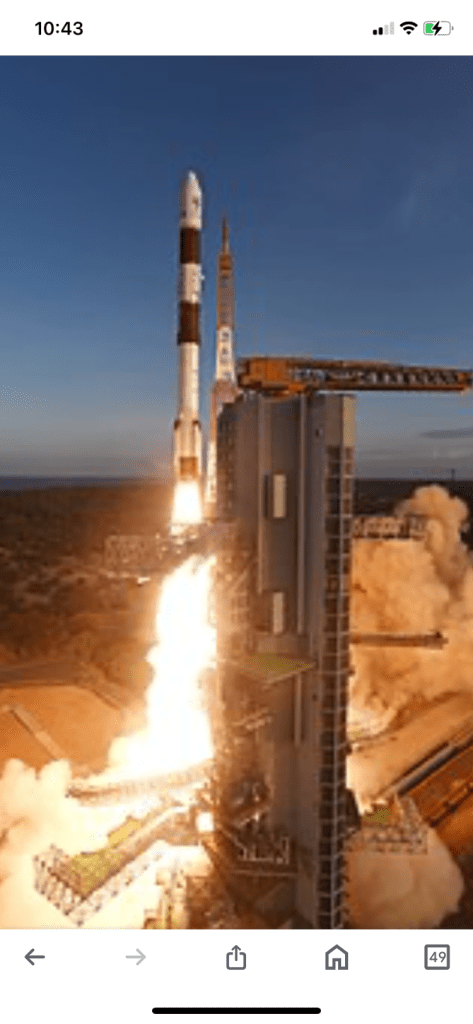
Dhruva Space is a Hyderabad-based company that builds, designs, and operates space missions. They have launched three missions in a row:
- Thybolt Mission Launched on November 26, 2022, this mission involved two amateur radio communication nanosatellites, Thybolt-1 and Thybolt-2.
- April 2023 mission This mission featured successful experiments, including 3U and 6U Satellite Orbital Deployers and the Dhruva Space Orbital Link (DSOL). The mission was launched on ISRO’s PSLV C55 as part of POEM-2.
Dhruva Space also aims to play a key role in India’s Human Space Flight Program, Gaganyaan. They are working with several research organizations on critical technologies including:
- Space food
- Simulators
- Inflatable technology
- On-orbit manufacturing
Dhruva Space offers engineering solutions across the space, launch, and ground segments.
Here are some of ISRO’s upcoming missions:
- Aditya-L1 Launched on September 2, 2023, this mission is India’s first dedicated solar observatory. It carries seven payloads to study the Sun’s dynamics and space weather.
- X-ray Polarimeter Satellite (XPoSat) Planned for launch in 2023, this space observatory will study the polarization of cosmic X-rays.
- Gaganyaan This mission is scheduled for a test flight on October 21, 2023. It’s the foundation for India’s human spaceflight program.
- Gaganyaan 3 This mission is scheduled for launch in 2024. It will be India’s first human space mission.
- Shukrayaan 1 This interplanetary mission to Venus is projected for launch in late 2024.
The first test flight for the Gaganyaan mission is scheduled for October 21, 2023. The test flight will launch from the first launchpad at SDSC-SHAR, Sriharikota. The test flight is scheduled for 8 AM IST.
The Gaganyaan mission will attempt to launch at least three astronauts to low-Earth orbit before the end of 2024. The first crewed mission was originally planned for December 2021, but is now expected to launch by mid-2024. The unmanned flight is anticipated to occur in 2025
The Gaganyaan mission will be launched by the LVM3 rocket. The LVM3 is a 143-foot-tall (43.5-meter) heavy lift launcher that has solid, liquid, and cryogenic stages. The LVM3 has been reconfigured to meet human rating requirements and is now called the Human Rated LVM3.
The test flight will be launched by a single-stage liquid rocket that was developed specifically for this mission. The test flight will simulate an abort scenario
The Gaganyaan mission will use the CE-20 cryogenic engine. The CE-20 engine is a vital component of the Cryogenic Upper Stage (CUS). The CUS is responsible for propelling the upper stage (C25) of the LVM3 vehicle. The CE-20 engine is undergoing a range of rigorous tests.
The LVM3-G also uses two L110-G Vikas engines in clustered configuration. The Vikas engine uses storable propellants in a pump-fed gas generator cycle. The human-rated Vikas engine has higher structural margins for sub-systems, improved assembly process, and additional measurements for health monitoring
The Gaganyaan mission is developed by the Indian Space Research Organisation (ISRO). The mission’s goal is to demonstrate ISRO’s human spaceflight capability. The mission will launch a three-person crew into space for five to seven days. The crew will orbit the Earth at an altitude of 300-400 km. The mission will also include a woman astronaut.
ISRO’s Ahmedabad center will play a key role in the mission. The HSFC will coordinate efforts from other ISRO centers, research labs, academia, and industries
The Gaganyaan mission will include three flights:
- Two unmanned flights
- One human spaceflight
The first unmanned flight was scheduled for December 2020, and the second was scheduled for June 2021. The first crewed flight is planned for 2024.
The Gaganyaan mission will also include about 20 major tests, including:
- Three uncrewed missions of the Human Rated Launch Vehicle (HLVM3)
- The first demonstration flight of the Crew Escape System Test Vehicle (TV-D1)
- Three more test missions, D2, D3, and D4
Yes, Gaganyaan is India’s first manned mission. The mission will launch three Indian astronauts, including a woman, into low-Earth orbit. The spacecraft will orbit the Earth for five to seven days.
The Gaganyaan mission is significant because it’s the first indigenous mission to send Indian astronauts into space. If it succeeds, India will be the fourth country to do so
In October 2021, Dhruva Space raised ₹22 crore in funding led by Indian Angel Network (IAN) Fund and Blue Ashva Capital. On 16 March 2022, Dhruva Space signed a commercial launch services agreement (LSA) with NewSpace India Limited for an in-orbit test of its Dhruva Space Orbit Deployers( source google)
Who owns Dhruva space?
Dhruva Space Private Limited is an Indian private aerospace manufacturer headquartered in Hyderabad, Telangana. Founded in 2012 by Sanjay Srikanth Nekkanti, the company is engaged in the development of small satellites in the commercial, governmental and academic markets.
Best clothes on discount on Amazon
https://94b1aqmi1xpu73k5lmyet09se7.hop.clickbank.net
https://325ffnofax–fridsapnwvl6ji.hop.clickbank.net
https://3aaffqcda10sgx7xnjv9u5rtcn.hop.clickbank.net
Best kitchen appliances on great discount on Amazon Universe discoveries