
The Upanishads don’t mention black holes specifically, but they do describe the Big Crunch, or pralaya, which is when all matter merges into darkness before being reabsorbed into the Brahman. This idea of absorption into the ultimate reality can be seen as analogous to the concept of black holes.
According to Vedic science, black holes are actually “Eternal Collapsing Objects” (ECOs) with a tremendous force of gravity. Matter that falls into a black hole is squeezed to infinite density at the center of the hole.
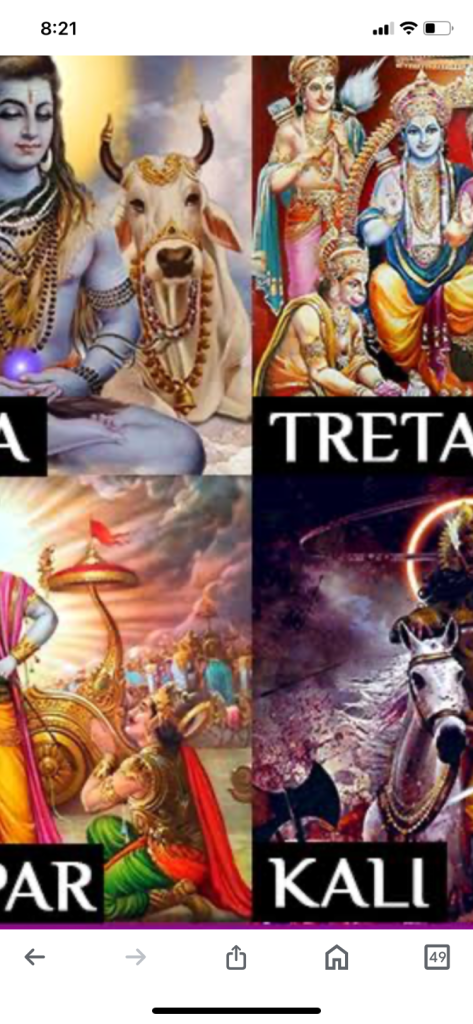
The world doesn’t collapse after every Yuga. The collapse of the earth and solar system only occurs at the end of 1000 Chatur-Yugas, which is 4.32 million years. After Kali Yuga ends, there will be a period of prolonged rains, and then Krita Yuga will start all over again
The Rig Veda calls a black hole a graha, which is a cavern-like, dark, and deep place. It also calls it a patra, which means a vessel. The Mandukya Upanishad uses the term Vishwaruchi to describe a black hole, which absorbs everything in the universe. The Vayupuran and Nasadiya Sukta also describe black as total stillness or the complete absence of light.
The Subala Upanishad says that when the universe dissolves, all matter merges into darkness before being reabsorbed into the Brahman. The universe then re-emerges from the darkness.
Black holes are considered destructive devices and one of the many aspects of Shiva.
The Big Bang Theory that originated in 1927 is a scientific effort to explain how our universe came into existence. It believes that the universe started as an infinitely small, hot, and dense ‘something’ which expanded rapidly from the singularity with a big explosion or ‘Big Bang’ from which formed the galaxies, stars, and the rest of the universe
The Vedic rishis were seer scientists of their times. There were over 400 of them who lived before 3000 BCE. They have questioned and interacted with nature and recorded their observations which have come down to us as the four Vedas, the primary one being the Rig Veda. Thus the science in the Vedas was born from intuition, inquisitiveness, intelligence, and a deep reverence for nature.
Some of the provoking description of the process of Creation include stanzas written eloquently. Indeed the science written in the Vedas was as profound as it was poetic.
“There was neither Aught nor Naught…
No air nor sky
What covered all? Where rested all?
A void in wrapth…
Who knows … from whence this vast creation arose?
No Gods had then been born
Who then can ever the truth disclose?
Whence sprang the world
Whether framed by hand divine or no,
Lord in heaven alone can tell
If even He can show.”
What the Puranas said about Adishesha (and the Black Hole)
Sir Roger Penrose, the eminent British mathematician and relativist who is known for his work on the Black Holes, made a revelation in his statement: “The Big Bang Theory in a certain sense is not the beginning. The Big Final Stage may also be the initial stage when there is only radiation left and the universe loses track of its scale.
Best kitchen products on heavy discount on Amazon
https://80223mod73wqg1ehqh2dea3z33.hop.clickbank.net
https://f1ddffcr31t2iqg94ikdsfwe8d.hop.clickbank.net Universe discoveries
Thanks ❤️
LikeLike
Logical connection
LikeLike