
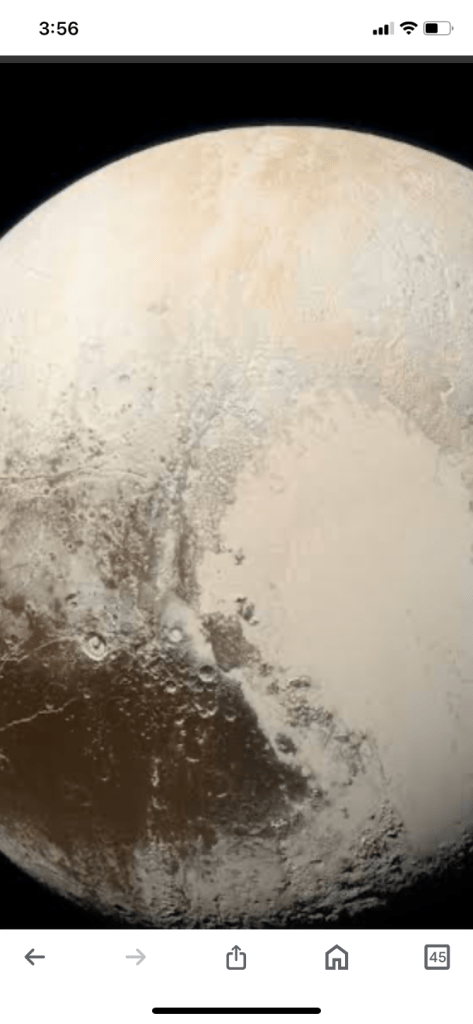
The dwarf planet Ceres is located in the asteroid belt between Mars and Jupiter. It’s the largest object in the asteroid belt and the only dwarf planet located in the inner solar system.
Ceres was discovered on January 1, 1801 by Giuseppe Piazzi at the Palermo Astronomical Observatory in Sicily. It was originally called an asteroid, but in 2006 scientists classified it as a dwarf planet because it’s so much bigger and different from its rocky neighbors.
Ceres is:
- The largest object in the asteroid belt
- The only dwarf planet located in the inner solar system
- The only dwarf planet located in the main asteroid belt
- The largest object in the asteroid belt, containing about a third of all the matter found in the belt
- A rocky, icy body with a near-spherical shape
- Made of 25 percent ice by mass
- Speckled with bright salt deposits that may be remnants of briny water leaking to the surface
A recent study points towards the presence of organic matter on Ceres in abundance. This could help researchers detect alien life in space
Giuseppe Piazzi, an Italian astronomer, discovered Ceres on January 1, 1801. Piazzi was searching for a star when he found Ceres. He initially thought he had discovered a comet, but he wasn’t confident in his belief. By the end of the year, he had collected enough evidence to call it a planet.
Piazzi named Ceres after the Roman goddess of corn and harvests. Ceres was the first asteroid to be discovered.
Ceres is made of iron-rich carbon rock, water ice, and hydrated minerals. The surface is a mixture of water ice and minerals like clay and carbonates. The crust is rocky and dusty with large salt deposits. The salts are made of different minerals like magnesium sulfate.
Ceres’s internal structure is likely a rocky core surrounded by a mantle of water ice. Gravity data suggests that Ceres is partially differentiated into a muddy (ice-rock) mantle/core and a less dense but stronger crust.
Ceres’s mass is about 9.1 × 10²⁰ kg, and its density is 2.2 grams per cubic cm. Its shape and density are consistent with a two-layer model of a rocky core surrounded by a thick ice mantle.
Ceres is sometimes called an ice dwarf. It’s more similar to the icy moons of the outer planets and to TNOs such as Pluto than it is to the terrestrial planets.
NASA studies show that Ceres is about 10 percent water, now frozen into ice. A new global map of Ceres suggests that the planet is extensively covered with surface and shallow subsurface ice.
Ceres is 950 kilometers wide and contains about one-third of all the mass in our solar system’s asteroid belt. It’s more similar to the terrestrial planets (Mercury, Venus, Earth, and Mars) than its asteroid neighbors, but it is much less dense.
Dwarf planets like Ceres and Pluto have solid surfaces, but are made up of more icy materials than terrestrial planets. Ceres’s layers aren’t as clearly defined as those of terrestrial planets.
Ceres’s density is about two-thirds that of the Moon. It’s classified as a dwarf planet because it’s massive enough to have strong self-gravity, orbits the Sun, and is roughly spherical. However, it doesn’t meet the third criterion for being a planet because it shares its orbit with other small asteroids
Ceres is a dwarf planet because it orbits the sun, has a round shape, and doesn’t clear its orbital surroundings of debris. The International Astronomical Union (IAU) defines a dwarf planet as a celestial body that:
- Orbits the sun
- Has enough mass to assume a nearly round shape
- Has not cleared the neighborhood around its orbit
- Is not a moon
Ceres is not a planet because it doesn’t dominate its orbit, sharing it with thousands of other asteroids in the asteroid belt. Ceres is the smallest of the known dwarf planets, but it’s the largest object in the asteroid belt
Ceres is the only dwarf planet in the asteroid belt because it’s the only one located inside Neptune’s orbit. Most dwarf planets orbit the sun at the outer edges of the solar system. Ceres is also the only dwarf planet in the inner solar system.
Astronomers think Ceres is a protoplanet, or the fossilized remains of a world that never fully formed. Jupiter’s strong gravity prevented it from becoming a fully formed planet. Ceres settled into its current location about 4 billion years ago
Ceres is different from other dwarf planets because it’s located in the asteroid belt, while the other dwarf planets are in the Kuiper Belt. Ceres is also the smallest known dwarf planet, but it’s the largest object in the asteroid belt.
Ceres is more similar to the terrestrial planets (Mercury, Venus, Earth, and Mars) than its asteroid neighbors. However, it’s much less dense. Ceres probably has a solid core and a mantle made of water ice.
Ceres’s orbit is moderately tilted relative to that of Earth. Its inclination (i) is 10.6°, compared to 7° for Mercury and 17° for Pluto.
Best kitchen products on heavy discount on Amazon
https://80223mod73wqg1ehqh2dea3z33.hop.clickbank.net
https://f1ddffcr31t2iqg94ikdsfwe8d.hop.clickbank.net
Best electronics items on heavy discount on Amazon Universe discoveries