
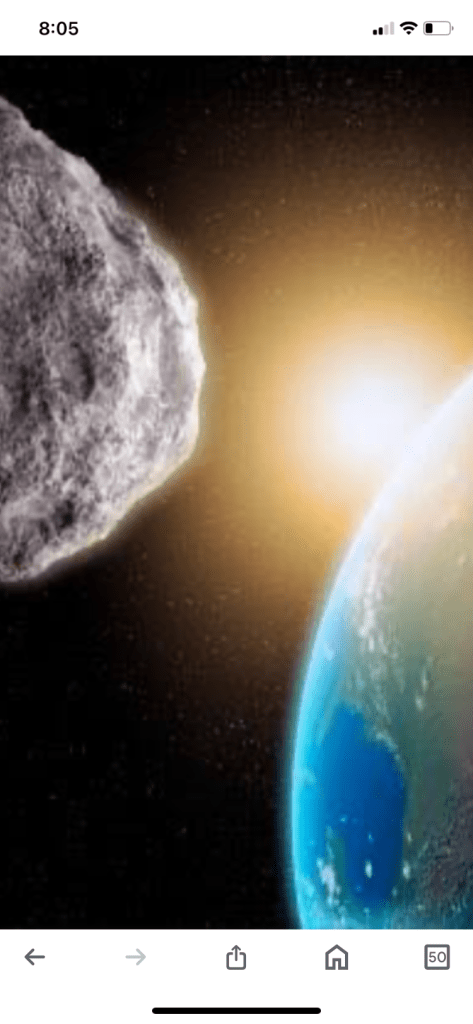
Yes, Apollo group asteroids can come closer to Earth than the moon. Apollo group asteroids are Earth-crossing space rocks with semi-major axes larger than Earth’s.
Here are some examples of Apollo group asteroids that have come closer to Earth than the moon:
- 2023 TK15 Passed Earth at a distance of 379,994 km, which is closer than the moon’s distance of 384,400 km.
- 2023 LZ Passed Earth at a distance closer than the moon.
- 2023 RR5 Passed Earth twice as close as the moon’s orbit. This asteroid was estimated to be around 20 feet in diameter.
- 2023 EY Passed Earth at a distance of 240,000 kilometers (149,000 miles), which is a little less than two-thirds the distance of the moon.
According to NASA, Asteroid 2023 TK15 will pass Earth at an extremely close distance of just 379,994 km, which is even closer than the Moon
Asteroid 2023 TV3 will pass Earth at a distance of 83,353 kilometers, which is four times closer than the moon. This will be one of the closest asteroid approaches of 2023.
Asteroid 2023 DZ2 passed Earth on March 24-25, 2023 at a distance of less than half the distance between the moon and Earth. It was about 160 feet long, which is about the size of an airliner
There are no asteroids in the inner solar system that are the size of the moon. The largest asteroid is Ceres, which is about one-quarter the size of the moon. Ceres is almost 1,000 km (600 mi) across and is classified as a dwarf planet.
The total mass of all asteroids combined is only 3% that of Earth’s moon. Asteroids range in size from Vesta, which is about 329 miles (530 kilometers) in diameter, to bodies that are less than 33 feet (10 meters) across.
Asteroids are made up of rock, metals, and other elements. They are different from comets, which are mostly rock and ice.
Asteroids are made up of:
- Rock: Some asteroids are made of clay and silicate.
- Metals: Mostly nickel and iron. Metallic asteroids can be up to 80% iron and 20% a mixture of nickel, iridium, palladium, platinum, gold, magnesium, and other precious metals.
- Organic compounds: Some asteroids in the asteroid belt are loaded with organic matter. These asteroids are considered the building blocks of life on Earth.
Scientists classify asteroids into three groups based on their composition:
- M-type: Made of nickel and iron.
- S-type: Made of silicates and nickel-iron.
- C-type: Made of clay and silicate rocks.
Asteroids are remnants of the protoplanetary disk that formed around the sun 4.6 billion years ago. The disk was made of dust and gas, and much of it coalesced to form the planets. However, some of the debris remained.
Astronomers believe that asteroids are the remains of a large planet that collided with each other during the expansion of the solar system. The gravity of newly formed Jupiter caused the small bodies to collide with one another, fragmenting them into the asteroids we observe today.
The majority of asteroids originate from the main asteroid belt located between Mars and Jupiter. NASA’s current asteroid count is over 1 million
Best luggage items on heavy discount on Amazon
https://183f9qfm081tbte2rajbnzuufi.hop.clickbank.net
https://4b32bjmk7-qw82d7ihzcd7er97.hop.clickbank.net Universe discoveries