
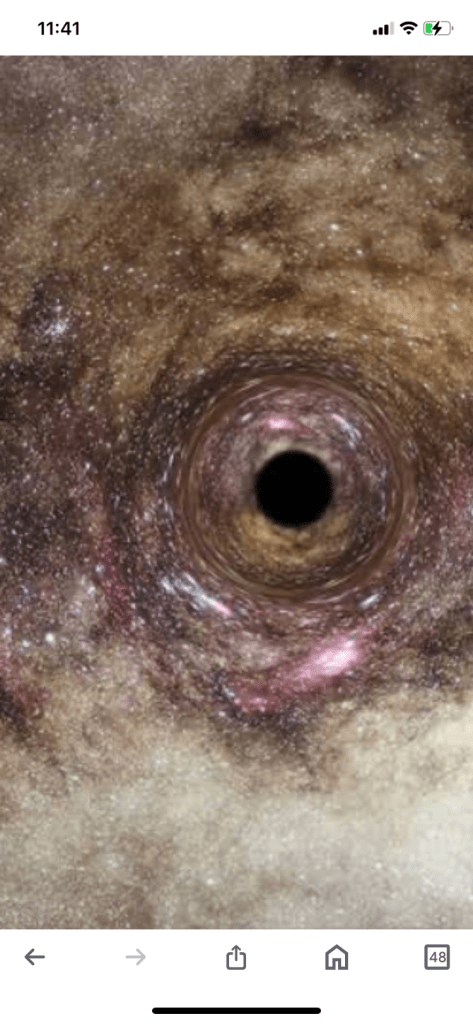
Dark energy may help black holes in binary systems maintain a safe distance from each other. Dark energy accelerates the expansion of the universe, which helps the black holes maintain their distance.
Researchers from the University of Southampton, Cambridge, and Barcelona have shown that black holes can exist in perfectly balanced pairs. These pairs are held in equilibrium by a cosmological force, mimicking a single black hole.
Binary black holes form when a black hole passes a star. The gravitational slingshot accelerates the star while decelerating the black hole. This slows the black holes enough that they form a bound binary system.
Dark energy can reside within black holes. It can be produced when large stars collapse in death. Observations of supermassive black holes at the centers of galaxies point to a likely source of dark energy.
Binary black holes may be more stable than scientists had previously believed, with the action of dark energy accelerating the expansion of the universe and helping black holes in these binaries maintain a safe distance
Dark energy is a hypothetical form of energy that affects the universe on the largest scales. It’s thought to be the cause of the universe’s accelerated expansion.
Dark energy is a negative, repulsive pressure that behaves like the opposite of gravity. It fills the universe and stretches the fabric of spacetime. Dark energy drives cosmic objects apart at an increasingly rapid rate.
The first observational evidence for dark energy’s existence came from measurements of supernovae. The Hubble Space Telescope has explored the nature of dark energy with observations such as the Great Observatories Origins Deep Survey (GOODS).
The exact nature of dark energy remains a mystery. One example is called phantom dark energy, where the acceleration of expansion is also increasing over time. This leads to a scenario called the Big Rip, where expansion becomes infinitely fast, tearing galaxies, atoms, and the fabric of space-time itself apart.
Scientists believe that dark energy exists all around us, making up almost 70% of the universe. Dark energy is distributed evenly throughout the universe, not only in space but also in time. Its effect is not diluted as the universe expands.
However, astronomers admit that the evidence for its existence is a bit vague. We have never seen dark matter and dark energy.
A controversial new theory suggests that supermassive black holes that lurk at the heart of most large galaxies could be the source of dark energy.
According to the laws of physics, nothing can travel faster than the speed of light in a vacuum. The speed of light is 299,792,458 meters per second. Only massless particles, including photons, can travel at that speed.
Dark energy is expanding the fabric of space at a rate that is estimated to be over twice the speed of light. For example, GN-z11 is moving away from us at an estimated speed of 426,882 miles per second (687,000 km/s)
Top videos games on heavy discount on Amazon
https://3a79apnq2vo49xkdko4h1-3y8f.hop.clickbank.net Universe discoveries