
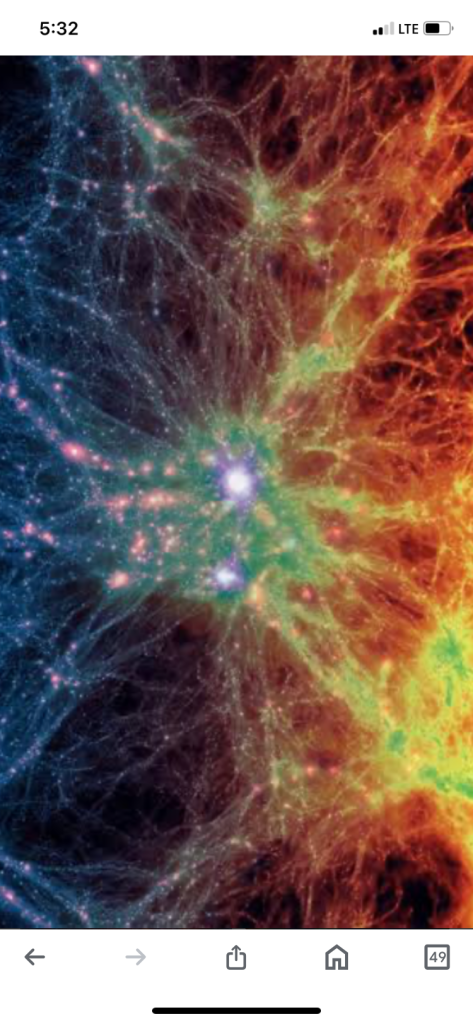
Astronomers have performed the biggest-ever computer simulations to investigate how the universe evolved from the Big Bang. Project Flamingocalculated how ordinary matter, dark matter and dark energy evolved according to the laws of physics
Project Flamingo is the largest supercomputer simulation ever used to calculate the evolution of all components in the universe. The project uses cosmological hydrodynamical simulations to investigate:
- The large-scale structure of the universe
- Cosmology theory
- Numerical methods
- Galaxy clusters
- Galaxy formation
The project calculates the evolution of all components of the universe, including: Ordinary matter, Dark matter.
The project is part of the Virgo Consortium.
A computer simulation is a program that uses mathematical modeling to imitate a real-world process or system. The simulation uses a model, or mathematical description, of the real system. The simulation predicts the behavior or outcome of the system.
Computer simulations are used in many fields, including:
- Structural biology
- Life sciences and medicine
In structural biology, computer simulations are used to study the structure and function of molecules. In the life sciences and medicine, computer simulations can take the form of:
- Computational models of cells, neurons, and brains
- Three-dimensional digital visualizations and animations of growth processes
You can create computer simulations using simulation modeling tools such as: Simul8, Anylogic, Arena.
These tools offer free or trial versions, tutorials, and example models
Here are some examples of computer simulations:
- Car crash modeling: Car manufacturers use simulations to virtually crash test new vehicles.
- Nuclear blast modeling: A mathematical model can describe a nuclear blast by incorporating variables like heat, velocity, and radioactive emissions.
- Weather forecasting: Simulations are used to forecast the weather.
- Flight simulators: Pilots use flight simulators to train.
- Fire drills: Simulations are used for fire drills.
- CGI graphics: Simulations are used in entertainment.
- Healthcare simulations: Simulations are used in healthcare to teach skills and prepare for emergencies.
Simulations can be small programs that run almost instantly on small devices, or large-scale programs that run for hours or days on network-based groups of computers.
There are two types of computer simulations: equation-based simulations and agent-based simulations.
Computer simulations can also be classified by their models:
- Discrete model: Changes to the system occur at specific times.
- Continuous model: The state of the system changes continuously over time.
- Mixed model: Contains both discrete and continuous elements.
Other types of computer simulations include:
- Discrete event simulation: Manages events in time.
- Dynamic simulation: Determines all factors, behaviors, and scenarios that might affect an event or a situation.
Best toys and games on heavy discount on Amazon
https://3751ffme2vq08zdblp2ns6awfs.hop.clickbank.net Universe discoveries