
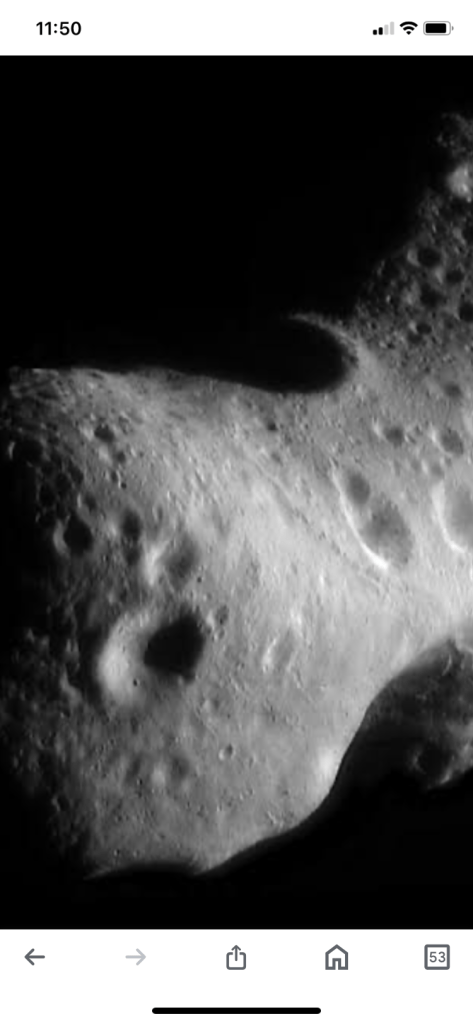
Scientists discovered that the asteroid Polyhymnia has a higher density than any elements known to exist on Earth. This suggests the existence of an element that is not listed in the periodic table.
Polyhymnia is a compact ultradense object (CUDO). This means that it might contain superheavy components that were previously unknown to humans.
The study was published in mid-September in The European Physical Journal Plus. The researchers concluded that Polyhymnia has a measured density higher than those of any elements known to exist on Earth.
A handful of asteroids in our solar system are so dense that no element on Earth can explain their properties
Asteroids are made up of different elements depending on how close they are to the sun. Asteroids that are closer to the sun are made up of carbon, nitrogen, hydrogen, and oxygen. Asteroids that are further away are made up of silicate rock.
Metallic asteroids are made up of:
- 80% iron
- 20% a mixture of:
- Nickel
- Iridium
- Palladium
- Platinum
- Gold
- Magnesium
- Other precious metals such as osmium, ruthenium, and rhodium
Other elements found in asteroids include:
Silicon, Hydrogen, Oxygen, Iridium, Palladium, Magnesium.
Asteroids can be grouped into three categories: carbonaceous, silicates, or metallic.
Earlier this month, the University of Arizona and NASA collaborated to bring back samples from an asteroid called Bennu to Earth. These samples are reported to be exceptionally rich in carbon, suggesting the possibility of valuable metals within some asteroids
Scientists use telescopes and radar to find near-Earth asteroids (NEAs). They compare multiple images of the same area of the sky, taken several minutes apart. They look for tiny bright spots that move against the background of stars.
Scientists use a two-step algorithm called Matched Filter Processing for Asteroid Detection. The algorithm:
- Removes mean and background noise.
- Enhances the signal component.
Once an asteroid is found, scientists study it in more detail. They estimate its size, spectra, and other characteristics. They use triangulation to determine its location in space. They use its speed and brightness to draw its orbit.
As of October 2023, there are 32,957 known NEAs. 2,366 of these are large enough and close enough to Earth to be considered potentially hazardous.
Best movies and tv on heavy discount on Amazon
https://bb838fmd0xp38xf93d868e9ybc.hop.clickbank.net Universe discoveries