
Astronomers want the James Webb Space Telescope (JWST) to study the Milky Way core for hundreds of hours. The JWST is examining every phase of cosmic history, including the formation of galaxies, stars, and planets.
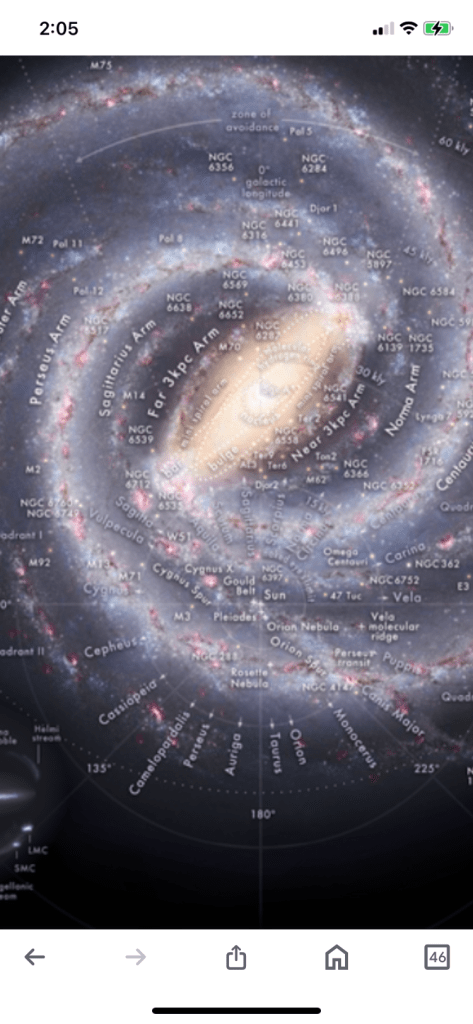
The Milky Way is a barred spiral galaxy that’s about 13.6 billion years old. It’s a huge collection of stars, dust, and gas. The Sun is located on one of the spiral arms, about 25,000 light-years away from the center of the galaxy.
The JWST launched in December 2021 and beamed back its first science images last July. It’s made many discoveries, including:
- Galaxies like our own Milky Way dominate throughout the universe and are surprisingly common.
- A highly active star-forming region in a galaxy near the Milky Way called the Small Magellanic Cloud (SMC).
- The amount of heat energy coming from TRAPPIST-1 c, revealing that the dayside temperature of the rocky world is about 225 degrees Fahrenheit (107 degrees Celsius).
The JWST is a 6-meter infrared telescope. It’s designed to study infrared astronomy. The JWST’s high-resolution and high-sensitivity instruments allow it to view objects that are too old, distant, or faint for the Hubble Space Telescope.
The JWST’s analysis includes:
- The first light in the universe
- The assembly of galaxies in the early universe
- The birth of stars and protoplanetary systems
- The evolution of our own Solar System
- The atmospheres of exoplanets
- The chemical fingerprints of biology
- The building blocks of life elsewhere in the universe
The JWST has detected:
- Distinct water signatures
- Evidence of haze and clouds
- Key carbon-bearing molecules on the potential ocean world K2-18b
- Hints of a substance produced by tiny plankton on Earth
The JWST has made many other discoveries, including:
- The earliest-known carbon dust in a galaxy.
- The most distant galaxies ever seen.
- The first direct image of an exoplanet.
- The deepest and sharpest infrared image of the distant universe to date.
- The presence of methane and carbon dioxide in the atmosphere of K2-18 b, an exoplanet 8.6 times as massive as Earth.
The JWST’s other discoveries include:
- Galaxies that existed when the universe was only 900 million years old.
- Large and mature but remarkably compact galaxies teeming with stars.
- A distant region of space known as Pandora’s Cluster.
- Stars born in the Pillars of Creation.
- Mysterious, boxy ripples surround Wolf-Rayet star.
The JWST was designed to see a period of the universe’s history that we have not seen before. Specifically, it was designed to see the first objects that formed as the universe cooled down after the Big Bang. The JWST’s infrared vision allows it to peer back over 13.5 billion years to see the first stars and galaxies forming out of the darkness of the early universe.
The JWST’s infrared light passes more easily through dust clouds than visible light. Colder objects such as debris disks and planets emit most strongly in the infrared. These infrared bands are difficult to study from the ground or by existing space telescopes such as Hubble.
Telescopes can be thought of as time machines because light takes time to travel across space. The further out in space astronomers look, the further back in time they are looking. For example, the light from the Moon is 1.3 seconds old by the time it reaches your eyes.
Telescopes see objects not as they are now but as they were when they released the light that has traveled across the universe to us. The light we are looking at can be billions of years old.
The Hubble Space Telescope can see the first galaxies to emerge from the “dark ages”. The Hubble can see even farther back in time by using gravitational lensing to find more distant galaxies. The James Webb Space Telescope can see even farther back in time with its powerful infrared vision.
Best toys and games on discount on Amazon
https://365b2nik29vqhza9thup32eq33.hop.clickbank.net Universe discoveries