
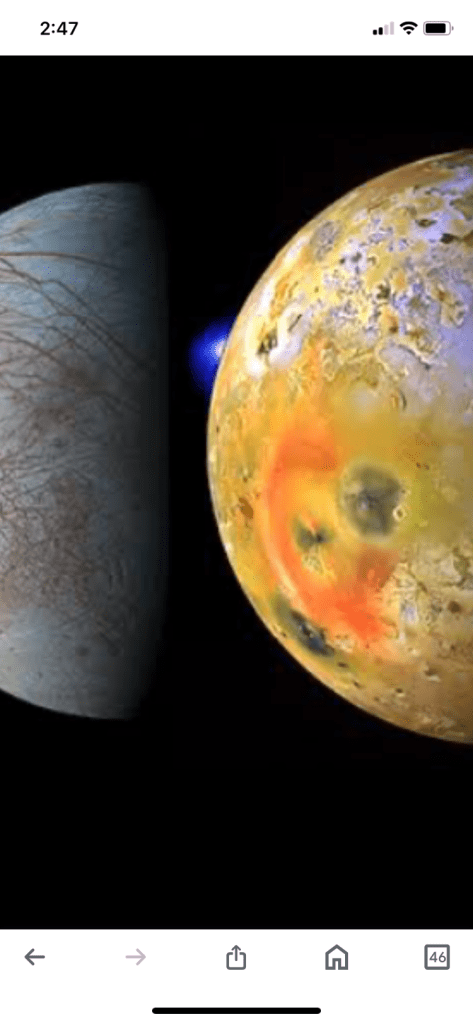
According to a study, the distribution of volcanic heat flow from 266 active hotspots on Io is consistent with the presence of a global magma ocean. The study’s authors write that this isn’t the first study to suggest that Io has a magma ocean.
Io’s volcanic activity is globally distributed, with a higher concentration of volcanoes in equatorial regions. The stretching of Io’s orbit causes friction and intense heat in its interior, sparking massive eruptions across its surface.
Magma is the molten or semi-molten natural material from which all igneous rocks are formed. It’s produced by melting of the mantle or the crust in various tectonic settings.
Io’s volcanic activity is caused by:
- The stretching of Io’s orbit, which causes friction and intense heat in its interior
- Rising magma, which transports a large part of Io’s heat
- Io’s upper mantle, which is thicker than 50 km
Io’s volcanic activity is caused by tidal heating. Io is caught in a gravitational tug-of-war between Jupiter and two nearby Jovian moons, Europa and Ganymede. These tidal forces generate the heat that drives Io’s intense volcanic activity.
Io is the innermost of the four large Jovian moons. It’s Jupiter’s third-largest and the innermost Galilean satellite. Io is the most geologically active object in the Solar System, with over 400 active volcanoes.
The gravitational pull of Jupiter’s other moons Europa and Ganymede causes tremendous amounts of internal friction and heat. This friction and heat gives rise to volcanoes such as Loki Patera, which spans more than 200 kilometers (124 miles) across
The major component of Io’s volcanic flows is sulfur and its compounds, such as sulfur dioxide and sulfur monoxide. These compounds are responsible for creating unique colors on the surface of Io, with bright yellow and orange regions indicating high concentrations of sulfur.
Most of the lava on Io is made of basalt, similar to lavas seen on Earth at shield volcanoes such as Kīlauea in Hawaii. The rocks formed from the lava are described as basalt, and have a similar composition to oceanic crust on earth.
Io’s volcanism is responsible for many of its unique features. Its volcanic plumes and lava flows produce large surface changes and paint the surface in various subtle shades of yellow, red, white, black, and green.
The main source of energy for Io’s volcanoes is friction. This friction is caused by tidal forces generated by Jupiter’s gravitational pull. The tidal forces cause fluid material within Io to swing back and forth, like oceanic tides on Earth. The friction from the particles rubbing against each other generates heat, which ultimately leads to eruptions.
The energy driving Io’s volcanism is derived from its orbital energy and, to a lesser extent, by the orbital energy of the other moons and the energy of Jupiter’s rotation.
Io has shield volcanoes, which are similar to volcanoes in Hawaii. The shield volcanoes on Io are called tholi.
Io also has silicate volcanism, which involves basaltic lava with magnesium-rich compositions. The Galileo spacecraft confirmed this in the 1990s and 2000s.
Io’s volcanic plumes can reach up to 250 miles (400 km) high. The lava on Io is much hotter than any lava that flows on Earth today. The calderas, or volcanic craters, on Io are also much larger than on Earth
Io’s largest volcano is Loki Patera. It’s 202 kilometers (126 miles) in diameter. Loki Patera is the most active and most powerful volcano in the Solar System. It erupts every 500 days.
Loki Patera is so powerful that it contributes 25% of Io’s total heat output. It contains an active lava lake, with an episodically overturning crust. The hot region of the patera has a surface area of 21,500 square kilometers, larger than Lake Ontario.
Loki Patera is named after a God in Norse mythology. It’s been known to be active since 1979.
Most volcanoes on Io have little relief. Those that can be considered mountains are generally smaller than the mountains formed by tectonic processes. They average only 1,000 to 2,000 meters (3,300 to 6,600 ft) in height and 40 to 60 kilometers (25 to 37 mi) in width.
Io’s volcanic plumes can reach up to 250 miles (400 km) high or higher. Some of the largest volcanic eruptions observed on Io have produced plumes that reach heights of 300 miles (500 kilometers)
Io’s surface temperature averages about -202°F (-130°C). However, its volcanoes can reach 3,000°F (1,649°C). The magma on Io is probably about 1300 kelvin, or just over 1000°C (1900°F). This is similar to the temperature of lava from volcanoes on Earth.
When lava first erupts from a volcanic vent, it is usually at temperatures between 700 and 1,200 °C.
Io has at least 12 active volcanoes erupting lava at temperatures over 1200 degrees Celsius
Most of the lava on Io is made of basalt.However, some lava flows are made of sulfur and sulfur dioxide. The Voyager spacecraft detected lava flows consisting of nearly pure elemental sulfur.
Io is primarily composed of silicate rock surrounding a molten iron or iron sulfide core. Io is rich in sulfur, which contributes to the different colors on its surface.
The lava on Io is extremely hot, reaching temperatures of approximately 1,900 K (3,000 °F, 1,630 °C). This resembles lavas produced more than three billion years ago on Earth.
Io is the most geologically active object in the Solar System, with over 400 active volcanoes. The reason for its high volcanic activity is that Io’s interior is constantly being squeezed and stretched by tidal interactions. These tidal forces come from Jupiter and one of its other large moons—Europa—playing a sort of tug-of-war over Io.
The gravitational pull of Jupiter’s other moons Europa and Ganymede causes tremendous amounts of internal friction and heat. This friction generates the heat that drives Io’s intense volcanic activity.
Io has virtually no atmosphere to trap heat, much like our own moon. The lava flows can reach 3,000 degrees Fahrenheit (1650 Celsius) in temperature, although the surface temperature on average is -202 degrees F (-130 C
Io is one of only four known volcanically active worlds in the Solar System. The other three are:
- Earth
- Saturn’s moon Enceladus
- Neptune’s moon Triton
Io is the most volcanically active body in the Solar System. It has hundreds of volcanoes, some of which erupt lava fountains dozens of miles high. Io’s sulfurous plumes can reach hundreds of miles high.
Io is the third largest of Jupiter’s moons, and the fifth one in distance from the planet. It’s a bit larger than Earth’s Moon.
What is a global magma ocean
A magma ocean is a global, near-surface shell of magma that can be tens or hundreds of kilometers thick. Magma oceans are formed during the early stages of planet formation when the planet or natural satellite is completely or partly molten. They are a common result of the high degree of heating that occurs during planet formation.
Magma oceans are significant events in the earliest stages of planetary evolution. They set the initial conditions for their future evolution. For example, understanding how a magma ocean evolved on Earth is key to understand why life exists on our planet.
Magma oceans are formed by the melting of planetesimals and planetary impacts. For example, the moon-forming impact likely melted the majority of Earth’s mantle to produce a global magma ocean that subsequently cooled and crystallized.
Almost all of the large rocky bodies in the Solar System went through at least one magma ocean phase. For example, Jupiter’s moon Io may have a subsurface ocean of magma or a solid core of hot metal.
Best toys and games on discount on Amazon
https://365b2nik29vqhza9thup32eq33.hop.clickbank.net Universe discoveries