
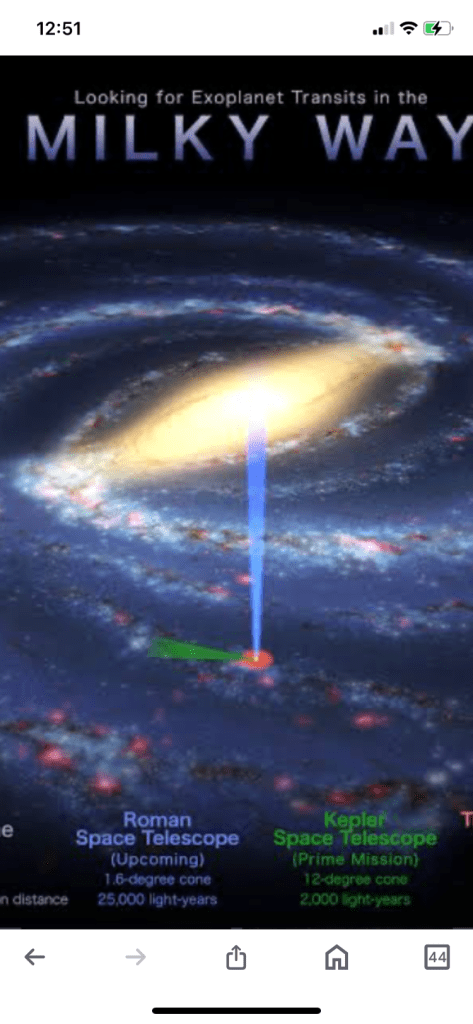
Nancy Grace Roman Space Telescope, which will provide humanity’s deepest-ever view into the Milky Way galaxy. The telescope will monitor hundreds of millions of stars for “tell-tale flickers” that may indicate the presence of:
- Planets
- Distant stars
- Small icy objects
- Isolated black holes
The telescope will use infrared vision to see through clouds of dust that block our view of the Milky Way’s central region. It will also study dark matter and dark energy by surveying more than a billion galaxies.
The telescope will observe from a vantage point about 930,000 miles (1.5 million km) away from Earth in the direction opposite the Sun. It’s scheduled to launch by May 2027
The Roman Space Telescope will also:
- Measure the distances to galaxy clusters to map their growth over time
- Pinpoint the distances to millions of galaxies by measuring redshift
- Map clusters of galaxies over time and space
- Discover around 2,600 exoplanets across the Milky Way galaxy
- Look at 100 million stars for hundreds of days in search of planets
- Complete the statistical census of planetary systems in the galaxy
- Probe a range of additional astrophysical and planetary science topics
The Roman Space Telescope has a 0.281 square degree field of view. This is 100 times larger than the field of view of Hubble’s visible cameras. The telescope’s Wide Field Instrument (WFI) has a 300-megapixel, near-infrared camera. The WFI will provide images of the same quality as Hubble, but with a field of view 100 times greater.
The telescope’s primary mirror is 2.4 m (7.9 ft) wide. It’s equipped with a high-performance coronagraph that can suppress starlight by factors of up to a billion to 1. This will allow the telescope to directly discover and characterize exoplanets
The Roman Space Telescope has a 2.4 meter aperture. It’s the same size as the Hubble Space Telescope’s primary mirror. The telescope’s basic design is similar to other telescopes:
- Light enters through the 2.4 meter aperture.
- The curved main mirror reflects and focuses the light.
- The secondary mirror reflects and focuses the light again.
- Elements tighten the beam and remove stray light rays.
- The light passes through a filter wheel that allows different wavelengths of light to pass through.
- The focused and filtered light reaches the focal plane where it creates an image on the detectors
The Roman Space Telescope has a resolution of 0.1 arcsec/pixel. This is the same resolution as the Hubble Space Telescope. The Roman telescope’s Wide Field Instrument (WFI) has a 300-megapixel camera. The WFI’s pixel scale is 110 milliarcseconds.
The Roman telescope’s WFI has a spectral range of 1.00-1.93 microns and a dispersion of about 1.1 nm/pixel. It uses one wideband and six narrowband filters to provide multiband visible to near-infrared imaging
The James Webb Space Telescope (JWST) and the Nancy Grace Roman Space Telescope (Roman) are both infrared telescopes. However, they have different science goals and are specialized for different tasks.
Mirror size: The JWST has a larger, segmented mirror (6.5 meters) than the Roman (2.4 meters). The JWST’s mirror provides unparalleled resolution and light-gathering capabilities.
Field of view: The Roman has a panoramic field of view that’s more than 100 times greater than the JWST’s. The Roman will image more than 50 times as much sky as the Hubble Space Telescope covered in its first 30 years.
Resolution: The Roman has a resolution of 0.1 arcsec/pixel, which is the same as the Hubble. The JWST’s Near Infrared Spectrograph (NIRSpec) enables 0.6–5.3 μm spectroscopy at resolving powers of ~100, ~1,000, and ~2,700 in 4 observing modes.
Launch dates: The JWST was launched on December 18, 2021, and is currently operational. The Roman is scheduled for launch by May 2027.
The Roman Space Telescope and the James Webb Space Telescope (JWST) are both infrared telescopes with different science goals. The Roman has a wider field of view, while the JWST has a narrow and detailed field of view. The Roman will take around 100,000 pictures every year. It would take longer than our lifetimes for even powerful telescopes like Hubble or Webb to cover as much sky.
The Roman’s science goals include:
- Unraveling the secrets of dark energy and dark matter
- Searching for and imaging exoplanets
- Exploring many topics in infrared astrophysics
The JWST’s science goals include:
- The first light in the universe
- The assembly of galaxies in the early universe
- The birth of stars and protoplanetary systems
- Planets (including the origins of life)
The Roman Space Telescope is powerful enough to:
- Capture images with the same resolution as the Hubble Space Telescope
- Image an area 100 times larger than the Hubble
- Take around 100,000 pictures every year
- Map the universe up to a thousand times faster than Hubble
- Detect exoplanets a billion times fainter than their host star
The Roman’s 300-megapixel Wide Field Instrument (WFI) can image a sky area 100 times larger than Hubble. A single Roman image will hold the equivalent detail of 100 pictures from Hubble.
The Roman’s rigid structure, fast slewing speed, and large field of view will allow it to move rapidly from one cosmic target to the next.
The Roman Space Telescope will observe from a vantage point about 930,000 miles (1.5 million km) away from Earth in the direction opposite the Sun. NASA estimates that the telescope’s infrared vision will allow it to see back into the universe to when it was little more than 300 million years old.
The Roman will observe thousands of galaxies at a time or tens of millions of stars in one image. It will also perform large surveys of galaxies and galaxy clusters to see the effects of dark matter and energy on their shapes and distributions in the universe
Best toys and games on discount on Amazon
https://365b2nik29vqhza9thup32eq33.hop.clickbank.net Universe discoveries