
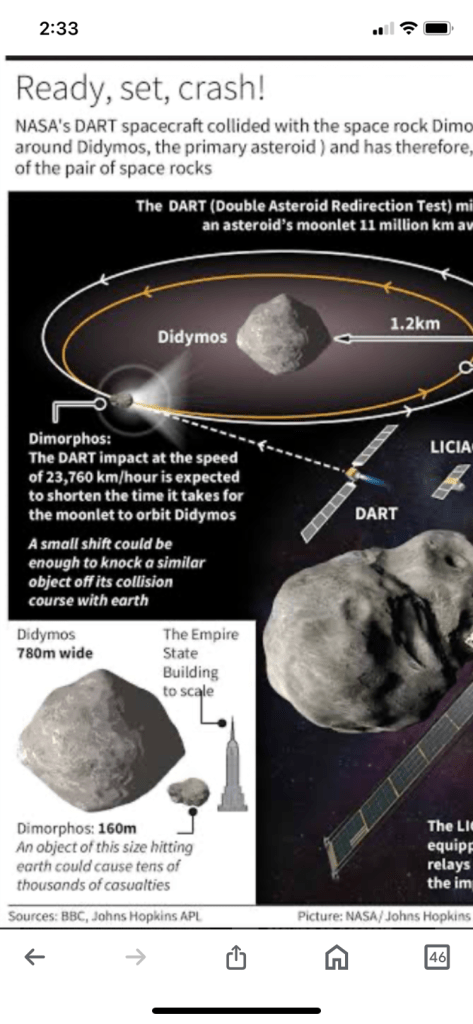
NASA’s DART spacecraft collided with the asteroid Dimorphos on September 26, 2022. The impact shortened Dimorphos’ orbit around the larger asteroid Didymos by 32 minutes. Dimorphos now completes an orbit in 11 hours and 23 minutes, compared to 11 hours and 55 minutes before the impact.
The DART spacecraft was the size of a golf cart. The impact displaced over two million pounds (one million kilograms) of the dusty rock into space. A Chilean telescope captured a trail of dust and debris that stretched at least 6,000 miles from where the crash had happened.
Scientists have made some puzzling observations using polarized light that suggest the average particle size or the average reflectivity might have slightly changed on Didymos. They are waiting for spring 2024 to get more observations.
The impact of the DART spacecraft on Dimorphos exposed part of the asteroid’s interior, making it appear temporarily blue. The impact also blasted off a “boulder swarm” of rock fragments.
The Didymos system is usually a single bright dot to telescopes on the ground. However, two days after the impact, the asteroid pair had a long, bright comet-like tail that stretched 6,000 miles (10,000 kilometers) into space.
The European Space Agency craft Hera will arrive at Dimorphos in late 2026 to get a close-up view of the impact’s aftermath
The DART mission was a test of a possible strategy for deflecting asteroids that are headed for Earth. The impact knocked Dimorphos slightly off course. The impact also dislodged 37 boulders from the asteroid’s surface.
The DART impact made Dimorphos an “active asteroid”. It orbits like an asteroid but has a tail of material like a comet.
The European Space Agency is developing a spacecraft called Hera that will arrive at Didymos in 2026. Hera will carry two CubeSats, Milani and Juventas, to do a detailed reconnaissance and assessment.
NASA confirmed that the DART mission was a success. The DART mission was the first time humanity purposely changed the motion of a celestial object. The impact successfully changed Dimorphos’ orbit around Didymos from 11 hours and 55 minutes to 11 hours and 23 minutes.
The DART mission was the first demonstration of asteroid deflection technology. The data from the test will help NASA understand how it could be applied in the future.
The DART mission successfully demonstrated that kinetic impact can be used as a planetary defense method. The mission also showed that smashing a spacecraft into an asteroid could be a viable way to defend Earth from threatening space rocks.
The DART mission’s results include:
- The first time humanity changed the motion of a natural object in space
- The first planetary defense mission of its kind
- The first detailed study of the formation of an active asteroid
- The brightness of the Didymos-Dimorphos system increased by 3 times
- The impact shortened Dimorphos’ orbit by about 33 minutes, more than 25 times the minimum benchmark for mission success
- Five new studies show smashing spacecraft into asteroids could be a viable way to defend Earth from threatening space rocks
Yes, the DART mission moved the asteroid. The DART mission was successful in changing the orbit of the asteroid Dimorphos. The impact shortened the asteroid’s orbit by 32 minutes. The DART mission was expected to be successful if it shortened the trajectory by 10 minutes. The DART mission moved a 525-foot asteroid
Best toys and games on discount on Amazon
https://365b2nik29vqhza9thup32eq33.hop.clickbank.net Universe discoveries