
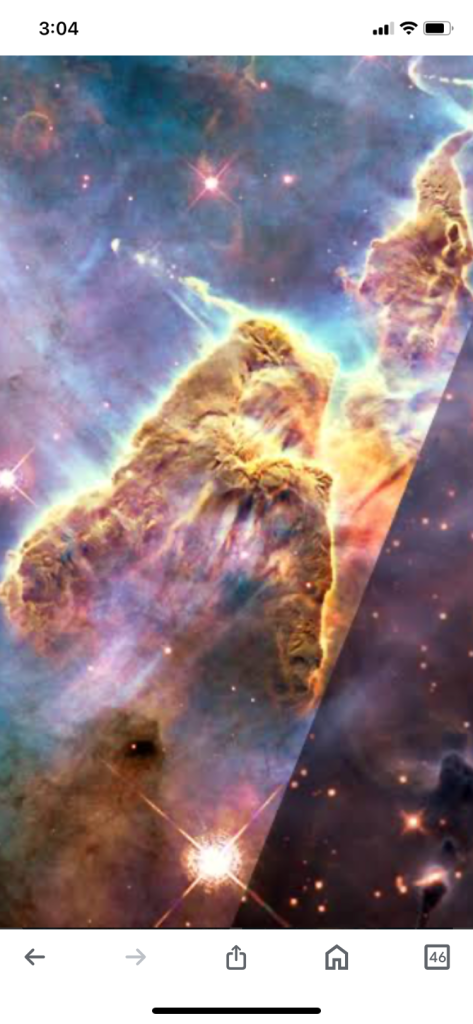
The Carina Nebula is a huge star-forming region in our galaxy. The pillars inside the nebula are made of cold hydrogen and dust. They serve as star incubators, with young, hot stars forming inside of them as the clouds of gas and dust collapse in on themselves.
The pillars are:
- Several light-years tall
- Composed of molecular hydrogen and dust
- Sculpted by violent stellar winds and powerful radiation from massive stars
- Carved out by outflows from the infant stars themselves
The pillars could be destroyed in as little as 100,000 to a million years. This process is called photoevaporation, and it’s destroying the Carina Nebula and its pillars.
Massive Protostars and Newly-Forming Planets! Star-forming nebulae are busy places. Unfortunately, clouds of gas and dust usually hide the action
The Pillars of Creation are located in the Eagle Nebula. The Eagle Nebula is part of the constellation Serpens and is about 6,500–7,000 light-years from Earth. The Pillars of Creation are three towers of gas and dust that are light-years tall. They’re located in an active star-forming region within the nebula.
The Carina Nebula is also known as the “Pillars of Destruction”. It’s located about 7,500 light years from Earth
The Carina Nebula is one of the brightest nebulae in the night sky. It’s an emission nebula, which means that the gas inside it glows due to intense radiation from its stars. The Carina Nebula is so bright that many of its structures and stars can be seen without binoculars.
The Carina Nebula is four times larger than the Orion Nebula, which is a popular deep-sky target in the Northern Hemisphere. It’s located in the Southern Hemisphere and was first observed from South Africa’s Cape of Good Hope.
The Carina Nebula contains at least a dozen stars that are 50 to 100 times the mass of our Sun. The largest star in the nebula is called Eta Carinae. It’s up to four million times brighter than our Sun and is about 2-3 million years old. Eta Carinae is actually a double-star system, which means it’s made up of two stars that travel together in the same orbit.
The Carina Nebula is red because of the interaction between hydrogen and ultraviolet light. Emission nebulae tend to be red because of the abundance of hydrogen. Other colors, such as blue and green, can be produced by the atoms of other elements.
The color of the nebula also represents the temperature of the ionized gas. Blue is relatively hot and red is cooler.
The visible-light colors emerge from the glow of different gases:
- Oxygen (blue)
- Hydrogen/nitrogen (green)
- Sulfur (red)
Areas that appear blue are not obscured by dust, while areas that appear red are hidden behind dark clouds of dust in visible light
The Carina Nebula is a complex region of bright and dark nebulosity. The dark patches in the nebula are called “Bok globules”. These small, dark nebulas are dense with gas.
The Carina Nebula is studded with cold dark clouds of gas and dust. These isolated clumps of dark clouds are nodules of dust and gas that are resisting being eaten away by photoionization. Photoionization is the process by which the energy from light removes electrons from atoms.
Yes, the Carina Nebula is visible to the naked eye. It’s located in the southern constellation Carina, the Keel. It’s visible from the Southern Hemisphere, but not from the Northern Hemisphere.
The Carina Nebula is also known as the Great Carina Nebula, NGC 3372, and the Keyhole Nebula. It’s one of the brightest nebulae in the sky. It’s so big and bright that it’s easy to spot with the naked eye.
The Carina Nebula is visible under dark skies. It can also be seen with the help of a small binocular
Here are some of the largest nebulae visible from Earth:
- Tarantula Nebula The largest known nebula and the most active star-forming region in our local galactic neighborhood. It’s 170,000 light-years away and can be seen in the constellation of Doradus in the southern sky.
- Gum Nebula The largest known emission nebula in terms of angular diameter as seen from Earth. It extends about 35° in the southern constellations Puppis and Vela.
- NGC 3603 The largest nebula seen in visible light in the Milky Way. It’s a prominent star-forming region in the Carina spiral arm of our galaxy, about 20,000 light-years away.
- Orion Nebula One of the brightest nebulae in the night sky. It’s the closest star-forming region to Earth, at 1,500 light-years away. It can be seen with the naked eye
The Helix Nebula, also known as the “Eye of God”, is a planetary nebula located in the constellation Aquarius. It’s about 650 light years away from Earth. The Helix Nebula is one of the closest and brightest planetary nebulae to Earth.
The Helix Nebula was discovered by Karl Ludwig Harding in the early 19th century. It was formed when a star exploded and blew off its outer layer before it died.
The Helix Nebula is nicknamed the “Eye of God” because of its striking appearance. The Hubble Space Telescope has taken images of the Helix Nebula. The Hubble image shows a blue center, a gold ring, and a dark red color.
The Helix Nebula is also known as NGC 7293.
The oldest planetary nebula ever found is IPHASX J055226.2+323724. It’s located in the 500-million-year-old Galactic Open Cluster M37, also known as NGC2099. The nebula is only the third example of a planetary nebula associated with an open cluster.
The nebula’s kinematic age is over 70,000 years. It’s believed to be of high astrophysical value.
The nebula was discovered by an international team of astronomers led by researchers from the University of Hong Kong. The team captured data between August 30 and September 10, 2022
Nebulae are part of a cycle that has lasted over 13 billion years. Nebulae turn into stars, and stars turn into nebulae. Nebulae don’t have a finite lifespan. They keep expanding and recycling elements. Eventually, the elements in the nebulae will be recycled through interstellar gas clouds and will become part of the next generation of stars.
Planetary nebulae last for about 20,000 years. The fluorescent light of planetary nebulae lasts for only about 10,000 years. Eventually, the core stops ejecting gas into space. The gas expelled earlier ultimately swirls away and merges into the interstellar medium.
For a star the size of the sun, it takes ~10 million years for the nebula to collapse. For bigger stars, it takes a shorter amount of time; as short as 100,000 years. For smaller stars, it can take far more than 10 million years
Nebulae can form in a few ways:
- Supernova: The explosion of a dying star can create nebulae.
- Cold interstellar gas and dust: Nebulae can form from clouds of cold gas and dust.
- Star nurseries: Nebulae can form in regions where new stars are beginning to form.
Planetary nebulae form at the end of the life of a star of intermediate mass, about 1-8 solar masses. The process of making a planetary nebula takes a few thousand years. The nebula itself lasts about 20,000 years before it disperses into interstellar space.
The Sun is a low-mass star and will produce a planetary nebula in about 5,000 million years. The Sun may make a planetary nebula when it runs out of nuclear fuel in about 5 billion years
Nebulae are formed when gravity causes gas and dust to attract each other, forming a large mass. This mass accumulates more matter and starts to rotate, eventually forming a new star.
Nebulae can also form from:
- The dust and gas released by dying stars
- Regions where new stars are forming
- The aftermath of a supernova
- Diffuse nebula, which are formed from the explosions of population three and two stars, and the leftover hydrogen and helium from the Big Bang
Planetary nebulae are formed when a star dies and ejects the outer layers of its atmosphere. The star’s hot core, or white dwarf, causes the gas to glow
Nebulae are often star-forming regions. In these regions, gas, dust, and other materials clump together to form denser regions. These regions eventually become dense enough to form stars.
Stars are born in dense clumps of gas, dust, and other material inside diffuse emission nebulae, also frequently referred to as “stellar nurseries”. Hubble’s Pillars of Creation is in this category, as is the famous Orion Nebula.
The temperature of the gas in the nebula is about 10,000 degrees Celsius, and the central stars of planetary nebulae are among the hottest stars in the Universe, with temperature in the range of 25,000 to over 200,000 degrees Celsius
Nebulae are made up of dust and gases, mostly hydrogen and helium. The exact composition of a nebula can vary depending on factors like age, location, and the type of stars that formed it.
Most nebulae are made up of:
- 90% hydrogen
- 10% helium
- 0.1% heavy elements like carbon, nitrogen, magnesium, potassium, calcium, and iron
- Trace amounts of lithium, beryllium, and boron
Planetary nebulae usually contain larger proportions of elements like carbon, nitrogen, and oxygen.
The dust in a nebula is typically made up of heavier elements like silicon, iron, and magnesium. These elements are typically in their oxidized or molecular form due to high energy radiation that is present in the nebula.
Yes, the Carina Nebula is located in the Milky Way. It’s located in the Carina–Sagittarius Arm of the Milky Way, which is in the southern part of the galaxy. The nebula is about 8,500 light-years from Earth.
The Carina Nebula is also known as the Eta Carinae Nebula, the Great Carina Nebula, and NGC 3372. It’s one of the largest star-forming regions in the Milky Way, stretching over 300 light-years across. It’s so big and bright that it’s easily visible to the naked eye on a clear night.
The Carina Nebula is home to the Eta Carinae double-star system, which is one of the largest and brightest star systems in the Milky Way. Eta Carinae is a rare type of star called a luminous hypergiant. It’s known for its periodic outbursts
Best toys and games on discount on Amazon
https://365b2nik29vqhza9thup32eq33.hop.clickbank.net Universe discoveries