
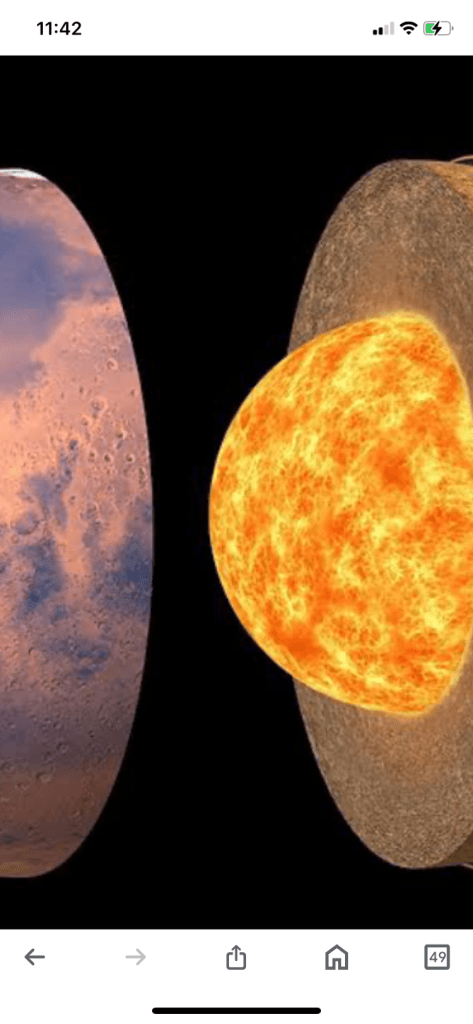
Yes, Mars has a layer of molten rock near its core. The layer is about 93 miles (150 km) thick and is made of soft, molten silicon-rich rock. It lies between the mantle and core.
The layer was discovered by analyzing seismic energy that vibrated through the planet after a meteorite hit Mars in September 2021. The layer’s reflection of seismic waves helped explain why 2021 studies underestimated the size of Mars’ core.
Mars’ core is liquid iron. It’s surrounded by a rocky mantle that’s between 770 and 1,170 miles (1,240 to 1,880 kilometers) thick. Above the mantle is a crust made of iron, magnesium, aluminum, calcium, and potassium. The crust is between 6 and 30 miles (10 to 50 kilometers) deep.
Mars’ core cooled earlier than Earth’s core because Mars is smaller. The residual heat left over from its formation had less distance to conduct to the surface.
Researchers used seismic data from NASA’s InSight lander to confirm that Mars has a liquid core. The data showed that the core is made of iron-alloy with high percentages of sulfur and oxygen. The data also showed that the core is smaller and denser than previously thought.
The researchers characterized the core separately from the mantle. They also found a slight increase in the planet’s spin.
Scientists can tell if a planet has a liquid core by tracking seismic waves. They can tell that the outer core is liquid if:
- P-waves slow down at the mantle core boundary
- S-waves disappear at the mantle core boundary
- Seismic shear-waves are not transmitted through the outer core
Other clues that a planet may have a liquid core include:
- Active volcanism
- Characteristics of a magnetic field
- A crust that’s thinner at the poles
Mercury is thought to have a liquid outer core and a solid inner core. Venus’ inner core is solid, even though it’s very hot.
Scientists know that Earth’s outer core is liquid because S-waves are not transmitted through it. S-waves can only travel through solids, while P-waves can travel through both solids and liquids. When P-waves hit the outer core, they bend downward and then bend again when they leave. This indicates that the outer core has a different composition from the mantle.
The Earth’s outer core is the only liquid layer of the Earth. It’s made up of liquid iron and nickel. The outer core remains liquid because there’s not enough pressure to keep it in a solid state.
The Earth’s magnetic field is created by a conductive fluid that’s in convection in the inner of the Earth. Without at least a partially liquid core, convection wouldn’t occur, making it impossible for a planet to form a magnetic field
Mars’ core became inactive about four billion years ago. The planet’s magnetic field disappeared, and the solar wind stripped away the atmosphere. The solar wind also allowed the Martian water to sputter into space.
Mars’ core does not have enough heat to kick-start the convection process needed to sustain a magnetic field. However, the Martian crust is magnetized, indicating the planet once had a magnetic field.
Mars is large enough to have remained hot inside and still have active tectonism. However, it shows little geological activity.
https://365b2nik29vqhza9thup32eq33.hop.clickbank.net Universe discoveries
Beautiful!
LikeLike