
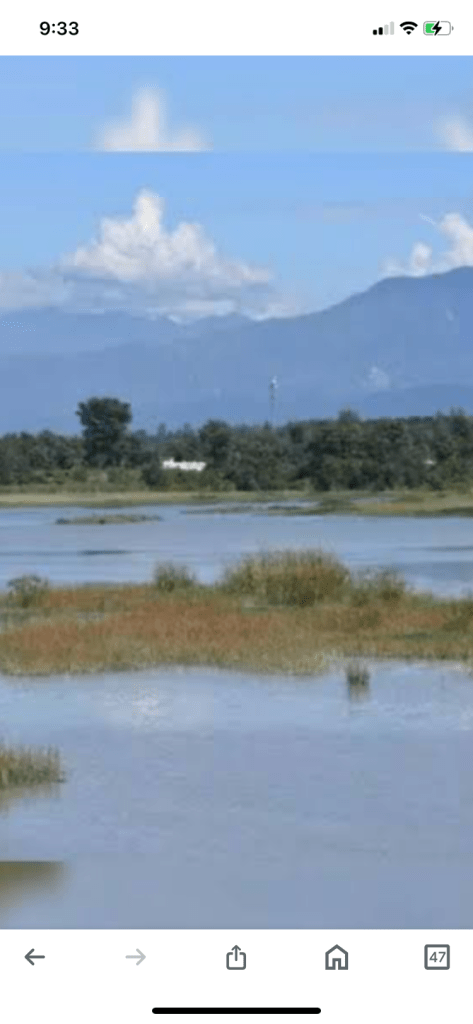
The NASA-ISRO Synthetic Aperture Radar (Nisar) satellite will launch in early 2024. The satellite will provide researchers with insight into Earth’s forests and wetlands. The mission’s goal is to understand how changes in these ecosystems impact the global carbon cycle and climate change.
The satellite will detect movements of the planet’s surface as small as 0.4 inches over areas about half the size of a tennis court. The data it collects will help researchers understand two key functions of both ecosystem types: the capture and the release of carbon.
Forests hold carbon in the wood of their trees, while wetlands store it in their layers of organic soil. When wetlands dry out, the carbon they store is exposed to oxygen, releasing carbon dioxide.
The satellite will also reveal information about:
- The evolution and state of Earth’s crust
- Our planet’s processes and changing climate
- Future resource and hazard management
The cost of the project will be shared between the two space agencies. ISRO’s contribution is estimated at around ₹ 788 crores. ( source google)
Once it launches in early 2024, the NISAR radar satellite mission will offer detailed insights into two types of ecosystems ‘forests and wetlands’ vital to naturally regulating the greenhouse gases in the atmosphere that are driving global climate change, NASA’s Jet Propulsion Laboratory (JPL) has said
The NISAR satellite was recently featured in news about:
- A send-off ceremony at the NASA Jet Propulsion Laboratory in California
- Significant progress in Bengaluru
- The US handing over the satellite to ISRO
- The satellite arriving in India
The NASA-ISRO Synthetic Aperture Radar (NISAR) mission is a joint project between NASA and the Indian Space Research Organization (ISRO). The mission will be the first NASA radar mission to systematically study the Earth’s solid ground, ice masses, and ecosystems. NISAR will map the entire globe in 12 days.
The mission will provide information about:
- Ice mass
- Land surface motions and changes
- Ecosystem disturbances
- Biomass
- Natural hazards
- Sea level rise
- Groundwater
NISAR will also help monitor and understand the impacts of climate change on the Earth’s land surface, including:
- Melting glaciers
- Sea-level rise
- Changes in carbon storage
The satellite will be the first radar imaging satellite to use dual frequencies. It will use radar waves to penetrate most weather clouds and be equally effective in darkness.
The Jet Propulsion Laboratory (JPL) in Pasadena, California is developing the L-band SAR payload for the NISAR satellite. The S-band SAR payload was built at the Space Applications Centre in Ahmedabad, India, and shipped to JPL. Engineers at JPL integrated the S-band SAR payload with the L-band SAR payload.
The NISAR satellite is the first time NASA and ISRO have collaborated on hardware development for an Earth-observing mission. The satellite will be launched from the Satish Dhawan Space Centre in Sriharikota, India.
The NASA-ISRO Synthetic Aperture Radar (NISAR) mission is one of the most expensive space projects yet. It’s the first time NASA and ISRO have worked together on hardware development for an Earth-observing mission. The satellite will be launched into a near-polar orbit from the Satish Dhawan Space Centre in Sriharikota, India( source google)
Best pet supplies on discount on Amazon
https://5ac90roi48sxj-hhlu4lz48u9i.hop.clickbank.net Universe discoveries