
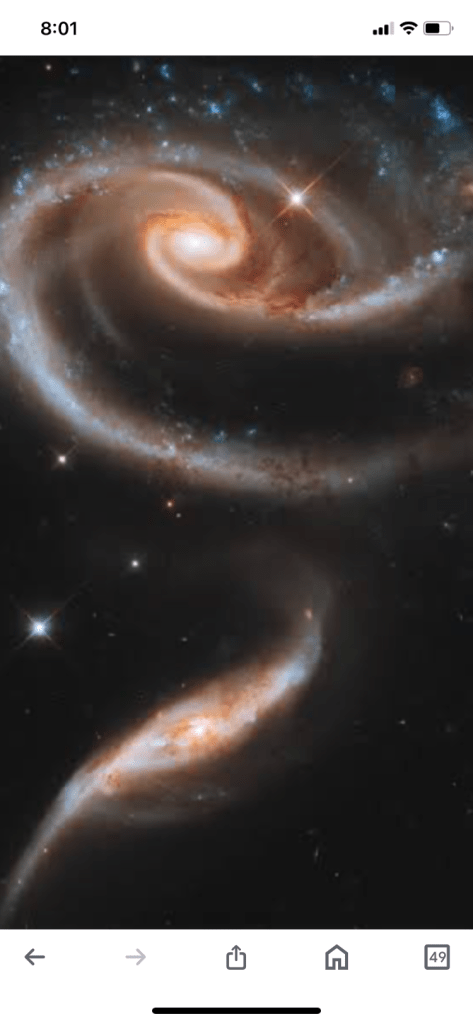
The James Webb Space Telescope (JWST) and “Renaissance Simulations” are both tools that help researchers study the early universe. The JWST is an infrared telescope that can observe objects that are too old, distant, or faint for the Hubble Space Telescope. The Renaissance Simulations are computer simulations that track the formation and growth of dark matter halos.
The JWST was launched in December 2021 and arrived at its destination in January 2022. It’s located in a solar orbit near the Sun–Earth L₂ Lagrange point, about 1.5 million kilometers from Earth. The JWST’s first image was released to the public on July 11, 2022.
The Renaissance Simulations were developed by astrophysical researchers from Maynooth University and Georgia Tech. They align with data obtained from the JWST. The simulations can accurately portray early galaxy formations and the Universe’s first stars. They can also track the formation and growth of dark matter halos, which eventually host the galaxies we observe.
The Renaissance Simulations allow researchers to glimpse the universe as it was only a few hundred million years after the Big Bang
The JWST has made several discoveries, including:
- Carbon dust The earliest-known carbon dust in a galaxy was detected in ten different galaxies that existed 1 billion years after the Big Bang.
- Ancient galaxies The JWST detected six massive ancient galaxies that astronomers are calling “universe breakers”.
- Supermassive black hole The most distant supermassive black hole was discovered, estimated to be 90 million times the mass of our Sun.
- Distant galaxies The four most distant galaxies known were observed, which also means they are the oldest.
- Water vapor Water vapor was detected in Comet 238P/Read, an object orbiting within the main asteroid belt between Mars and Jupiter.
The JWST is the largest, most technically advanced telescope ever built. Its larger size and richer infrared views allow it to peer back over 13.5 billion years.
Here are some other discoveries made by the JWST:
- 50 distant stars: The JWST observed the birth of 50 distant stars.
- Methyl cation: The JWST discovered a chemical called methyl cation in a distant ring of rock, dust, and gas.
- Water vapor: The JWST detected water vapor around a rocky exoplanet that orbits a star 26 light-years away from Earth.
- Pillars of Creation: The JWST uncovered a dusty structure in the Pillars of Creation.
- MACS0647: The JWST provided unprecedented details on the early universe.
- IC 1623: The JWST captured a pair of merging galaxies.
- Dense Cosmic Knot: The JWST found a dense cosmic knot in the early universe
The JWST has observed the four most distant galaxies known. These galaxies existed when the universe was only 350 million years old, which is about 2% of its current age. One of these galaxies, Maisie’s galaxy, formed less than 400 million years after the Big Bang.
The JWST has also detected the following objects that existed early in the universe’s history:
- CEERS 1019 The galaxy that hosts the most distant active supermassive black hole. It formed 570 million years after the Big Bang.
- Six massive ancient galaxies Astronomers are calling these galaxies “universe breakers” because their existence could upend current theories of cosmology. They existed about 540 million to 770 million years after the Big Bang.
Dark matter is a hypothetical substance that surrounds galaxies. It’s thought to be the glue that holds the universe together. Dark matter halos are believed to be the places where galaxies were born.
Scientists have never directly detected dark matter, but they can observe its gravitational effects. These effects include:
- Formation and evolution of galaxies
- Gravitational lensing
- Observable universe’s current structure
- Mass position in galactic collisions
- Motion of galaxies within galaxy clusters
- Cosmic microwave background anisotropies
Dark matter is thought to be made up of strange particles that were created in the very early universe. These particles may include:
- Axions
- Weakly interacting massive particles (called WIMPs)
- Neutrinos
The earliest detection of dark matter was around galaxies that existed about 12 billion years ago.
The Renaissance Simulations are a series of computer simulations that model galaxy formation in the early Universe. The simulations were designed to simulate the dominant sources. They yielded a sample of over 3,000 high redshift (20 > z > 7) galaxies. The simulations were also used to follow the growth of over 15,000 black holes born into mini-haloes in the early Universe.
The Renaissance Simulations were performed in the same comoving volume of (40 Mpc)3. They are extremely high-resolution and physics-rich AMR calculations.
The Renaissance Simulations closely align with observations made by the James Webb Space. They have yielded results on:
- Galaxy properties
- UV escape fractions during the epoch of reionization
You can browse Renaissance simulation resources on Teachers Pay Teachers. ( source google)
Best books on discount on Amazon
https://dd183rem83r4c49jvh3hy2fmcb.hop.clickbank.net Universe discoveries