
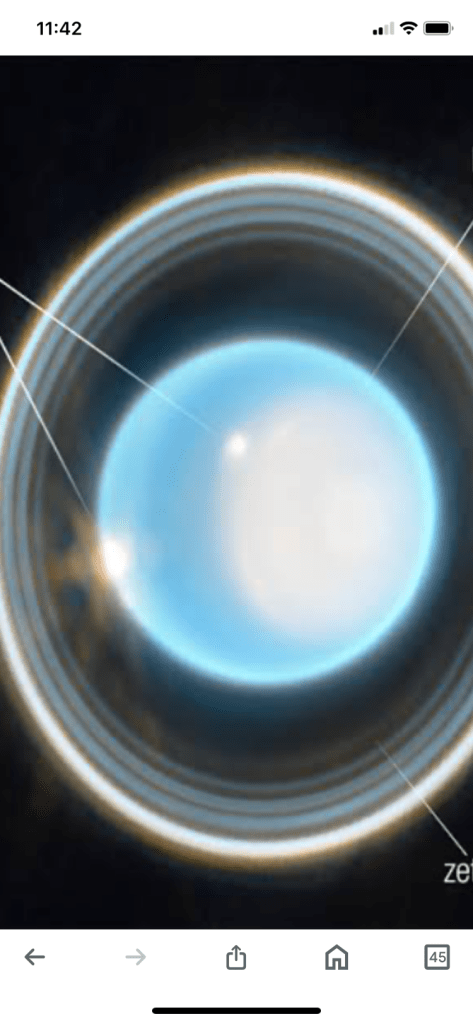
Yes, Uranus has infrared auroras. Astronomers confirmed the existence of these auroras just in time for Halloween.
Uranus’ auroral glow is predominantly in ultraviolet and infrared wavelengths. The ultraviolet aurora was first seen in 1986 by NASA’s Voyager 2 probe. It took nearly 40 years to detect the infrared counterpart.
Scientists hope that the findings could help explain the magnetic fields of other planets in our solar system.
Uranus’ unique atmospheric composition is dominated by hydrogen and helium, and exists at substantially lower temperatures than Earth. The total power radiated by Uranus in the far infrared (i.e. heat) part of the spectrum is 1.06±0.08 times the solar energy absorbed in its atmosphere. Uranus’s heat flux is only 0.042±0.047 W/m2, which is lower than the internal heat flux of Earth of about 0.075 W/m2.
Consequently, Uranus’ auroral glow predominantly emits ultraviolet and infrared wavelengths. The initial sighting of Uranus’ ultraviolet aurora dates back to 1986 when NASA’s Voyager 2 probe made its historic flyby. However, it has taken nearly four decades to detect its infrared counterpart
Uranus is unique because it’s the only planet with an equator that’s nearly at a right angle to its orbit. Uranus’s tilt is 97.77 degrees. This tilt might be the result of a collision with an Earth-sized object long ago.
Uranus’s tilt causes the most extreme seasons in the solar system. Uranus is tilted so far that it essentially orbits the sun on its side, with the axis of its spin nearly pointing at the star.
Uranus also has 13 rings that encircle the planet from top to bottom. Uranus is the seventh planet from the Sun, and it was the first planet to be discovered through a telescope.
Uranus has been called the most unloved planet because it’s difficult to explore. It’s 20 times farther from the sun than Earth, and only one spacecraft has visited it.
Uranus has also been called the most boring planet. When Voyager 2 imaged Uranus in 1986, it saw a bland-looking sphere with only about 10 visible clouds. However, some say that Uranus is misunderstood and is actually one of the most interesting planets.
Uranus’s environment is not conducive to life as we know it. The temperatures, pressures, and materials that characterize this planet are most likely too extreme and volatile for organisms to adapt to.
Here are some more facts about Uranus:
- Uranus is the second-least dense planet, after Saturn.
- Uranus is slightly larger in diameter than Neptune, but smaller in mass.
- Uranus’s average temperature is -357° F (-216° C).
- It takes Uranus 84 Earth years to make a trip around the Sun.
- Uranus has 27 moons, including 5 major moons.
- Uranus’s blue-green color comes from methane gas in the atmosphere.
- Uranus’s atmosphere is made of methane, hydrogen, and helium.
- Uranus was discovered by William Herschel in 1781. He wanted to call it Georgium Sidus
Best clothes on discount on Amazon
https://5ac90roi48sxj-hhlu4lz48u9i.hop.clickbank.net Universe discoveries