
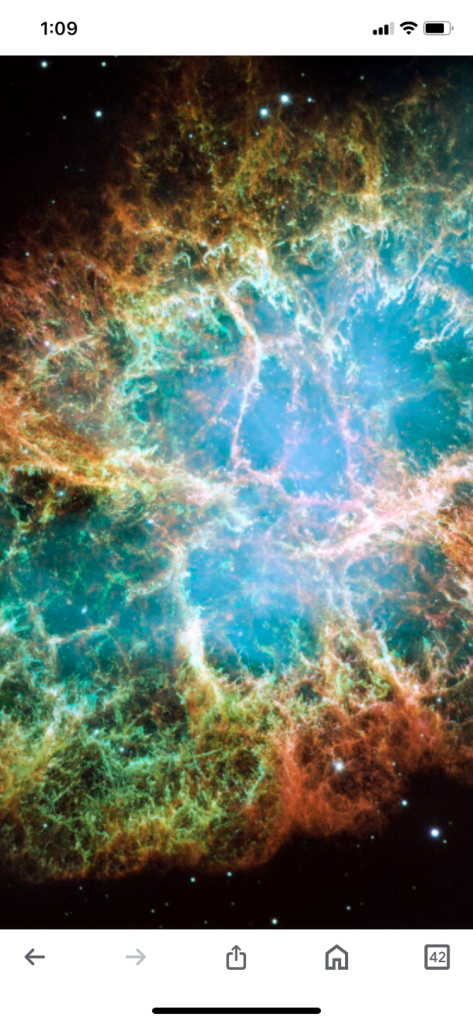
The James Webb Space Telescope (JWST) revealed new details about the Crab Nebula. The JWST’s infrared capabilities showed red and orange dust filaments around the nebula’s core. The filaments create an intricate pattern across the nebula. The JWST also revealed emissions from dust grains in the central region.
Details revealed by the JWST
- Red-orange gas tendrils: Encasing the nebula’s core
- Emissions from dust grains: Located in the central region
- Synchrotron radiation: A type of radiation in the nebula
The Crab Nebula is a supernova remnant located 6,500 light-years away in the constellation Taurus. It’s about 10 light-years across, or about 10 trillion miles. The gas in the nebula is expanding through space at over 600 miles per second.
The nebula’s orange filaments are the remains of the star and are mostly made of hydrogen. The blue in the filaments in the outer part of the nebula represents neutral oxygen. Green is singly ionized sulfur, and red indicates doubly ionized oxygen. These elements were expelled during the supernova explosion
Using JWSTs infrared capabilities, the image of the Crab reveals red/orange filaments of dust around the central region. The filaments weave an intricate pattern over the whole nebula, but it’s the core that has received more attention
Yes, the Crab Nebula is located in the Milky Way galaxy. It’s located in the Perseus Arm of the galaxy.
The Crab Nebula is also known as Messier 1 (M1), NGC 1952, and Sharpless 244. It’s a supernova remnant that’s about 6,500 light-years away from Earth. The nebula is about 10 light-years across.
The Crab Nebula is a huge cloud of dust and gas that surrounds a neutron star. The neutron star is called the Crab pulsar. It’s 28–30 km across and emits pulses of radiation from gamma ray bursts to radio waves. The Crab pulsar spins at a rate of 30.2 times per second.
The Crab Nebula is a supernova remnant. It’s the remains of a star’s explosive death. The Crab Nebula is a pulsar wind nebula, which is the result of energetic particles and magnetic fields expelled from a pulsar. A pulsar is the dense core of what was once a massive star.
The Crab Nebula is one of the brightest supernova remnants in the sky. It’s located in the constellation Taurus
The Crab Nebula is the result of a supernova explosion that occurred in 1054 AD. The explosion was recorded by Chinese astronomers. The star that exploded was likely 10 times more massive than our Sun. When the star ran out of fuel, it collapsed into a neutron star. The outer layers of the star were violently thrown off, forming the supernova explosion.
The Crab Nebula may be from a new type of supernova called an electron-capture supernova. Scientists previously thought the Crab Nebula was the remnant of a type II supernova.
The star that created the Crab Nebula was a blue supergiant. It was likely a massive star with a mass between 8 and 10 times that of the Sun. It had a surface temperature of around 40,000 Kelvin. It would have had a radius of about 60-70 times that of the Sun.
The star was very luminous and hot. It was visible in daylight for 23 days and at night for almost 2 years. The supernova explosion was so bright it was comparable to the full moon, six times brighter than Venus.
The Crab Pulsar in the Crab Nebula has a true age of 925 years. The pulsar’s characteristic age is 1,240 years. The supernova that created the pulsar occurred in 1054 AD
Best clothes on discount on Amazon
https://dd183rem83r4c49jvh3hy2fmcb.hop.clickbank.net Universe discoveries