
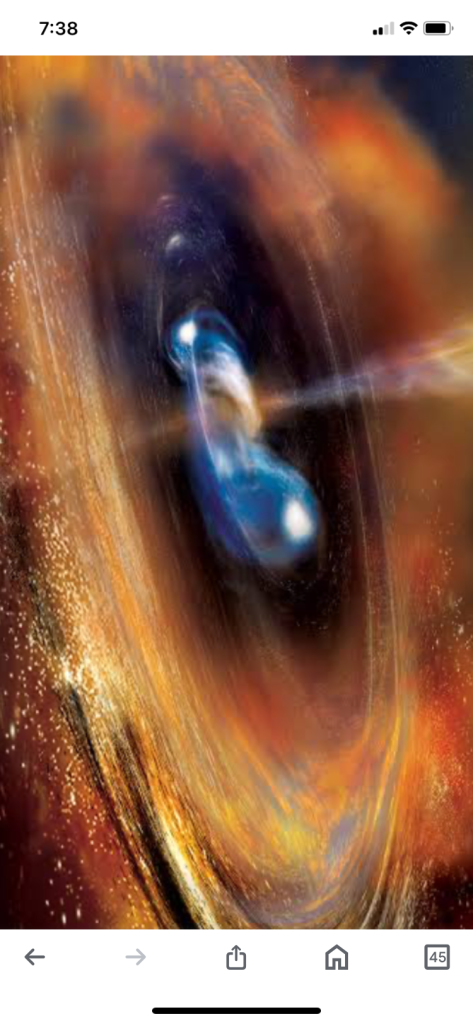
Star explosions, or supernovae, can boost cosmic rays to near the speed of light.
How it works
- Shockwaves: Shockwave from the supernova buffets trapped particles, increasing their energy each time.
- Energy: The particles become so energetic that the supernova remains can’t hold on to them.
- Escape: The particles escape into space as cosmic rays.
What are cosmic rays?
- Cosmic rays are high-energy particles or clusters of particles that move through space at nearly the speed of light.
- They originate from the Sun, from outside of the Solar System in our own galaxy, and from distant galaxies.
- When cosmic rays impact Earth’s atmosphere, they produce showers of secondary particles.
- Cosmic rays are invisible to the naked eye.
How many supernovae occur
- Supernovae occur approximately once every 50 years in our Galaxy.
- The last supernova observed in the Milky Way was in 1604.
- A supernova may have exploded in the constellation Cassiopeia about 300 years ago.
These rays are charged particles such as protons, electrons and some ions that were accelerated to nearly the speed of light by intense magnetic fields in the supernova. Many scientists suspect cosmic rays come from supernovas, but the rays’ exact origins have been difficult to pin down
How do supernovae accelerate cosmic rays?
Scientists suspect the supernova wreckage from dead stars accelerates particles to such high energies when charged particles are ensnared by magnetic fields around them. This process allows shockwaves from the supernova to buffet the trapped particles repeatedly, increasing their energy each time.
Where do cosmic rays come from?
The lowest energy cosmic rays arrive from the Sun in a stream of charged particles known as the solar wind, but pinning down the origin of the higher-energy particles is made difficult as they twist and turn in the magnetic fields of interstellar space
Are cosmic rays good or bad?
What is the risk from cosmic radiation? Cosmic radiation exposes the body to radiation in a manner similar to exposure from a medical X-ray. The average annual dose due to cosmic radiation in the US is 0.34 mSv (34 mrem) per year. This low radiation dose is unlikely to affect human health
Can you feel cosmic rays?
Cosmic rays collide with air molecules high above the ground and their energy gets dispersed among many secondaries. And even in space you’d not feel anything, because only a tiny fraction of its energy will be deposited inside your body
Who discovered cosmic rays?
Cosmic rays were discovered by Victor Hess in 1912 in balloon experiments, for which he was awarded the 1936 Nobel Prize in Physics. Direct measurement of cosmic rays, especially at lower energies, has been possible since the launch of the first satellites in the late 1950s.
Do astronauts see cosmic rays?
Astronauts aboard the International Space Station (ISS) say that they can apparently perceive cosmic rays. The radiation appears as dots, streaks or clouds on their retinas, even when their eyes are closed
Does Sun emit cosmic rays?
Radiation from space is called cosmic radiation, which is constantly hitting the Earth. Our solar system’s Sun and other stars in the galaxy emit a constant stream of cosmic radiation
Who won the Nobel Prize for cosmic rays?
Victor Franz Hess
Victor Franz Hess (German: [ˈvɪktoːɐ̯ fʁants ˈhɛs]; 24 June 1883 – 17 December 1964) was an Austrian-American physicist, and Nobel laureate in physics, who discovered cosmic rays
Do cosmic rays enter Earth?
Cosmic rays constantly rain down on Earth, and while the high-energy “primary” rays collide with atoms in the Earth’s upper atmosphere and rarely make it through to the ground, “secondary” particles are ejected from this collision and do reach us on the ground
Do black holes emit cosmic rays?
In this way, black holes transfer an enormous amount of energy to their host galaxies, explained Karwin. “These ultra-fast outflows act like a piston and actually accelerate charged particles, known as cosmic rays, to near the speed of light
Can cosmic rays cause lightning?
When penetrating particles from cosmic rays move through the atmosphere—in this case through electrically loaded clouds—they are ionising the air, making conducting paths for the lightning
Supernovae accelerate cosmic rays by:
- Magnetic fields: Charged particles are trapped by magnetic fields.
- Shockwaves: Shockwave from the supernova buffets the trapped particles, increasing their energy.
- Remnants: The remnants of the explosion are expanding clouds of gas and magnetic field. The particles bounce repeatedly among the entangled magnetic fields within the gaseous remnant and accelerate into cosmic rays.
The remnants of supernovae can last for thousands of years
https://dd183rem83r4c49jvh3hy2fmcb.hop.clickbank.net Universe discoveries