
Yes, there may be double gravitational lenses. However, it’s unlikely that we’ll be able to detect them for now.
A large sample of gravitational lens systems is likely to contain a significant fraction of double lens systems.
Gravitational lenses
- A mass distribution, such as a galaxy, can act as a gravitational lens.
- Gravitational lenses can bend light and distort images of objects beyond the gravitating mass.
- The first gravitational lens was discovered in 1979. It was known as the “Twin QSO” because it initially looked like two identical quasistellar objects.
- The first, and brightest lens system was discovered in 1995 with the Hubble telescope.
- Quasars with a double-image gravitational lens could help figure out how fast the universe is expanding.
Yes, there may well be double gravitational lenses, but as this paper shows, it is unlikely we will be able to detect them for now and sadly I suspect the idea of using them as a long-distance cosmic telephone will for now remain science fiction
Gravitational lensing can produce multiple images because:
- Light takes different paths Light can take multiple paths around a gravitational lens, arriving at Earth at different times.
- Light is deflected The closer the light of more-distant galaxies passes to the lens, the stronger the deflection. If the light passes close enough to the lens, multiple images are likely to appear.
- The lens and observer are aligned Strong gravitational lensing produces multiple images if the object lens and observer are in a specific alignment.
- The mass is distributed asymmetrically Gravitational lenses often produce four distinct images because the cluster of galaxies is lumpy. The mass is distributed asymmetrically.
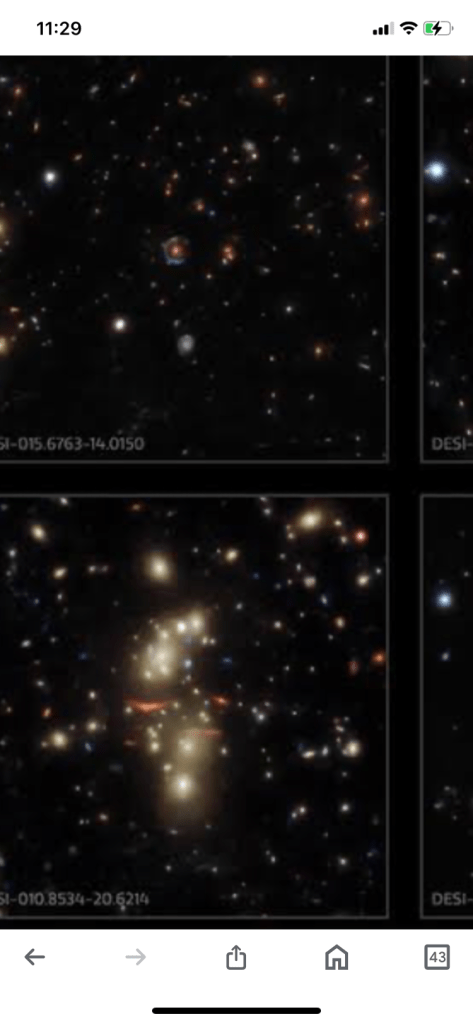
Gravitational lensing can produce multiple images of the original galaxy, each with a characteristically distorted arc-like shape or even into rings.
Gravitational lensing is when a massive celestial body, such as a galaxy cluster, bends the path of light around it. The body causing the light to curve is called a gravitational lens.
How it works
- Mass causes curvature of spacetime
- The mass warps the space-time through which the photons travel
- The light is visibly bent, as if by a lens
- The effect is like looking through a giant magnifying glass
Examples
- The first gravitational lens was discovered in 1979. It became known as the “Twin QSO”.
- The effect was first demonstrated during a total solar eclipse in 1919. The positions of stars near the Sun were observed to be slightly shifted from their usual positions
Gravitational lensing is a rare effect that occurs when light passes through a mass distribution, such as a galaxy. The light’s path is slightly changed, which can distort the image of an object behind the mass. Gravitational lensing can also amplify light.
Double quasars
- Clusters of galaxies can act as gravitational lenses, producing double quasars. These quasars can have splittings as large as 1–2 arc minutes.
- The Twin Quasar is a gravitational lens that can be observed with the eye. It’s 7.8 billion light years away and has a distance of 6 arc seconds between its two light points. It’s very small, about 1/300 the size of the Moon.
Other gravitational lensing effects
- Gravitational lensing can allow the Hubble Space Telescope to see fainter and more distant galaxies.
- Gravitational lensing can warp images of background light into distinct circular rings. This can help to infer the presence of black holes and measure their mass.
- When gravitational waves pass by a massive object on their way to Earth, a strong gravitational lensing effect can happen. The gravitational wave signal will be amplified, deflected, and delayed in time.
 Universe discoveries