
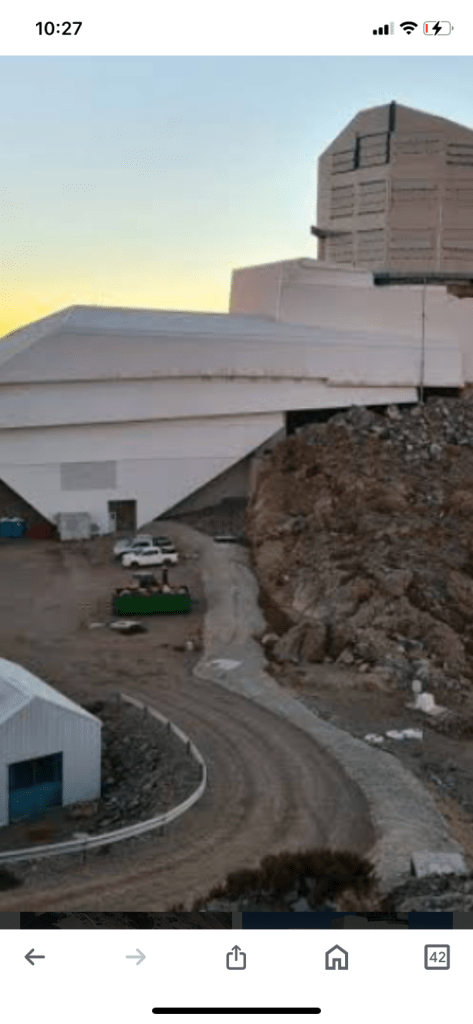
The Vera Rubin Observatory is a ground-based telescope located in the Chilean Andes. It’s expected to detect up to 70 interstellar objects (ISOs) per year. The observatory is equipped with the world’s most powerful camera.
About the Vera Rubin Observatory
- The observatory is named after the American astronomer Vera Rubin.
- It’s expected to see first light in 2025.
- The observatory will cover about 18,000 deg2 of the southern sky.
- The main survey will use about 90% of the observing time.
About the Vera Rubin Telescope
- The telescope will scan the night sky.
- It has the potential to identify thousands of ISOs.
- The telescope could find up to 70 objects a year coming from other star systems.
Vera Rubin was an American astronomer who pioneered work on galaxy rotation rates. She discovered:
- Galaxy rotation problem The discrepancy between the predicted angular motion of galaxies and the observed motion.
- Flat rotation curves The orbiting speeds of gas clouds in the outer parts of galaxies remain constant to distances well beyond the visible starlight.
- Dark matter The outer stars in the Andromeda galaxy were rotating at similar speeds as inner stars, contrary to Newtonian dynamics. This led to the idea of dark matter, unseen matter that extends in a halo around galaxies and affects their rotation.
Rubin’s work was the cornerstone of dark matter research. Her findings revealed a large missing chunk of the Universeand opened up a new field for the following generations of astronomers to explore.
Vera Rubin also discovered:
- NGC 4550: A galaxy with half of its stars orbiting in one direction and half in the opposite direction. This may have been caused by two galaxies merging.
- Galaxies are mostly dark matter: Rubin’s work changed the way we think about the universe.
- Galaxies spin faster than they should: Rubin’s discovery helped prove the existence of dark matter
Vera Rubin’s discovery that galaxies spin faster than they should helped prove the existence of dark matter. Rubin’s work provided evidence for the existence of dark matter by identifying the galaxy rotation problem.
Rubin’s calculations showed that galaxies must contain about ten times as much “dark” mass as can be accounted for by the visible stars. She realized that if a halo of dark matter adorned each galaxy, matter would spread throughout the galaxy instead of concentrating in the center. The force of gravity and orbital velocity would be similar in all parts.
Rubin’s data helped finally convince a skeptical scientific community that dark matter exists.
Vera Rubin wrote more than 200 papers on the structure of the Milky Way. She also wrote Vera Rubin on Dark Matter: A Factor of Ten
The Vera C. Rubin Observatory is an astronomical observatory under construction in Chile. It’s located on the Cerro Pachón ridge in north-central Chile. The observatory’s main task will be to carry out a synoptic astronomical survey called the Legacy Survey of Space and Time (LSST).
Features
- Telescope: 8.4-meter telescope
- Camera: 3200 megapixel camera
Funding The observatory is a federal project jointly funded by the National Science Foundation (NSF) and the Department of Energy (DOE). The original NSB-authorized Total Project Cost (TPC) was $473.0 million for NSF’s contribution. The project is currently being re-baselined to account for the impacts of the COVID-19 pandemic.
Location The observatory site is inland and approximately 60 m (100 km) by road from the support town of La Serena.
https://dd183rem83r4c49jvh3hy2fmcb.hop.clickbank.net Universe discoveries
The Vera Rubin Observatory in the Chilean Andes boasts cutting-edge technology, including an 8.4-meter telescope and a 3200-megapixel camera. It’s named after the pioneering astronomer Vera Rubin and is set to make significant contributions to our understanding of the universe through the Legacy Survey of Space and Time (LSST).
This impressive project is commendable and reflects the author’s expertise in explaining its significance.
Praise to the author for an informative and engaging blog post about this remarkable observatory.🤝👍
LikeLike