
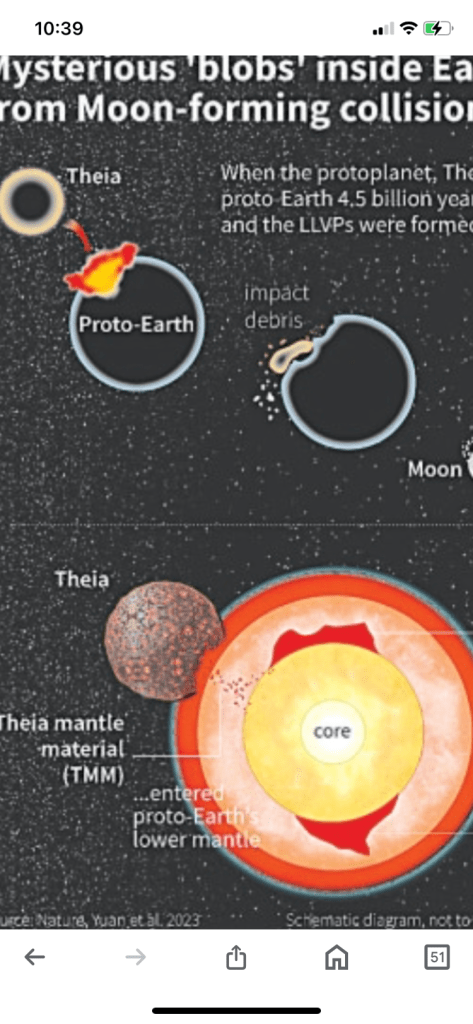
According to a Caltech-led study, two massive, iron-rich structures deep within Earth’s mantle are remnants of Theia. Theia was a hypothesized ancient planet in the early Solar System that collided with Earth around 4.5 billion years ago. The collision led to the formation of the Moon and left behind parts of Theia near Earth’s core.
The two continent-sized regions are known as large low-velocity provinces (LLVPs), or “blobs”. These regions are located one beneath Africa and the other beneath the Pacific Ocean. Waves move at different speeds depending on the material they pass through, and it was observed that they slowed down significantly when passing through these two regions.
Theia is hypothesized to have been about the size of Mars, and may have formed in the outer Solar System and provided much of Earth’s water
The collision between Theia and Earth melted the Earth’s crust and outer mantle. The outer rocky shells of both planets were blasted into a disk of debris around Earth. The Moon formed from this debris.
Theia’s iron core was consumed by Earth’s core. Some of Theia’s mantle may have become incorporated into Earth’s mantle. This mantle clumped and crystallized together to form the two blobs at Earth’s core-mantle boundary.
Theia has not been discovered. The giant-impact hypothesis is a scientific hypothesis that proposes a tentative explanation for a phenomenon. The hypothesis has been the favored model for explaining the formation of the Moon for years.
Evidence for the existence of Theia includes:
- Analysis of lunar rock and soil samples
- Analysis of isotopic ratios
- Evidence that Theia might have formed in the outer Solar System
- Evidence that much of Earth’s water originated on Theia
- Evidence that the Moon is a perfect blend between Earth and Theia
- Evidence that the Moon was not captured into Earth’s orbit
Theia hit Earth when it was nearly fully formed. The collision occurred about 4.4 to 4.45 billion years ago, which is about 0.1 billion years after the Solar System began to form. The impact was of moderate velocity.
The Earth formed over 4.6 billion years ago from a mixture of dust and gas around the young sun. It grew larger through countless collisions between dust particles, asteroids, and other growing planets.
If a planet the size of Theia hit Earth today, it would melt the crust and end all life on Earth.
Theia was a Mars-sized planet that lasted around 20-100 million years. The collision was so powerful that it broke apart Theia and sent huge amounts of material into orbit around Earth. This material eventually coalesced into the moon
However, the recent study, published in the journal Nature, suggests that these structures are remnants of Theia, a planet believed to have violently crashed into Earth. The impact is thought to have absorbed most of Theia into the young Earth, forming the LLVPs, while the remaining debris coalesced to form the Moon
The most widely accepted theory for the Moon’s formation is the giant-impact hypothesis. This theory suggests that the Moon formed when a Mars-sized planet collided with Earth. The collision created a ring of debris that collected in orbit around Earth to form the Moon.
The collision occurred about 4.5 billion years ago. The debris was sent into orbit immediately after the collision. The ejected particles were then bonded together by gravity to form the Moon.
The Moon is the largest moon in the solar system relative to its host planet, Earth.
Best headphones in 75% off on Amazon
https://c60a9ccid6t0ct98uj-js03r3u.hop.clickbank.net Universe discoveries