
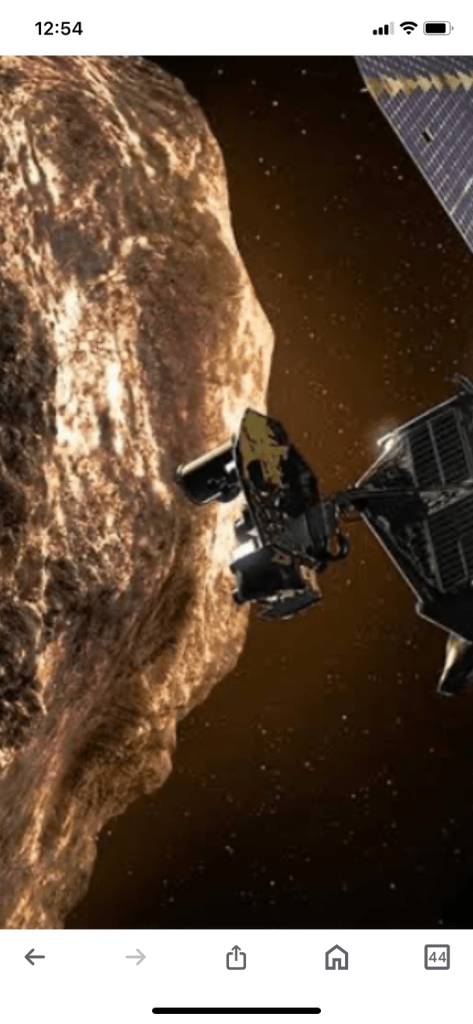
NASA’s Lucy spacecraft successfully completed its first flyby of the asteroid 152830 Dinkinesh. The asteroid is also known as “Dinky”. Dinkinesh is the first of eight asteroids that Lucy will observe during its 12-year mission.
The Lucy mission is set to visit several asteroids over 12 years. The spacecraft’s payload includes three instruments: a high-resolution visible imager, an optical and near-infrared imaging spectrometer, and a thermal infrared spectrometer.
The Lucy spacecraft has a dry mass of 821 kg and a fully fueled mass of 1550 kg. The solar arrays can produce 504 W of power at the furthest encounter distance. The total cost of the Lucy mission is $989.1 million.(source google)
The Lucy mission’s path includes:
- Dinkinesh: Lucy’s first flyby, on November 1, 2023
- Earth: Lucy will swing by Earth in December 2024 for a second gravity assist
- Main belt: Lucy will fly by another asteroid in the main belt in 2025
- Eurybates: Lucy will reach its first target, the asteroid Eurybates, in August 2027
- Trojans: Lucy will reach its first swarm of Trojans in August 2027
- Earth: Lucy will swing back to Earth in September for a third gravity assist
- Patroclus and Menoetius: Lucy will study Patroclus and Menoetius in 2033
Lucy’s primary targets are the asteroids captured from the main belt by Jupiter. These asteroids are called “Trojans” after characters from Greek mythology. Most of Lucy’s target asteroids are left over from the formation of the solar system.
Lucy’s trajectory will take it on a heliocentric orbit. It will travel almost 4 billion miles (6 billion kilometers) and make three-and-a-half giant loops around the Sun. Lucy’s average cruising speed is about 39,000 miles (62,000 kilometers) per hour.
Lucy’s trajectory was carefully designed to ensure that it will not hit Earth or contaminate any place that could have signs of life for more than 100,000 years.
Lucy’s trajectory will bring it past Earth twice — in 2022 and then 2024 — so the spacecraft can use this planet’s gravity to hurl itself toward the Trojans. Lucy’s trajectory will also help it capture images of the nearly full Earth and Moon.
The Lucy mission’s purpose is to uncover the origins of the universe. The mission is seeking cosmic fossils that could unlock the secrets of the early solar system.
The Lucy mission is designed to:
- Understand the composition of the diverse asteroids that are a part of the Trojan asteroid swarms
- Determine the mass and densities of the materials
- Look for and study the satellites and rings that may orbit the Trojan asteroids
- Take the first ever close-up images of these asteroids
The Lucy mission is the first space mission to study the Trojan asteroids. The mission takes its name from the fossilized human ancestor (called “Lucy” by her discoverers) whose skeleton provided unique insight into humanity’s evolution.
The Lucy mission is named after the fossilized skeleton of a 3.2 million-year-old human ancestor found in Ethiopia in 1974. The skeleton was named “Lucy” by the team of paleoanthropologists who discovered it. The name was chosen because the fossil revolutionized our understanding of the human species. The NASA team hopes that the robotic Lucy will do the same for the solar system’s evolution.
The hominid was named after the 1967 Beatles song “Lucy in the Sky with Diamonds”
Lucy is a NASA space probe. During its first flyby of the asteroid Dinkinesh, Lucy discovered that Dinkinesh is actually a system of two asteroids, with a small 220m-wide satellite spinning around it. Scientists at NASA were amazed at this discovery and called it “marvellous
https://819d6plobwy0k2lepl1mn0o71t.hop.clickbank.net Universe discoveries
👌👌👌😊👏Good job, my friend 👍
LikeLiked by 1 person
Thanks a lot 🙏
LikeLiked by 1 person
🙏🙏
LikeLike