
The Search for Extraterrestrial Intelligence (SETI) works best when telescopes double-check each other. SETI scientists are looking for radio transmissions that are similar to those produced by human electronics. These signals are easily distinguishable from radio waves from natural sources, such as stars or galaxies.
Interferometry is a special technique used in radio astronomy. Radio astronomers can combine data from two telescopes that are very far apart and create images that have the same resolution as if they had a single telescope as big as the distance between the two telescopes.
The Allen Telescope Array (ATA) is located at the Hat Creek Observatory in the Cascade Mountains of California. The telescope can split the recorded signals in the control room prior to final processing. Simultaneous observations are possible because for SETI, wherever the telescope is pointed, several target stars will lie within the large field of view afforded by the 6 m dishes.
Interferometry is a technique that combines the light collected by more than one telescope. This allows telescopes to act together as one bigger “virtual telescope”. The waves of light from each telescope are added together which makes them brighter. Interferometry makes it possible to see fainter objects in more detail.
A telescope array is a group of telescopes arranged so that, as a set, they function similarly to one giant telescope. This allows astronomers to gather higher quality information, generating high resolution data with great sensitivity to faint signals.
Interferometry is routinely done in radio astronomy. It has also been done with optical telescopes but it is more difficult to achieve due to synchronizing the light.
Here are some other SETI telescope locations:
- Planetary Society’s Optical SETI Telescope: Located at Oak Ridge Observatory in Harvard, Massachusetts
- University of California, Berkeley: Conducts optical SETI searches and collaborates with the NIROSETI program
- Very Large Array (VLA): Located in New Mexico, it’s the most productive radio telescope in the world
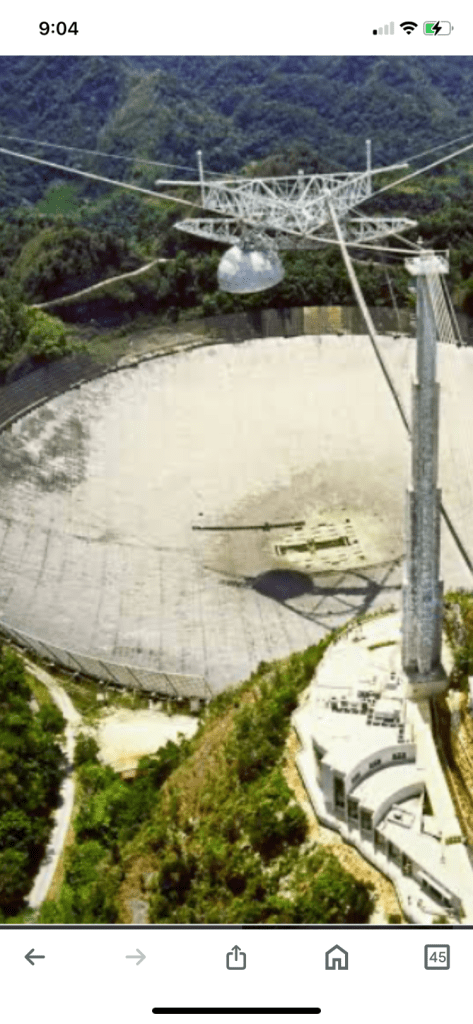
- Arecibo Observatory: Located in Puerto Rico, it has a 305-meter (1,000-foot) radio telescope
telescope array is a group of telescopes that function together as one large telescope. This allows astronomers to gather higher quality information, generating high resolution data with great sensitivity to faint signals.
Telescope arrays are much more versatile than a single large telescope. The individual telescopes of an array can be used independently, as single telescopes, to observe different objects in entirely different parts of the sky. Totally separate projects can be accommodated simultaneously.
For example, the Very Large Array (VLA) is an interferometer that operates by multiplying the data from each pair of telescopes together to form interference patterns.
Here are some other SETI antenna locations:
- Allen Telescope Array (ATA) Located at the Hat Creek Observatory in the Cascade Mountains of California, about 300 miles north of San Francisco. The ATA is surrounded by volcanic mountains that keep out interferences, such as television, radio, and distant cellular phone transmissions.
- Very Large Array (VLA) Located in New Mexico, it’s the most productive radio telescope in the world. The VLA consists of twenty-seven 25-meter telescopes that are used by astronomers to observe black holes, conduct research about the formation of the universe, and study young stars to understand how planets form.
The Very Large Array (VLA) is the most powerful radio telescope in the world. It’s located on the Plains of San Agustin near Socorro, New Mexico. The VLA is operated by the National Radio Astronomy Observatory.
The VLA is a set of 27 radio telescope dishes. The antennas can be moved apart on railroad tracks, and their combined signals give the resolving power of a synthetic aperture in diameter.
The VLA is used to produce images of the sky as seen at radio wavelengths. Both the pointing and the data collection of the antennas are controlled by computers in real time.
The VLA went into operation in 1980. The location is an important factor in the array’s effectiveness, as it offers an environment devoid of signal interference and excess humidity.
Best deals in 32 inch television on great discount on Amazon
https://819d6plobwy0k2lepl1mn0o71t.hop.clickbank.net Universe discoveries