
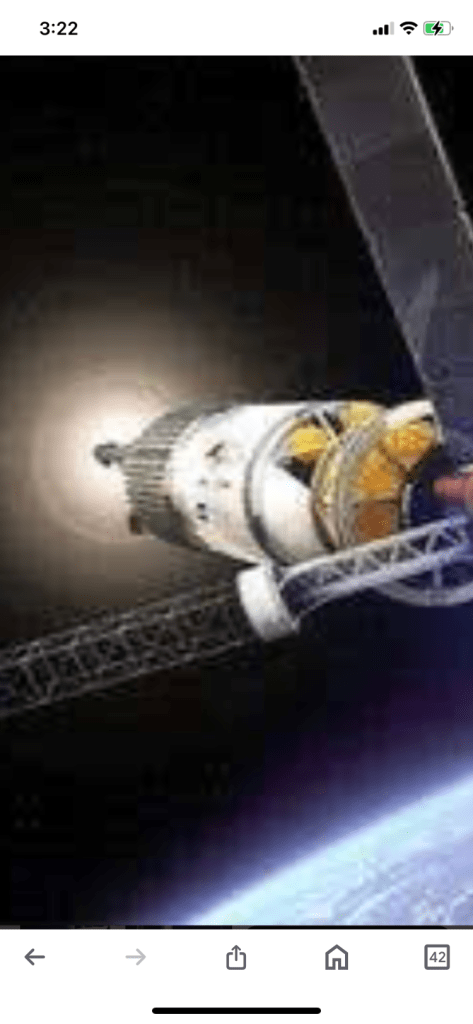
NASA and Aerojet Rocketdyne recently completed qualification testing for the Advanced Electric Propulsion System (AEPS). The AEPS is a 12-kilowatt, solar electric propulsion (SEP) engine that will be used for long-term space missions to the Moon and beyond.
The X3 ion engine is the most powerful ion engine ever made, and puts out 5.4 N of force, using 103 kW. It’s fuel is inert xenon gas, ionized and heated to a plasma.
The AEPS ion engine will be used in NASA’s mission to put the Gateway station into orbit. The characteristic blue exhaust gases are produced during AEPS operation from ionized xenon gas
NASA has used ion engines in several missions, including:
- NSTAR ion engine Developed in the late 1990s for interplanetary science missions. It was space-tested in the Deep Space 1 probe, which launched in 1998.
- Dawn spacecraft Launched in 2007, it uses three NSTAR ion thrusters to travel deep into our solar system.
- Communication satellites Ion thrusters based on a NASA design are used to keep over 100 geosynchronous Earth orbit communication satellites in their desired locations.
Ion propulsion is good for moving ships once they are in space, and it is especially good for very long journeys. However, it can’t get a ship into space.
Ion engines are not practical on Earth because their thrust is too small to overcome air resistance. Ion engines also don’t work in the presence of ions outside the engine.
Ion engines produce less thrust than their weight on Earth. This means that the downward acceleration of gravity is much larger than the upward acceleration produced by the ion engine, so it wouldn’t break free.
However, ion engines have been tested on Earth and successfully operated for more than five years continuously. An aerospace engineer at the University of Michigan says that ion thrusters can be used on Earth, but any such use would likely be in limited capacities.
Ion thrusters can propel spacecraft to speeds over 320,000 kp/h (200,000 mph), but they must be in operation for a long time to achieve that speed. The ion propulsion system on Deep Space 1 increases the speed of the spacecraft by about 4.5 kilometers per second, or about 10,000 miles per hour.
The NEXT engine is a type of electric propulsion in which thruster systems use electricity to accelerate the xenon propellant to speeds of up to 90,000mph (145,000km/h or 40 km/s). NEXT can produce 6.9 kW thruster power and 236 mNthrust.
Ion thrusters in operation typically consume 1–7 kW of power, have exhaust velocities around 20–50 km/s (Isp 2000–5000 s), and possess thrusts of 25–250 mN and a propulsive efficiency 65–80%.
Ion engines don’t use fuel in the traditional sense.Instead, they use electrical energy to ionize and accelerate a reaction mass, which is a gas. The electrical power level and xenon fuel feed can be adjusted to throttle each engine up or down in thrust.
Xenon is commonly used as propellant in ion thrusters because it is easy to ionize, has a reasonably high atomic number, is inert, and causes low erosion. However, xenon is globally in short supply and expensive. In 2021, it cost approximately $3,000 per kg.
Other chemically inert gasses are also acceptable. For example, scientists have tested ion thrusters powered by iodine.
Best computers and laptops on heavy discount on Amazon
https://819d6plobwy0k2lepl1mn0o71t.hop.clickbank.net Universe discoveries
excellent technical explanation, Satyam.
LikeLiked by 1 person
Thanks 🙏 freinds
LikeLiked by 1 person
Very nice article 🙏🌿
LikeLiked by 1 person
Thanks a lot freinds
LikeLiked by 1 person