
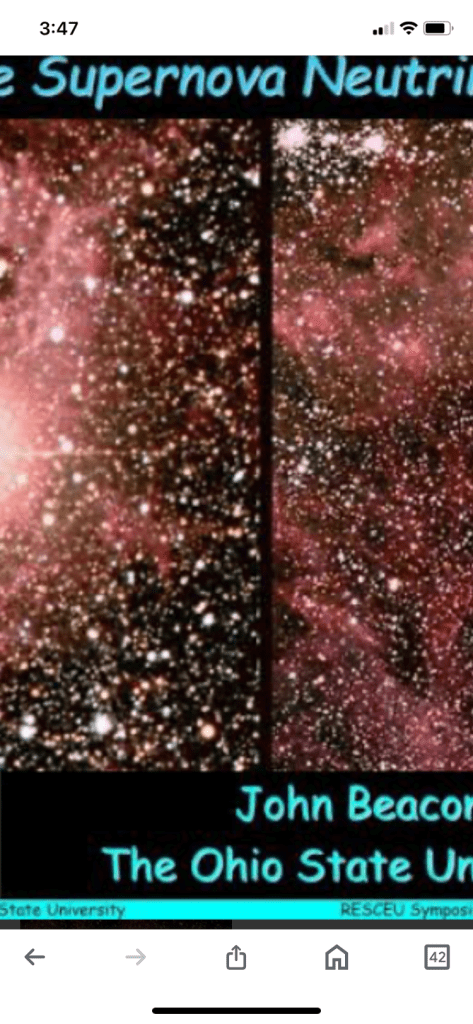
The diffuse supernova neutrino background (DSNB) is a continuous source of neutrinos from all core-collapse supernovae in the universe’s history. The DSNB is the flux of neutrinos reaching Earth from all core-collapse supernovae.
Astronomers think there is likely a background of neutrinos across the cosmos. They may be able to map the historical distribution of supernova explosions by 2035.
When massive stars die as supernovae, they send a burst of neutrinos across the universe. On average, a single collapse happens every second in the observable universe and produces 10^{58} neutrinos.
The observation of supernova neutrinos in February 1987 experimentally verified the theoretical relationship between neutrinos and supernovae. The Nobel Prize-winning event, known as SN 1987A, was the collapse of a blue supergiant star in the Large Magellanic Cloud outside our Galaxy.
This intriguing concept is being explored with a number of existing and upcoming instruments in particular the Jiangmen Underground Neutrino Observatory (JUNO) which will start collecting data in 2023 and the neutrino detector ‘Super Kwmiokande’ in Japan which has been collecting data over the last 8 years
Neutrinos play a key role in the collapse and explosion of massive stars. They:
- Govern the infall dynamics of the stellar core
- Trigger and fuel the explosion
- Drive the cooling and deleptonization of the newly formed neutron star
- Carry away an estimated 99 percent of the supernova’s total radiated energy
- Enable us to study the central engine of core-collapse supernovae
- Relay information on the structure, dynamics, and nuclear physics
Neutrinos are produced in enormous numbers inside the core during a supernova. They barely interact with matter, so most of them fly right through the star’s layers and reach Earth before any other signs of the event.
The absorption of electron neutrinos and antineutrinos in the surroundings of the newly formed neutron star can power the supernova explosion. The neutrino-driven supernova model predicts that trapped neutrinos will generate plumes of high-entropy material, leading to bubbles in supernova remnants rich in metals such as titanium and chromium.
Neutrino detectors are important for studying supernovae because they can provide information about:
- Total energy produced Physicists can calculate the total energy produced by a supernova and estimate how much of it was emitted as neutrinos.
- Explosion mechanism The flavor composition, energy spectrum, and time structure of the neutrino burst can provide information about the explosion mechanism.
- Proto neutron star cooling The mechanisms of proto neutron star cooling can be studied.
- Neutrino-neutrino interactions Neutrinos undergoing collective flavor conversions in a supernova’s dense interior offer opportunities to study neutrino-neutrino interactions.
- Distant supernova explosions Astronomers can get a more detailed understanding of very distant supernova explosions by searching for high-energy neutrinos.
Neutrinos can be captured in huge underground neutrino detectors before the supernova’s light shows up.
Yes, neutrinos from a supernova can be detected on Earth.
Why neutrinos reach Earth before light
- Neutrinos are weakly interacting: Neutrinos can slip out of the supernova envelope hours before light particles, which ride the explosion’s shockwave, are ejected.
- Neutrinos are slower: Neutrinos are significantly slower than light because of their mass.
How neutrinos are detected
- Neutrinos are captured in underground detectors Neutrinos can be captured in huge underground neutrino detectors, before the supernova’s light shows up.
- Neutrinos are detected by neutrino detectors There are various neutrino detectors across the world, including IceCube in Antarctica.
- Neutrinos are detected by solar-neutrino detectors The two most common types of solar-neutrino detectors are the water Cherenkov detector and the liquid scintillator detector.
Yes, neutrinos can escape supernova explosions:
- Neutrinos can escape the star within a few tens of seconds
- Neutrinos can escape from the center even more quickly than light does
- Electron neutrinos can escape freely only at the beginning of stellar core collapse
Neutrinos are produced in enormous numbers inside the core during a supernova. They barely interact with matter, so most of them fly right through the star’s layers and reach Earth before any other signs of the event.
Neutrinos are predicted to be responsible for the supernova explosion:
- Neutrino heating is predicted to energize the supernova shock wave and drive it outward
- The neutrino-driven supernova model predicts that trapped neutrinos will generate plumes of high-entropy material
- Neutrino heating is predicted to be responsible for the supernova explosion
 Universe discoveries