
The High Energy L1 Orbiting X-ray Spectrometer (HEL1OS) payload on board the Aditya-L1 spacecraft captured the first high-energy X-ray glimpse of solar flares during its first observation period on October 29, 2023. The impulsive phase of solar flares was recorded.
A solar flare is a sudden brightening of the solar atmosphere.
The HEL1OS light curve also shows evidence of a few impulsive events which are weak in the GOES light curve. Detailed analysis of HEL1OS data will be able to tell whether or not any interesting evidence of electron acceleration is present in these weak GOES events.
The 1,500 kg (3,300 lb) Aditya-L1 satellite carries seven science payloads with various objectives, including:
- Instruments to measure coronal heating
- Solar wind acceleration
- Coronal magnetometry
- Origin and monitoring of near-UV solar radiation
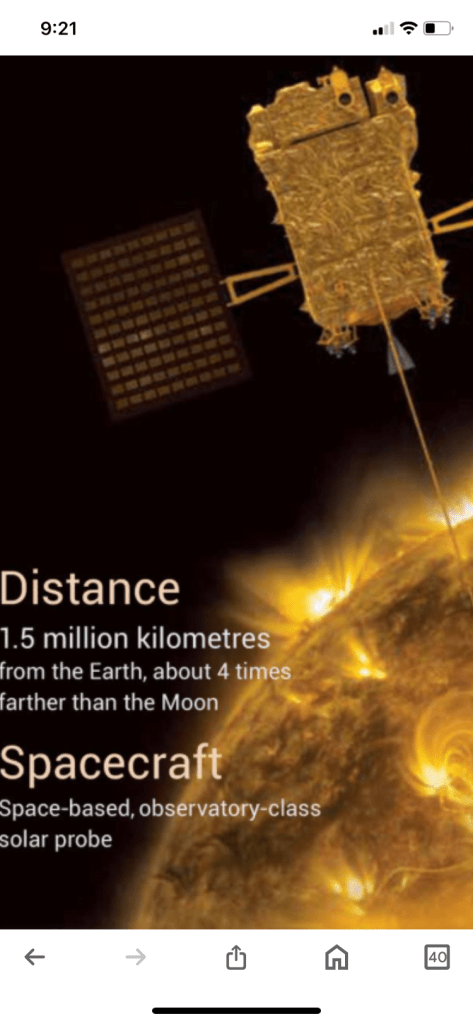
Aditya-L1 will stay approximately 1.5 million km away from Earth, directed towards the Sun, which is about 1% of the Earth-Sun distance.
The Indian Space Research Organisation (ISRO) on Tuesday said the HEL1OS payload has captured the first high-energy X-ray glimpse of solar flares.. “During its first observation period on October 29, the High Energy L1 Orbiting X-ray Spectrometer (HEL1OS) on board Aditya-L1 recorded the impulsive phase of solar flares.
The seven payloads of Aditya-L1 are:
- Visible Emission Line Coronagraph (VELC): Studies the solar corona from the lowermost part upwards
- Solar Ultraviolet Imaging Telescope (SUIT): Captures the UV image of the solar photosphere and chromosphere
- Solar Low Energy X-ray Spectrometer (SoLEXS): Soft X-ray spectrometer for Sun-as-a-star observation
- High Energy L1 Orbiting X-ray Spectrometer (HEL1OS): Hard X-ray spectrometer for Sun-as-a-star observation
- Aditya Solar wind Particle EXperiment (ASPEX):
- Plasma Analyser Package for Aditya (PAPA):
- Magnetometer (MAG):
All seven payloads were developed indigenously, five by ISRO and two by Indian academic institutes in collaboration with ISRO. The payloads are expected to provide crucial information to understand the Sun, and how its radiation work, heat, flow of particles, and magnetic fields affect us.
The Aditya-L1 mission is significant because it is India’s first space-based mission to study the Sun. The mission’s objectives include:
- Studying the Sun’s corona, photosphere, chromosphere, and solar wind
- Understanding the Sun’s behavior, including its radiation, heat, particle flow, and magnetic fields, and how they impact Earth
- Studying the dynamics of the Sun’s chromosphere and corona
- Studying chromospheric and coronal heating
- Studying the physics of partially ionized plasma
- Studying coronal mass ejections (CMEs) and their origins
- Studying the coronal magnetic field and heat transfer mechanisms
- Studying flare exchanges
- Studying the origin and acceleration mechanisms of solar wind particles and how they interact with the interplanetary medium
- Diagnosing the temperature, velocity, and density of corona and coronal loops plasma The mission is important for protecting satellites and infrastructure in space. It will also provide critical data for understanding the Sun’s influence on Earth’s climate and space environment.
Aditya-L1 is a solar observatory operated by the Indian Space Research Organisation (ISRO). The name Aditya comes from Sanskrit and means “sun”. L1 refers to Lagrange Point 1 of the Sun-Earth system.
Aditya-L1 is India’s first solar observatory-class mission. It will study the Sun’s outer atmosphere from a distance of about 1.5 million km. The satellite is placed in a halo orbit around the L1 point, which allows it to continuously view the sun without any occultation or eclipse.
Aditya-L1 has a mission life of five years. Its payloads are expected to provide crucial information on:
- Coronal heating
- Coronal mass ejection
- Pre-flare and flare activities
- Dynamics of space weather
- Propagation of particles and fields
The satellite has seven payloads, four of which carry out remote sensing of the Sun and three of which carry in-situ observation.
Best pet supplies on heavy discount on Amazon
https://6de4bnle441v6v8robtju3v27p.hop.clickbank.net Universe discoveries