
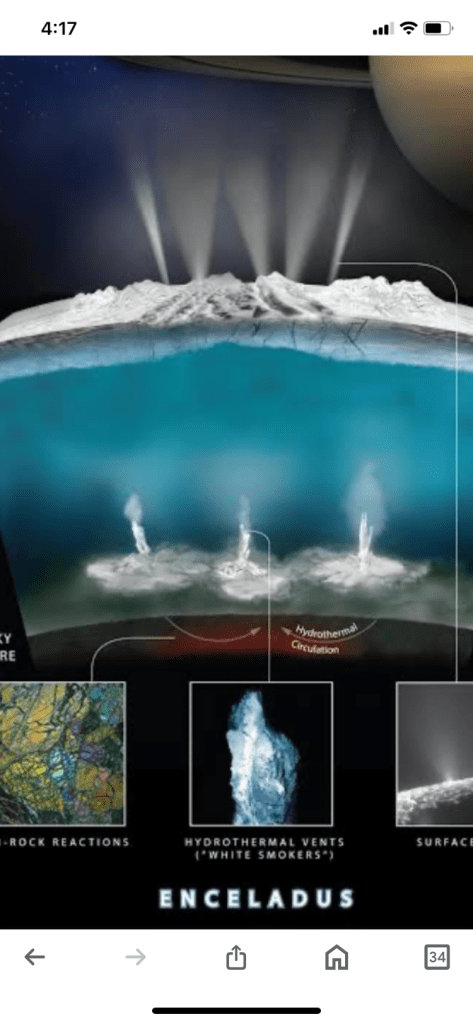
Yes, Enceladus, one of Saturn’s moons, has all the raw materials for life:
- Liquid water
- Source of energy
- Chemical ingredients
The chemical ingredients are known as CHNOPS, which stands for carbon, hydrogen, nitrogen, oxygen, phosphorus, and sulfur. Researchers found evidence of all six elements on Enceladus.
Enceladus is one of the likeliest candidates for life beyond Earth in the solar system.
Other evidence that suggests life is present on Enceladus includes:
- Plumes The plumes of ice grains and water vapor that erupt into space from cracks in the icy surface of Enceladus contain almost all the basic requirements of life as we know it.
- Ice grains The ice grains contain a rich array of minerals and organic compounds, including the ingredients for amino acids.
- Hydrothermal vents The global, salty ocean and hydrothermal vents on the seafloor point to the possibility of a habitable ocean world.
- Carbon dioxide and methane The data reflected generous amounts of carbon dioxide and methane (CH4), both of which told us that methane-based life forms or methanogens could exist around hydrothermal vents on Enceladus.
Other evidence that suggests Enceladus might be habitable includes:
- Alkaline ocean Enceladus’ ocean is moderately alkaline with a pH between 7.95 and 9.05.
- Hydrothermal vents The hydrothermal vents are fissures in the rocky core of Enceladus. The jets of hot water carry minerals and nutrients that could support life.
- Phosphorus Scientists have discovered high levels of phosphorus in the ocean spray of Enceladus. This is the first time that this essential ingredient for life has ever been detected in extraterrestrial seawater.
- Heat The Cassini spacecraft returned data that suggest that the subsurface ocean on Enceladus may be in contact with rock and that there is a significant amount of heat present associated with the plume activity.
While Enceladus has all the ingredients for life, life has not been found on the moon. The surface temperature of Enceladus is too cold for survival, so any life would be aquatic and located under the thick ice crest.
However, if life is found on Enceladus, it would suggest that life is probably common throughout the cosmos. If life has not evolved there, it would suggest life is probably more complicated or unlikely than we have thought.
Yes, Enceladus has oxygen. Scientists have found oxygen on Enceladus along with carbon, hydrogen, nitrogen, and sulfur. Enceladus also has a significant atmosphere made up mostly of water vapor.
However, there is no available oxygen to work with on Enceladus. Organisms would have to contend with a tremendous amount of pressure to derive energy from the chemical reaction between Enceladus’ subsurface ocean and its rocky core.
According to Morgan Cable, a research scientist at NASA’s Jet Propulsion Laboratory, any life on Enceladus could resemble the creatures that thrive around Earth’s hydrothermal vents. These creatures feed off hydrogen and carbon dioxide.
NASA believes Enceladus can support life because it has:
- Liquid water
- Source of energy
- Chemical ingredients
Enceladus has a source of energy from friction created by its orbit around Saturn. It also has organic compounds that are building blocks for life. The moon’s ocean contains canonical building blocks of life, including organic and inorganic carbon, ammonia, and possibly hydrogen sulfide.
Enceladus also likely has hydrothermal vents releasing hot, mineral-rich water into its ocean. This activity creates water with temperatures of at least 90 degrees Celsius (194 degrees Fahrenheit)
Yes, NASA is planning a mission to Enceladus:
- Enceladus Orbilander: A proposed NASA Flagship mission that would orbit Enceladus for a year and a half, sample its water plumes, and then land on the surface for two years. If selected by NASA, it could launch in 2038 and arrive at Enceladus in 2050.
- Breakthrough Enceladus A privately funded astrobiology mission by Breakthrough Initiatives. NASA will provide expert reviewers and feedback on the design.
- Explorer of Enceladus and Titan (E2T) A space mission concept by the European Space Agency in collaboration with NASA.
- Enceladus Explorer (EnEx) A planned interplanetary orbiter and lander mission with a subsurface ice melting probe.
NASA lists a mission to Enceladus as one of its highest priorities for the coming decades.
The Enceladus Orbilander mission’s goal is to search for life on Enceladus. The mission would orbit Enceladus for 1.5 years, sampling its water plumes, and then land on the surface for 2 years. The spacecraft would carry 13 instruments to probe for signs of life in the plume and on the surface. The instruments would also investigate the geological context in which those signs exist.
The mission would also:
- Access oceanic material from orbit and from the moon’s surface
- Sample Enceladus’s plumes twice per day for 200 days
- Determine the detailed habitability of the ocean by quantifying the geochemistry and understanding the geophysical processes
The Enceladus Orbilander mission concept demonstrates that scientifically compelling but resource-conscious Flagship-class missions can be executed in the next decade to search for life at Enceladus.
The mission’s instruments include:
- Mass spectrometers to weigh and analyze molecules
- A seismometer
- A microscope
- A DNA sequencer
- Cameras
- Radar sounders
- A laser altimeter
The mission’s instruments would probe for signs of life in the plume and on the surface, as well as investigate the geological context in which those signs exist.
Budget buy on men and women apparel’s
https://3feccqnl5z1tgrhdnsqd4o3c0w.hop.clickbank.net/?cbpage=dtc Universe discoveries