
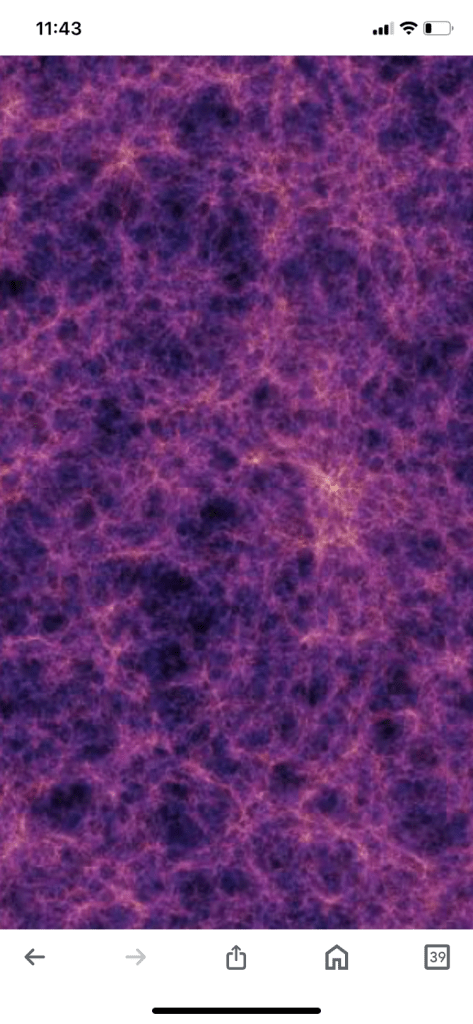
Slime mold, or Physarum polycephalum, is a single-cell organism that builds complex filamentary networks in search of food. The creeping tendrils of slime seem to mirror the structure of the universe’s enormous filaments. This superficial similarity helped scientists map out the cosmic web, the vast threads of matter that connect galaxies.m
Researchers seeded an algorithm inspired by the food-seeking behavior of slime mold with the positions of about 37,000 galaxies, where the galaxies served as the “food”. This helped them model and create a 3D map of the cosmic web connecting these galaxies.
Slime molds are not known to be a danger to human or animals. They play an important role as decomposers and recyclers of nutrients in the food web. Their diet consists of the bacteria which feed on decomposing plant matter. In turn, slime molds may be consumed by nematodes, beetles, and other larger life forms
Slime molds clearly have something to teach us about the Universe we inhabit. The deeper results of this study show that star formation was at similar levels both close to and distant from MCPM filaments in early epochs of z~2.
Slime molds have been used as model organisms for studying cell biology, including motility, cell cycle, differentiation, and more. Slime molds are also being studied for their cognition, which includes sensing, communication, navigation, decision-making, memory, and learning. Some scientists suggest that slime mold behavior may shed light on the origins of intelligence.
Slime molds are also being studied for their ability to:
- Chemotaxis: Move towards or away from different chemicals they sense in their environment
- Learning: Use information from previous experiences to adjust their behavior
- Mitosis: The process of nuclear division
Slime molds are considered intelligent because they can solve complex problems without a brain or neurons. For example, they can find the shortest path through a maze, remember where they’ve been, and solve math problems. Slime molds can also keep time, anticipate, and decide.
Scientists are mystified about how slime molds’ memory works. They encourage us to consider natural forms of intelligence that exist outside the human mind. Slime molds represent an alternative to convoluted brain-based intelligence.
Slime molds are good model organisms because they are simple and easy to manipulate. For example, the cellular slime mold Dictyostelium discoideum is a commonly studied species. It has a simple life cycle and is easy to use.
Slime molds are also good models for studying mitosis, the process of nuclear division. In plasmodial slime molds, millions of nuclei in a single plasmodium divide at the same time.
Slime molds also have similarities with the network of synaptic connections in animal brains. Their topology derives from a network of interconnected, vein-like tubes in which signaling molecules are transported.
Slime molds don’t think in the traditional sense, but they do solve optimization problems. They use their extended hydrodynamic transport network to make decisions.
Slime molds use tubes in their cell plasma to sense stimuli in their environment, such as chemicals, light, and humidity. They then act accordingly, choosing conditions or food that maximize their survival. For example, when placed in a maze with food at one end, Physarum can branch into every nook and cranny to solve the maze. Once it finds the food, the branches that didn’t locate food retract, leaving behind a trail of slime. This slime serves as a signal telling the mold not to go in that direction in the future.
Slime molds also possess a unique, coupled-oscillator based sensorimotor system that may be the key to their highly developed problem-solving abilities.
Here are some more interesting facts about slime molds:
- Physarum polycephalum: This species of slime mold can merge with other individuals to form a cell that can reach a meter in length. It can also morph into many shapes and sizes, including a microscopic amoeba, a multinucleate syncytium, and millimeter-scale fruiting bodies.
- Predatory heterotroph Physarum is a predatory heterotroph that captures other living organisms, primarily bacteria, by phagocytosis. It’s also a saprophyte that feeds on dead organic material.
- Spore formation During unfavorable conditions, slime molds form spores that have true cell walls and are extremely resistant to adverse conditions.
- Life cycle Myxomycetes have an interesting life cycle that includes a wet spore phase and a dry spore phase. When conditions are favorable, they move about like amoebae. When conditions are not favorable, they form a resting body (sclerotium) with dry, airborne spores.
- Helpful Slime molds are not toxic, poisonous, or venomous, and they help build up sandy soils by returning nutrients to the soil.
The food-seeking behavior of a simple organism is helping astronomers trace the universe’s vast cosmic web, dark matter and all.
Astronomers at the University of California, Santa Cruz used slime mold to help map the universe’s dark matter. The researchers used an algorithm inspired by the food-seeking behavior of slime mold. The algorithm was seeded with the positions of about 37,000 galaxies, which served as the “food”. This helped them model and create a 3D map of the cosmic web connecting these galaxies.
Slime mold, or Physarum polycephalum, is a single-cell organism that builds complex filamentary networks in search of food. The intricate patterns of this yellow slime mold can help tease out the structure of the vast strings of matter that connect galaxies in the universe’s cosmic web.
The researchers also analyzed the light from 350 faraway quasars catalogued in the Hubble Spectroscopic Legacy Archive. These distant cosmic flashlights are the brilliant black-hole-powered cores of active galaxies, whose light shines across space and through the foreground cosmic web
https://6e44dmgl9x1ud0litn-j-6fy0n.hop.clickbank.net
 Universe discoveries