
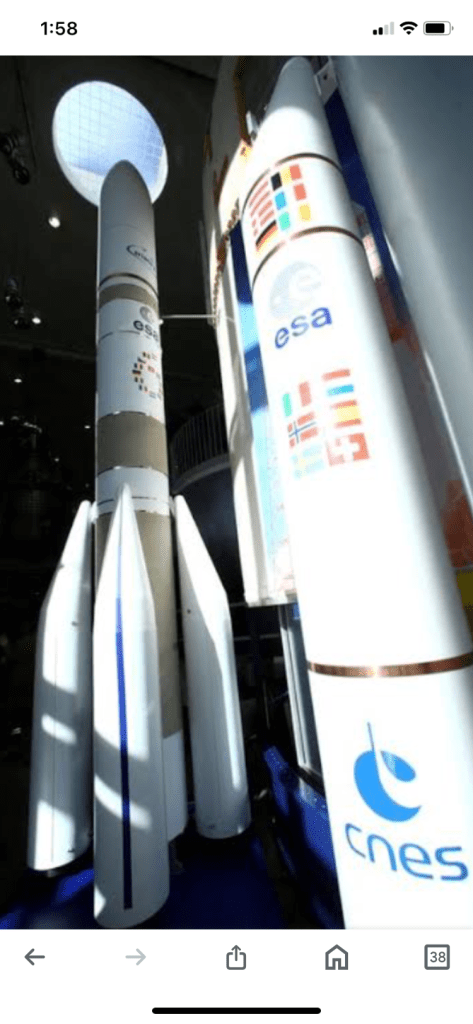
The European Space Agency (ESA) wants a private cargo spacecraft by 2028. The ESA is an international organization with 22 member states. Its mission is to develop Europe’s space capability and ensure that investment in space continues to deliver benefits to the citizens of Europe and the world.
The ESA is looking to change the way it approaches space exploration and foster a commercial cargo return capability. The ESA has proposed “a competition between innovative European companies” to develop a ship that would transport cargo to the ISS by 2028.
Private spaceflight refers to spaceflight developments that are not conducted by a government agency, such as NASA or ESA.
Private space exploration is spaceflight development that is not conducted by a government agency. The private sector has become increasingly involved in space exploration. Companies like Virgin Galactic, SpaceX, and Blue Origin are taking people to space in their own private spacecrafts. NASA is also increasingly partnering with private companies to accomplish its missions.
The first privately owned and operated rocket to reach space was Conestoga I, which was launched from Matagorda Island on September 9, 1982. In May of 2020, SpaceX made history as the first private company to send humans into space.
Some say that private space exploration can be seen as a net ethical process, as long as government action is in place to oversee and balance the potential shortcomings of the private sector’s risky and capitalistic nature.
NASA has several reasons for using private companies:
- Saving public money: Private companies are willing to invest their own capital alongside the government.
- Taking more risk: Private companies can take more risk than government-run programs.
- Using more advanced techniques: Private companies can use more advanced program management techniques than government-run programs.
- Allowing NASA to think bigger: Private industry has taken over the “easy” parts of space operations, allowing NASA to pursue Moon and Mars missions.
- Opening space to more people: NASA wants to open space to more people, and supports private missions.
In 2019, NASA kicked off a strategy to enable a vibrant low Earth orbit economy. This included offering flight opportunities for commercial providers to utilize the International Space Station (ISS) as a destination for private astronaut missions
Here are some private companies that work with the European Space Agency (ESA):
NewSpace Capital A global private equity firm that joined the ESA’s Investor Network
Airbus A public-private partnership with ESA for EDRS, which forms the “SpaceDataHighway” for Europe
- Arianespace Manufactures space launch vehicles, established by 23 European partners and ESA
SpaceX Based in California, has become NASA’s primary supplier for space transportation services
Other partners of ESA include:
Eurostar Neo, Belgium, Sweden, Switzerland, United Kingdom, EHP, ETCA, APR Technologies, RUAG
The European Space Agency (ESA) has 22 member states:
Austria, Belgium, Czech Republic, Denmark, Estonia, Finland, France, Germany, Greece, Hungary, Ireland, Italy, Luxembourg, The Netherlands, Norway, Poland, Portugal, Romania, Spain, Sweden, Switzerland, United Kingdom.
Latvia, Lithuania, and Slovenia are associate members. Four other EU states have cooperation agreements with ESA: Bulgaria, Croatia, Cyprus, and Malta.
The ESA was founded in 1975 with the ESA Convention, when ESRO was merged with ELDO. The founding member states were:
Belgium, Germany, Denmark, France, United Kingdom, Italy, Netherlands, Sweden, Switzerland, Spain.
The ESA’s head office is in Paris, France, and it has independent sites in many European countries, including:
France, Germany, Spain, Netherlands, Italy, United Kingdom, Austria, Belgium.
The ESA is headed by a Director General who is elected by the Council every four years. The current Director General is Josef Aschbacher.
The European Space Agency (ESA) recruits people at various stages of their career. Most ESA staff positions are in engineering and scientific disciplines. The ESA welcomes applications from all qualified candidates, regardless of gender, sexual orientation, ethnicity, beliefs, age, or disability.
To work at ESA, you must be a citizen of one of the following ESA Member States:
Austria, Belgium, Czechia, Denmark, Estonia, Finland, France, Germany, Greece, Hungary, Ireland, Italy, Luxembourg, The Netherlands, Norway, Poland, Portugal, Romania, Spain, Sweden, Switzerland, United Kingdom.
For example, to become an ESA astronaut, you must meet the following minimum formal criteria:
- Be a citizen of an ESA member (or associate member) state
- Be under the age of 50
- Be between 150 and 190 cm tall
- Have a “normal weight” BMI range
- Be fluent in English and another language
- Have a minimum of a master’s degree in natural sciences, medicine, engineering, mathematics, or computer sciences(source google)
Best handbags on discount on Amazon
https://685b7pqhd0q-g1dftiyfygx0ib.hop.clickbank.net Universe discoveries
amazing
LikeLiked by 2 people
Thanks a lot
LikeLike
Nice article 🌿
LikeLike