
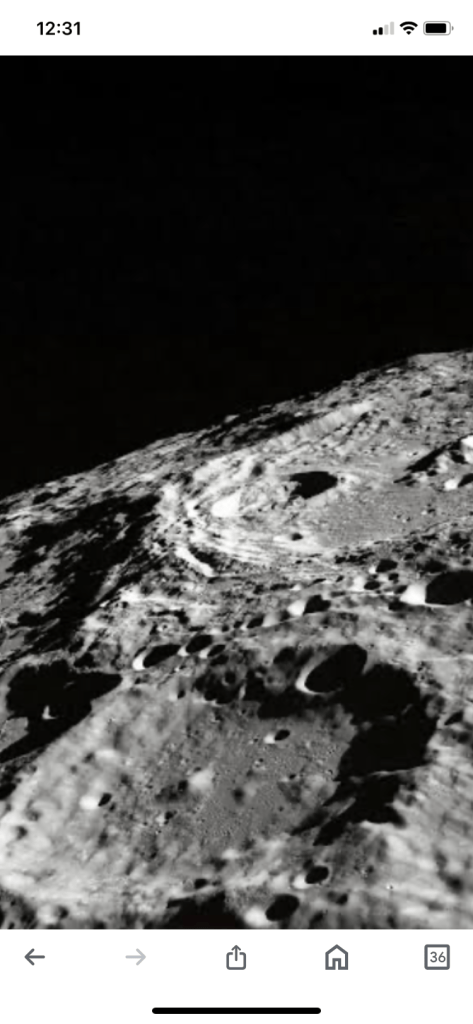
By discovering two interstellar objects (ISOs), we know that asteroids and comets from other star systems pass through the Solar System from time to time. By inference, some of these must have crashed into the Moon, creating impact craters.
Yes, some of the moon’s craters are from interstellar impacts.
The moon’s craters are holes on the surface of the moon caused by the impact of meteoroids, asteroids, and comets. The moon is an easy target for these space rocks because it has no atmosphere to protect it.
The impact was so powerful that it pulverized the ground, creating what we call regolith, and sprayed it out to form those ejecta rays.
The International Astronomical Union currently recognizes 9,137 craters, of which 1,675 have been dated.
A new paper suggests that young, small craters with high-melt volume near the Moon’s equator are likely the best candidates for ISO-generated craters on the lunar surface.
There are many reasons why the Moon has more impact craters than Earth, including:
- Weathering and erosion: Earth’s surface is constantly changing due to weathering and erosion from wind, water, and lava.
- Tectonic activity: Earth’s surface has been recycled many times by tectonic activity.
- Atmosphere: Earth’s atmosphere causes small to medium meteors to burn up or disintegrate before hitting the ground.
- Water: Earth has liquid water, which can erode the surface.
- Volcanism and seismicity: Earth’s dynamic planet has volcanoes and earthquakes that can erase impact craters.
The Moon has no atmosphere, water, or tectonic activity, so its surface has changed very little over time. The Moon has not had tectonic activity for billions of years, which has given craters more time to form and stay.
Impact craters are usually 10 to 30 times larger than the impactor because when a high-speed object strikes another object, it generates a shock wave that expands in all directions. This is similar to the behavior of an explosion. The resulting mark is typically 10-30 times larger than the object that caused it.
Impact craters are almost always round because the impact shock wave travels outward equally in all directions regardless of the impact angle. The circular shape is due to material flying out in all directions as a result of the explosion upon impact, not a result of the impactor having a circular shape.
The largest impact crater on Earth is the Vredefort crater in South Africa, which is over 300 kilometers wide. It was formed about 2 billion years ago.
Best shoes for men and women On heavy discount on Amazon
https://bf700icdd9t37zjg-e1kwcke4d.hop.clickbank.net Universe discoveries