
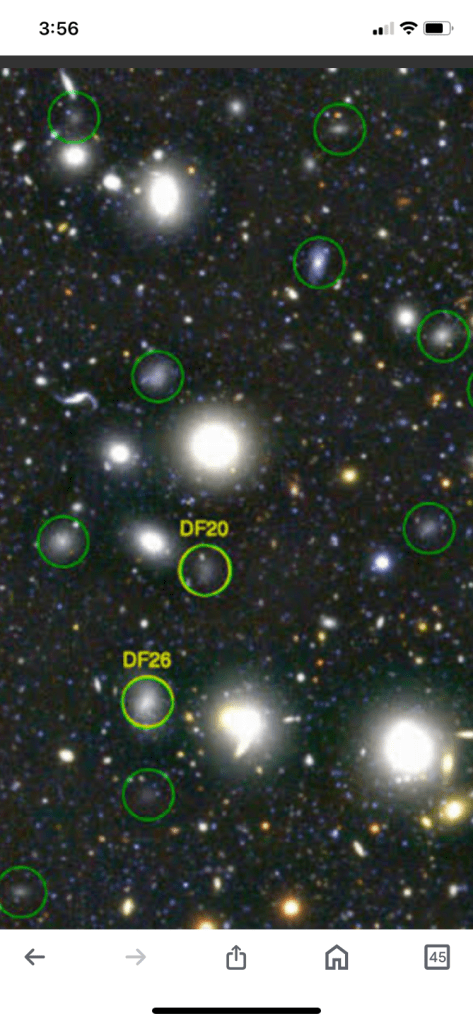
They are almost like globular clusters but on steroids! The problem with them is that there is no evidence that supports why they exist! The dominant theory is that they are the nucleus of dwarf galaxies that remain after the outer layers have been stripped away.
Astronomers using the Gemini North Telescope recently solved a long-standing mystery about how ultra-compact dwarf galaxies (UCDs) are formed. The dominant theory is that UCDs are the nucleus of dwarf galaxies that remain after the outer layers have been stripped away. However, until now, there have been no concrete observations confirming this process.
A dwarf galaxy is a small galaxy composed of about 1,000 up to several billion stars, as compared to the Milky Way’s 200–400 billion stars. They are elliptical in shape, contain very little or no gas, and have no evidence of recent star formation.
The largest UDGs have sizes similar to the Milky Way, but have only about 1% as many stars as our home galaxy. The mystery of UDGs is still baffling scientists as they try to explain why these faint but large galaxies are not ripped apart by the tidal field of their host clusters.
Here are some recent discoveries of dwarf galaxies:
- Donatiello II Italian amateur astronomer Giuseppe Donatiello discovered this dwarf galaxy. It is one of six dwarf galaxies discovered by Donatiello.
- Three ultra-faint dwarf galaxies (UFDs) A team of researchers led by Burçin Mutlu-Pakdil, an assistant professor of physics and astronomy at Dartmouth College, identified these galaxies. They are among the faintest galaxies discovered outside of the Local Group.
- A new ultra-faint dwarf galaxy A group of astronomers led by William Cerny of the University of Chicago, Illinois, found this galaxy. It is a satellite of the Milky Way galaxy.
- The GLASS-z13 galaxy The James Webb Space Telescope discovered this galaxy, which was formed just 300 million years after the Big Bang.
- JADES-GS+53.15508-27.80178 An international team of astronomers discovered this new quiescent galaxy using the James Webb Space Telescope. It was found at a high redshift and has a relatively low mass.
Ultra-faint dwarf galaxies (UFDs) are the faintest galaxies in the universe. They contain a few hundred to one hundred thousand stars. UFDs are among the oldest and most metal-poor galaxies in the cosmos, and they contain no gas and a high dark matter mass fraction.
UFDs are the least luminous, most dark matter dominated, and least chemically evolved galaxies known. They are perceived by astronomers as the best candidate fossils from the universe at its early stages.
UFDs are unique by being super faint and small. They could be the key to looking into the past to the early universe and finding the first generation of stars formed after the Big Bang.
Here are some reasons why we can’t see many dwarf galaxies:
- Dark matter Many dwarf galaxies have a lot of dark matter and very few stars, making them faint and difficult to detect. For example, six dwarf satellites orbiting the Milky Way were recently discovered to be made of 99% dark matter and only 1% stars.
- Diffuse Dwarf galaxies are diffuse and difficult to detect, though most have been found tucked within clusters of larger, brighter galaxies.
- Distance As a galaxy’s distance from Earth increases, its light is spread over a greater area before reaching us, and is therefore dimmer.
- Gravitational effects Dwarf galaxies are small, faint galaxies that can usually be found in galaxy clusters or near larger galaxies. Because of this, they might be affected by the gravitational effects of their larger companions.
- Halos Some galaxies might be “missing” because many of these halos were too small to attract enough matter to make stars.
Dwarf galaxies have more dark matter than larger galaxies for several reasons, including:
- Gravitational force: Dark matter’s gravitational force holds dwarf galaxy clusters together.
- Less debris: Dwarf galaxies are older and have less debris like gas and dust, making them unobstructed hunting grounds for dark matter.
- Less mass: The less mass there is overall, the greater the dark matter fraction.
- Gravitational potential fluctuations: Gravitational potential fluctuations driven by bursty star formation can “heat up” dark matter at the centers of dwarf galaxies.
- Weaker gravitational fields: Dwarf galaxies have weaker gravitational fields, making it easier for matter to escape.
The universe appears to have about five times more dark matter than regular matter.
The dwarf galaxy problem, also known as the missing satellites problem, is a mismatch between the number of observed dwarf galaxies and the number predicted by computer simulations. The problem is that we observe far fewer dwarf galaxies than we expect based on computer simulations of the universe.
The “missing satellites problem” (MSP) is the discrepancy between the number of satellite galaxies seen when a Milky-Way type galaxy is simulated, and the dwarf galaxies observed around our own Milky Way.
The problem has remained unresolved for more than 20 years. Erik Tollerud, an astronomer at the Space Telescope Science Institute, and his colleagues estimated that there might be as many as a thousand invisible dwarf galaxies.
https://93e03qgia0ux72gf4hu66gnl6i.hop.clickbank.net Universe discoveries