
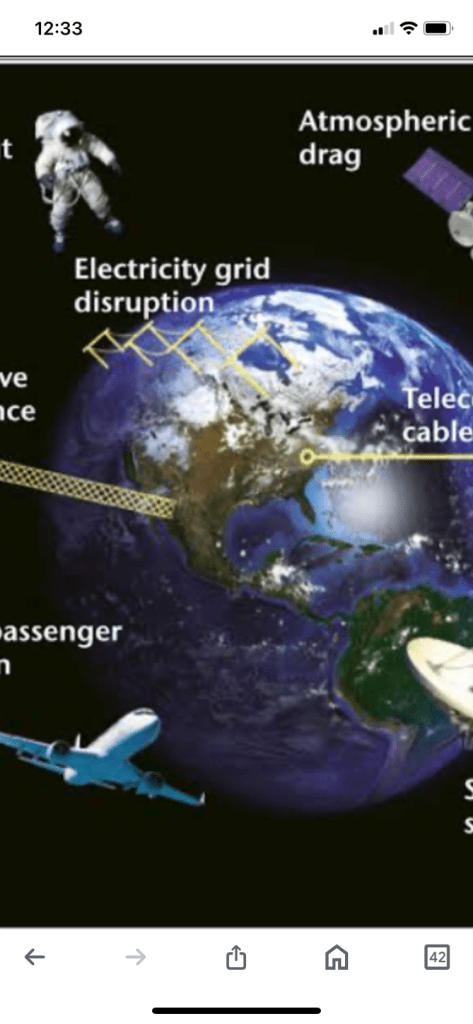
Earth’s past and future habitability depends on how space weather interacts with our magnetosphere. Space weather is the variable conditions on the sun and in space that can influence the performance of technology we use on Earth.
Earth’s magnetosphere, ionosphere, and atmosphere protect us from the most hazardous effects of space weather. For example, when a coronal mass ejection (CME) arrives at Earth, it can produce a geomagnetic storm, which can cause disruptions to modern conveniences. Space weather can also produce electromagnetic fields that induce extreme currents in wires, disrupting power lines, and even causing widespread power outages.
The Sun’s solar wind (SW) and interplanetary magnetic field (IMF) combine to create space weather. As the solar wind flows past Earth, it mostly deflects around Earth’s magnetosphere, the protective magnetic field that surrounds our planet.
The research shows how space weather and the Earth’s magnetic field strength have both changed over time and contributed to habitability or made habitability more difficult. It shows, in particular, that when Earth is in a multipole configuration, prior to pole reversal, we’re more susceptible to space weather
Space weather can impact Earth in many ways, including:
- Power grids Space weather can cause extreme currents in the electric grid, leading to widespread blackouts
- Communication Space weather can disrupt radio signals and navigation systems, and create problems with Global Navigation Satellite Systems (such as Global Positioning Systems or GPS)
- Satellites Severe space weather can damage satellites used for global positioning, communications, and weather forecasting
- Auroras Solar storms can create intense currents in Earth’s magnetosphere and cause the ionosphere and upper thermosphere to heat up, resulting in auroras
- Aviation Space weather can impact aviation operations, including degradation or loss of HF radio transmission and satellite navigation signals
Space weather is a consequence of the behavior of the Sun, the nature of Earth’s magnetic field and atmosphere, and our location in the solar system. With forecasting and proper preparation, these disruptive effects can be largely avoided.
Earth’s magnetic field protects us from harmful solar radiation. The magnetic field is generated by the Earth’s core, which is made up of hot, molten iron. The field deflects harmful solar radiation and space particles, which would otherwise bombard our planet and damage life.
The magnetic field is strongest at the equator and weakest near the poles. The atmosphere shields us from most of the remaining radiation that travels to Earth.
The ozone layer in the stratosphere absorbs solar ultra-violet radiation and affects how much of the Sun’s heat is radiated back into space. The ozone layer shields us from the harmful effects of excessive UV radiation, which can lead to sunburn, skin cancer, and eye damage.
Space weather can be dangerous for astronauts. For example, during a solar radiation storm, large bursts of protons and other particles from the Sun can increase the amount of radiation near Earth to harmful levels. This can have dangerous health effects for astronauts at the International Space Station (ISS).
Space weather can also disrupt radio communications and endanger astronauts. For example, a serious solar flare can put astronauts at risk of getting radiation poisoning.
Space weather can also impact aviation operations. Effects include degradation or loss of HF radio transmission and satellite navigation signals; navigation system disruptions; and avionics errors.
Space weather can reach Earth at different speeds:
- Coronal mass ejections (CMEs) The fastest CMEs can reach Earth in 15–18 hours, while slower ones can take several days.
- Solar flares The most energetic particles from solar flares can reach Earth in 30 minutes. The radiation from solar flares can travel at or near the speed of light, reaching Earth within about 8 minutes.
- Solar wind The solar wind carries charged particles from the Sun’s corona toward Earth at up to a million miles per hour. It takes around three days for the solar wind to reach Earth.
Other forms of space weather include:
- Explosions on the Sun that send millions of tonnes of gas towards Earth
- Clouds of high energy particles
- High energy protons
- Electromagnetic energy, including radio waves, ultraviolet light, visible light, infrared radiation, microwaves, x-rays, and gamma rays
Space weather is a bigger concern now than it was in the past because:
- Modern technology is vulnerable: Modern technology depends on signals that are vulnerable to space weather.
- Space weather can damage satellites: Increased orbital drag caused by space weather may reduce low-Earth orbit satellites’ lifetimes or make a satellite inoperable.
- Space weather can damage power grids: Space weather can damage power grids.
- Space weather can increase radiation exposures: Space weather can increase radiation exposures for occupants of space habitats and high-altitude aircraft.
- Space weather can cause electrical blackouts: In the past, activity on the Sun has even temporarily caused large electrical blackouts.
Space weather affects a number of today’s critical technologies, therefore, the global economy
Best science fiction books on discount on Amazon
https://93e03qgia0ux72gf4hu66gnl6i.hop.clickbank.net Universe discoveries