
Two exoplanets in the Milky Way may have formed continents up to five billion years before Earth: HD 76932, HD 201891.
These planets orbit two stars that are slightly smaller than our sun. They are located 70 to 110 light-years away in a region called the “thick disk”.
Jane Greaves, an astronomer at Cardiff University, led the study. Greaves wrote in the study that if life on another planet had a five-billion-year head start, it could potentially host life more evolved than us.
The research suggests the possibility of discovering rocky exoplanets with continents, potentially setting the stage for life to thrive.
Jane Greaves, the Cardiff University astronomer who carried out the study, found that two exoplanets’ continents may have come four to five billion years before the Earth’s. “If life on another planet had a five-billion-year head start, it could potentially host life more evolved than us,” Greaves wrote in the study.m
The first exoplanet discovered outside the Milky Way could be M51-ULS-1b, which orbits 28 million light-years away in the Whirlpool Galaxy (M51). The binary system M51-ULS-1 consists of either a neutron star or a black hole that’s paired with a more standard companion star.
The discovery was led by NASA’s Chandra X-ray Observatory, which looked for dips in the brightness of X-rays. The team used Chandra to detect signs of a planet transiting a star beyond the Milky Way galaxy.
The first exoplanet was discovered in 1992 by radio astronomers Aleksander Wolszczan and Dale Frail. The discovery was of two planets orbiting the pulsar PSR 1257+12. The planets were named Poltergeist and Phobetor.
The closest exoplanet to Earth is Proxima Centauri b, which is located about 4.2 light-years away. It orbits the star Proxima Centauri every 11.186 Earth days at a distance of about 0.049 au, which is over 20 times closer to Proxima Centauri than Earth is to the Sun.
Proxima Centauri b is a super Earth exoplanet that orbits a M-type star. It was discovered in 2016.
Other exoplanets that are close to Earth include:
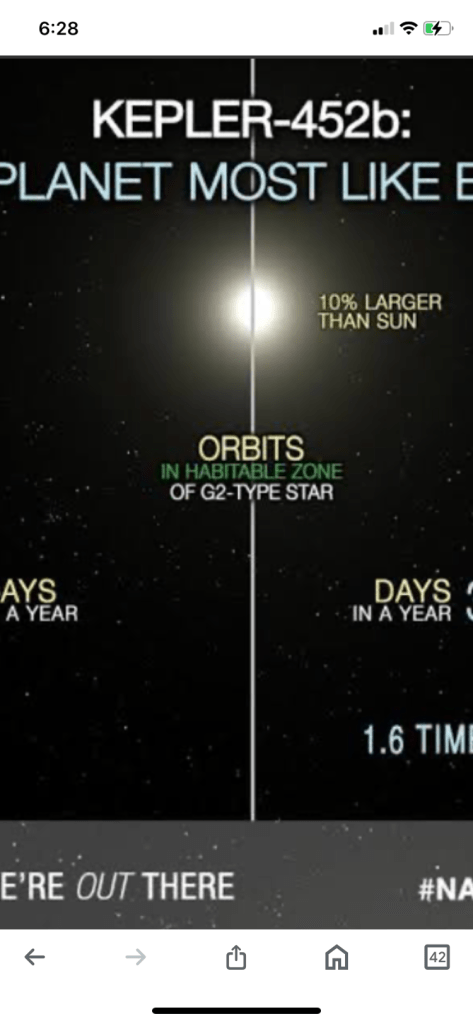
- Kepler-452b This exoplanet is 60% larger than Earth in diameter and is thought to be rocky and within the habitable zone of a G-type star similar to ours.
- TOI 700 e This exoplanet is similar in size to Earth, likely rocky in composition, and could potentially support life. It is just over 100 light years from Earth.
As of March 2022, NASA says there are over 200 exoplanets that could be similar to Earth. However, Earth-like planets are not as common as other types of planets because many conditions need to be met for them to exist.
As of June 2021, a total of 59 potentially habitable exoplanets have been found. One 2020 study that analyzed Kepler data calculated that the Milky Way could have as many as six billion Earth-like planets. Another study estimated the number of potentially habitable planets in our galaxy at about 300 million.
In the observable universe, there are 2 trillion galaxies, each with 100 billion stars. One in five stars has an Earth-like planet, which means there are as many as 40 billion Earth-sized planets
https://0b8eepnpz21xlzkewdt40lzodp.hop.clickbank.net Universe discoveries