
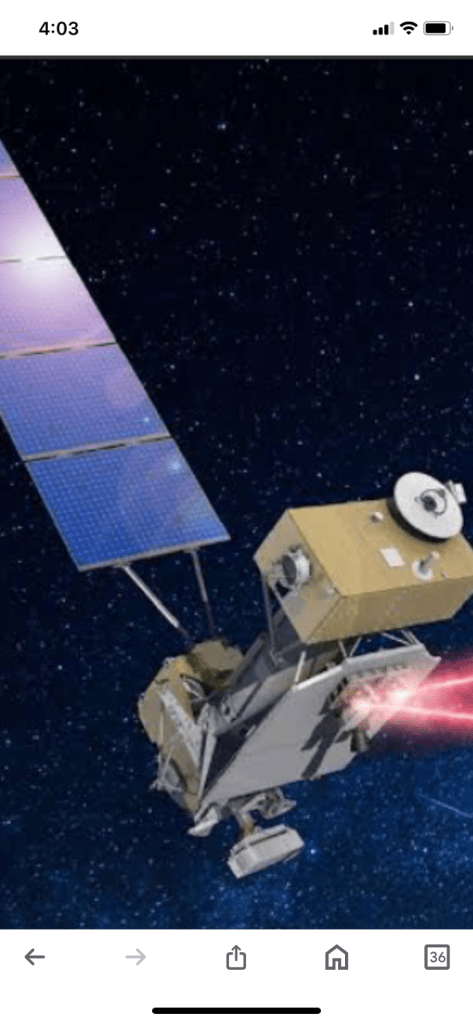
Laser communication, also known as optical or free-space communication, is a new way for spacecraft to communicate. Laser communication is expected to increase the efficiency of spacecraft communications by 10 to 100 times.
The new system is called Deep Space Optical Communications (DSOC). It uses infrared lasers to communicate between spacecraft and ground stations. DSOC is expected to be tested on the Psyche mission to the main-belt asteroid 16 Psyche, which launched in 2023.
Laser communication uses modulated laser beams to send and receive information wirelessly between two points. Laser light has much shorter wavelengths than radio, so more information can be transmitted per second.
Some other examples of laser communication include:
- NASA Laser Communications Relay Demonstration (LCRD) Launched in 2021 to test a two-way laser relay system to link orbiting satellites
- International Space Station NASA officials say a refrigerator-sized relay will allow astronauts on the space station to send high-resolution data, including images and video
The new system is called Deep Space Optical Communications (DSOC.)DSOC uses infrared lasers to communicate between spacecraft and ground stations. In this first experiment, the Psyche spacecraft communicated with the Hale Telescope at Caltech’s Palomar Observatory in San Diego County, California
Laser communication, also known as optical or free-space communication, uses modulated laser beams to send and receive information wirelessly between two points.
Laser communication systems have the following advantages:
- Low cost
- Small hardware
- Low power consumption
- Absence of electromagnetic interference
- High data rate
- Small antenna size
- Narrow beam divergence
- Narrow field of view
- Large communication capacity
- Light weight
Laser communication systems can be used for:
- Inter-satellite links
- Deep space exploration
- Connecting satellites and receiving stations on Earth
- Providing internet during flight
NASA’s Laser Communications Relay Demonstration Project (LCRD) is currently undergoing development and testing.
Laser communication systems work on the principle of amplitude modulation. This involves varying the amplitude of the carrier based on the amplitude of the modulating signal.
Laser communication systems use two microcontrollers, one at the transmitter and one at the receiver. The laser diode converts the electrical signal into a light signal and transmits it into free space. The receiver uses a light detector to receive the laser beam.
Laser communication systems are similar to modems, which convert digital information to analog for transmission
Here are some types of laser communication systems:
Gas lasers These lasers have an active medium made up of one or more gases or vapors.
Fiber lasers These lasers have a smaller, straighter beam than other types of lasers. They are also known for their small footprint, low maintenance, and good electrical efficiency.
Atmospheric attenuation This system can withstand atmospheric attenuation up to 11.67 dB/km. It can connect two optical fiber communication networks where optical fibers cannot be laid.
Coherent Laser diodes are used for their narrow spectral properties.
Laser scanners Lasers can be focused onto very small spots and switched on and off billions of times per second. They are important tools in telecommunications and information processing.
 Universe discoveries