
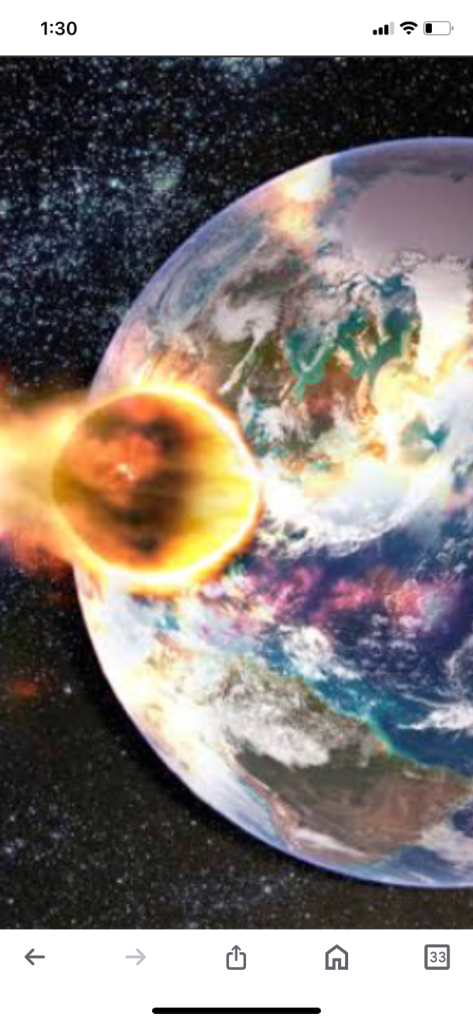
Comets can deliver organic molecules to planets if they travel at speeds below 15 kilometers per second. At higher speeds, the molecules would break apart due to the extreme speed and temperature.
The comets could deliver the following organic molecules:
- Amino acids
- Hydrogen cyanide
- Vitamins, such as vitamin B3
These molecules are necessary for life as we know it.
Comets can travel at the right speed in “peas in a pod” systems. In these systems, planets orbit closely together. Comets can “bounce” from one planet to another within these systems.
The study is published in the journal Proceedings of the Royal Society A.
According to new research from the University of Cambridge, comets must travel slowly – below 15 km/s (9.32 mi/s) – to deliver organic material onto other planets. Otherwise, the essential molecules would not survive the high speed and temperatures generated by atmospheric entry and impact
Comets may have delivered organic materials to Earth about four billion years ago. These materials combined with Earth’s own organics to create life.
Comets are mostly ice, but they also contain interstellar dust and organic molecules. They can carry the following elements, which are important for life on Earth: Carbon, Hydrogen, Nitrogen, Oxygen, Sulfur.
Comets may have also delivered water and organic compounds to Earth. These compounds could have produced amino acids, which are the building blocks of proteins. Comets could have also delivered complex molecules like dipeptides, which could have led to the growth of more complex proteins and sugars.
Yes, comets contain organic molecules. Scientists have detected organic molecules in comets since the 1990s. These molecules include: Methanol, Ethane, Methane, Hydrogen cyanide.
Scientists have also found complex organic molecules in comets. For example, scientists found organic molecules in Comet 67P.
Comets are made up of ice and dust. They are mostly water and carbon dioxide ices, plus dust
Comets may have delivered water and organic compounds to Earth. Some scientists believe that comets contributed much of Earth’s water. However, the ratio of heavy water to “regular” water on comets is different than on Earth. This suggests that at most, 10% of Earth’s water could have come from a comet.
Comets may have also delivered carbon-based molecules. These molecules could have caused amino acids to change into peptides, which are the first building blocks of life.
It’s unlikely that life began in comets. However, comets may have delivered the building blocks of life to Earth and other planets.
The panspermia theory suggests that life originated in space and was transported to Earth by comets, asteroids, or meteorites. This theory suggests that the origin of life is not related to Earth’s early environment.
Scientists don’t know if the building blocks of life were created on Earth or delivered by comets and meteorites
The comet theory of life suggests that comets crashed into Earth, delivering complex carbon molecules that started life. These molecules included components of nucleic acids, lipids, and amino acids. The theory states that the planet was cooling enough to not incinerate the molecules.
The cometary panspermia theory suggests that comets contain bacteria and viruses that led to the origin and evolution of life on Earth. This theory also states that life exists on countless planets and in dust clouds, and that comets transport life between these habitats.
The panspermia theory suggests that life exists throughout the universe and is distributed by space dust, meteoroids, asteroids, comets, and planetoids. This theory also suggests that spacecraft carrying microorganisms can distribute life.
The origin of life is the process by which life arises from non-living matter. The prevailing scientific hypothesis is that the transition from non-living to living entities on Earth was not a single event. Instead, it was a process of increasing complexity.
The three required conditions for the origin of life are:
- Availability of organic compounds
- Liquid (aqueous) environs
- A source of energy
The earliest lifeforms are suspected to have been simple unicellular microbes which formed at least 3.7 billion years ago. Many scientists believe that RNA, or something similar to RNA, was the first molecule on Earth to self-replicate.
The Big Bang Theory is the most accepted theory regarding the origin of the planet earth and the existence of different life forms on it. According to this theory, the universe is a result of a massive explosion which occurred 20 billion years ago.
https://64bc7dkj4612j3ch8oizn8mj27.hop.clickbank.net Universe discoveries
BUON WEEK-END
LikeLike