
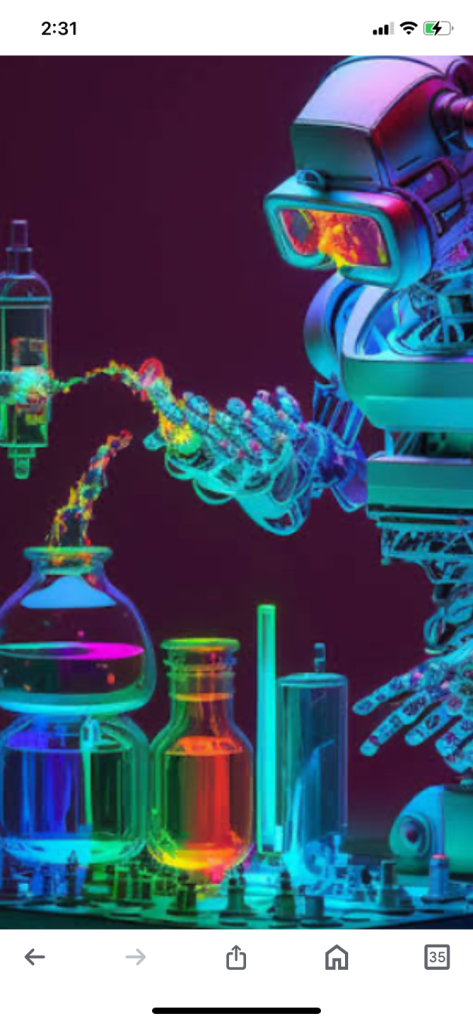
Oxygen-producing materials made from meteorites found on Mars have been produced using a robotic artificial intelligence (AI)-chemist. The research, published in Nature Synthesis, provides a proof-of-concept for generating oxygen and may have implications for future manned missions to Mars.
A team from the Chinese Academy of Sciences has developed a robotic AI chemist that can make oxygen on Mars. The AI chemist can automatically synthesize and optimize OER catalysts from Martian meteorites. The AI chemist can also create compounds that could be used to generate oxygen from water.
The AI chemist completed the optimization of catalysts within two months, a task that would take a human chemist 2,000 years. The robot chemist worked on the samples from Mars for six weeks without any human intervention and synthesized 243 different molecules.
The robotic AI chemist could be significant for upcoming Mars missions. It could help with resource utilization and diminish the necessity of importing oxygen from Earth.
Oxygen is rare on Mars. It is only 0.13%, compared to 21% in Earth’s atmosphere.
NASA has a device on Mars called MOXIE (Mars Oxygen In-Situ Resource Utilization Experiment) that converts carbon dioxide from the Martian atmosphere into oxygen. MOXIE has been successfully producing oxygen since April 2021. In 2021, MOXIE produced oxygen in seven different tests, including during the day and night, and through different Martian seasons.
MOXIE is designed to strip oxygen atoms from carbon dioxide molecules. Carbon dioxide molecules are made up of one carbon atom and two oxygen atoms
MOXIE uses an electromagnetic process to create oxygen. The process involves:
- Filtering: MOXIE takes in the Martian atmosphere through a HEPA filter that traps dust.
- Compressing: MOXIE compresses the atmosphere with a scroll pump.
- Heating: MOXIE heats the atmosphere to 800°C.
- Splitting: MOXIE uses a solid oxide electrolysis (SOXE) assembly to split the carbon dioxide molecules into oxygen ions and carbon monoxide.
- Analyzing: MOXIE analyzes the oxygen produced for purity and quantity.
- Venting: MOXIE vents the oxygen back into the Martian atmosphere along with the carbon monoxide and other exhaust products.
MOXIE is similar to a fuel cell running in reverse. A fuel cell uses fuel and oxygen to make electricity. MOXIE uses energy from the Mars 2020 rover’s radioisotope thermoelectric generator to convert it into stored energy in oxygen and carbon monoxide molecules.
Mars has oxygen in frozen water and in surface rocks. The planet’s atmosphere is made up of:
- 95% carbon dioxide
- 3% nitrogen
- 1.6% argon
- Traces of oxygen, carbon monoxide, water, methane, and other gases
- A lot of dust
Mars’ atmosphere is about 100 times thinner than Earth’s atmosphere. The density of oxygen on Mars is about 1/10,000 of what Earth has.
The oxygen on Mars is tied up in frozen water and in surface rocks. The surface is red from oxidation.
A robotic AI chemist is a robot that uses artificial intelligence (AI) to synthesize compounds that can generate oxygen from water. A team of Chinese scientists has developed a robotic AI chemist that can produce oxygen from water on Mars. The robot uses meteorites from Mars to synthesize the compounds.
Other uses of robots in chemistry include:
- Mixing
- Handling
- Palletizing
- Predicting molecular properties
Robotics is a branch of engineering and computer science that involves designing, manufacturing, and operating robots. The goal of robotics is to create intelligent machines that can help humans.
AI is used in many areas of chemistry, including:
- Drug discovery: AI can analyze chemical and biological data to identify potential drugs, predict their effectiveness, and optimize their properties.
- Materials design: AI can analyze chemical structures and properties to predict the behavior of compounds.
- Chemical synthesis: AI can optimize chemical synthesis to create new molecules or materials.
- Molecular property identification: AI can detect the chemical properties of molecules.
Other areas where AI is used in chemistry include:
- Reaction optimization
- Spectroscopy and analysis
- Process control and optimization
- Computational chemistry
AI can also help chemists predict the outcomes of new experiments and optimize reaction conditions. This can improve yields and reduce waste.
https://a3adejhd06r49v9en8z3fd6pez.hop.clickbank.net Universe discoveries