
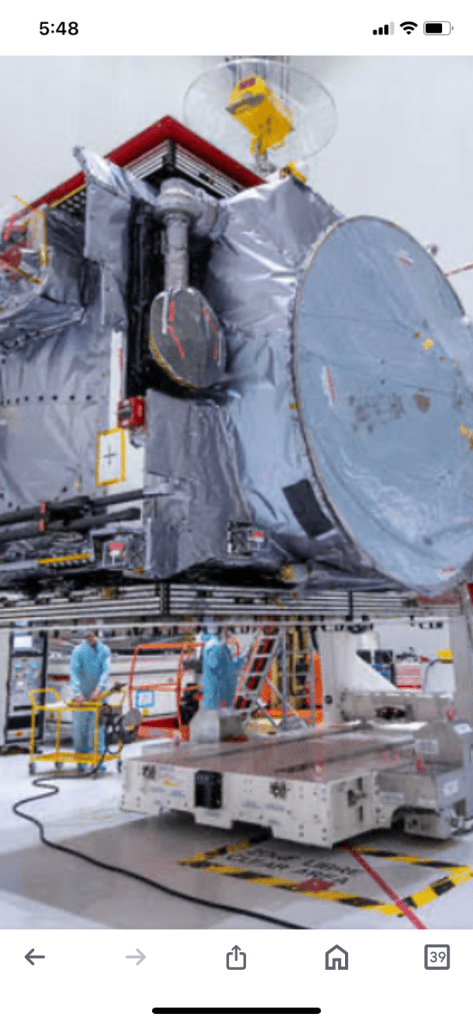
The Jupiter Icy Moons Explorer (Juice) is a spacecraft launched by the European Space Agency (ESA) on April 14, 2023. The spacecraft will study Jupiter and its three largest moons, Ganymede, Callisto, and Europa. Juice will orbit Ganymede, the largest moon in the solar system, making it the first probe to orbit a planetary moon other than Earth’s.
Juice will use a variety of instruments to make detailed observations of Jupiter and its moons. The mission will collect data for about four years before ending in 2035.
Here are some specifications for the Juice spacecraft:
- Dry mass: 2,420 kg
- Propellant: 3,650 kg
- Total mass: 6,000 kg
Juice was launched from the European Spaceport in Kourou, French Guiana. It will arrive at Jupiter in 2031 and spend 2.5 years orbiting the planet
Juice’s propulsion system uses a bi-propellant chemical system. The propellant is a combination of mono-methyl hydrazine (MMH) fuel and mixed oxides of nitrogen (MON) oxidizer. The two components spontaneously ignite when they come into contact.
Juice’s main engine is a 425 N thruster. The spacecraft also has 10 thrusters.
Some challenges for the JUICE mission include:
- Protecting electronics from Jupiter’s radiation
- Electromagnetic cleanliness on the spacecraft
- Solar array performance in a cold and intense radiation environment
The Juice spacecraft has the following dimensions:
- Main body: 4.09 x 2.86 x 4.35 meters
- Solar panels: 85 square meters
The spacecraft’s main body is cuboid in shape and is called the “bus”. The solar panels are the largest ever built for an interplanetary spacecraft. They are the size of a basketball court and are designed to collect as much energy as possible near Jupiter.
The JUICE spacecraft reached a speed of 2.5 kilometers per second at launch. This gave it enough energy to escape the Earth-Moon system.
The JUICE spacecraft’s flyby velocity at Europa is 4 km/s. Other flybys are in the range of 1 up to 7 km/s. The orbital velocity in Ganymede orbits is around 2 km/s.
The JUICE spacecraft will take eight years to reach Jupiter. This is longer than other missions to the planet because the spacecraft needs to be moving slowly enough to enter Jupiter’s orbit. The spacecraft will also need to perform a number of gravity assist maneuvers.
It takes eight years for JUICE to reach Jupiter because the spacecraft needs to gain energy. It uses gravity assists to speed up and save propellant.
Orbiter missions don’t take direct paths to Jupiter. Instead, they travel around the inner solar system, flying by other planets to get speed boosts. JUICE will perform gravity assist maneuvers with Earth, Venus, and the moon.
The distance between Earth and Jupiter varies greatly over time. In the best case, a straight shot from Earth to Jupiter would take about 33 years.
The Europa Clipper and the Jupiter Icy Moons Explorer (JUICE) are both spacecraft that will study Jupiter and its moons. The Europa Clipper is a NASA mission that will focus on Europa, while JUICE is an ESA mission that will study Jupiter’s atmosphere, magnetosphere, and rings.
JUICE
Launch date
Juice launch date
April 2023
Mission
Study Europa’s surface, subsurface, atmosphere, and magnetic environment
Study Jupiter’s atmosphere, magnetosphere, Io, smaller moons, and rings
Goal of Europa clipper
Determine if Europa could support life
Study three icy moons, Jupiter’s atmosphere, magnetosphere, Io, smaller moons, and Jupiter’s rings
The Europa Clipper will make nearly 50 flybys of Europa during its four-year mission. It will reach altitudes as low as 25 kilometers above the surface.
JUICE will use gravity assists to reach Jupiter. It will perform four gravity-assist flybys at Earth and Venus. The first flyby will be a lunar-Earth gravity-assist, which will involve a flyby of the Moon followed by a flyby of Earth 1.5 days later.
JUICE will also circle Mars for gravity assist maneuvers. It will experience very high and very low temperatures as it performs these maneuvers.
JUICE will reach Jupiter in July 2031. It will have enough fuel to make 35 flybys of the icy moons before orbiting Ganymede from December 2034
It takes so long for JUICE to reach Jupiter because it doesn’t have enough energy to go into a more direct orbit. JUICE needs to perform gravity assist maneuvers to gradually increase its energy.
JUICE is also fighting the Sun’s gravitational pull as it travels through the Solar System. To get into orbit around Jupiter, JUICE will need to lose some energy. This deceleration will require a lot of fuel.
https://bfaddqjkd5ntjx8e4hea-9n804.hop.clickbank.net Universe discoveries