
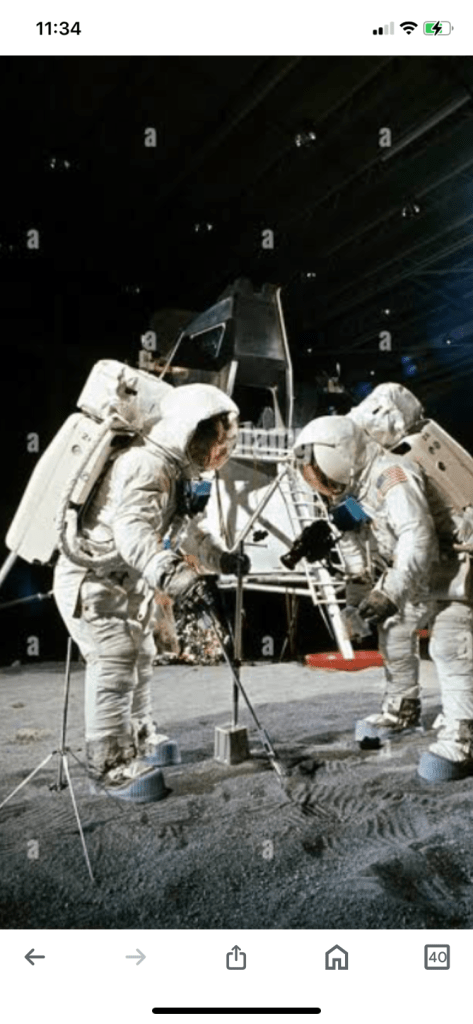
NASA has simulated how moon landings can kick up dust. The simulations show the forces exerted by plumes on a flat surface during the last 30 seconds of descent. The simulations also look at shear stress, which is the amount of lateral force applied over a set area.
The simulations show that the lander’s descent can cause a rapid increase in shear stress on the lunar surface. This can stir up lunar regolith, which is the layer of fine, loose dust and rock on the moon’s surface. The intense forces generated by the plumes can kick up dust, rocks, and debris at high speeds. This can cause hazards such as:
- Visual obstructions
- Interference with navigation and scientific instruments
- Damage to the lander and surrounding hardware
NASA has also conducted tests to measure the density and size of particles during terrestrial simulations of lunar landings
When spacecraft land on the Moon, their exhaust strikes the powdery regolith on the lunar surface. The Moon has low gravity and no atmosphere, so the dust is thrown up in a huge plume.
Landing on the moon is difficult because of many factors:
- No atmosphere: There’s no air resistance to slow down a spacecraft, so it has to rely on its own rockets. This can be fuel-intensive.
- Uneven surface: The moon has many craters and boulders, making it hard to find a safe landing spot.
- No GPS: There’s no satellite network to provide precise landing coordinates.
- Reduced gravity: The moon has less gravity than Earth.
- Dust: The moon has a lot of dust.
The south pole of the moon is especially difficult to land on because of its mountainous terrain
Moon dust is created when meteoroids crash into the moon’s surface. The impact heats and pulverizes the rocks and dirt, which contain silica and metals like iron. The dust is fine and powdery, but it can cut like glass.
The moon’s surface is covered by a thick layer of regolith, which is made up of fragmental and unconsolidated rock material. The regolith is the result of:
- Meteoric impacts
- Bombardment by charged particles from the sun and stars
- Mechanical weathering
The dust is so abrasive that it can destroy spacesuit boots and vacuum seals. It can also be unhealthy because the sharp edges of the dust have not been worn down by erosion.
The moon’s dust can create a glow near the horizon during lunar sunset. This happens when electrically charged particles are levitated by electrostatic fields. The cloud of dust then scatters light.
Moon dust doesn’t float because there’s no atmosphere. In a vacuum, dust particles fall to the ground immediately.
The moon does have gravity, but it’s less than Earth’s. The moon also has no air, so there are no particles for the dust to collide with.
However, some dust does float up to 60 miles above the moon’s surface. This dust is part of the moon’s exosphere, where gravity binds the particles. The particles are so sparse that they rarely collide.
Moon dust is negatively charged due to constant solar radiation. This charge causes the dust to stick to everything it touches, including: Astronauts’ boots, Gloves, Suits, Cords, Tools.
The dust is also very dry, which can lead to a significant static charge. The dust is so abrasive that it can destroy spacesuit boots and vacuum seals.
Researchers at Washington State University have developed a liquid nitrogen spray that can remove almost all of the simulated moon dust from a space suit.
https://bfaddqjkd5ntjx8e4hea-9n804.hop.clickbank.net Universe discoveries