
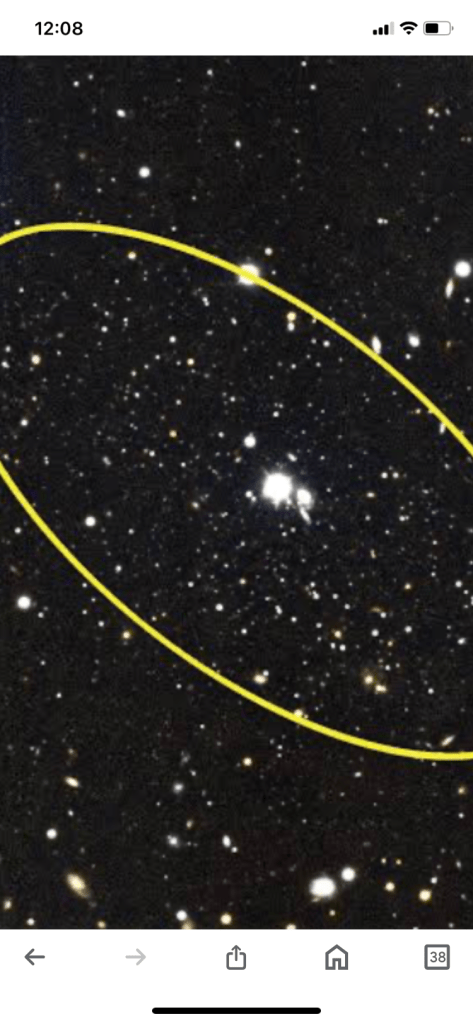
Commonly thought to be long-lived satellites of our galaxy, a new study now finds indications that most dwarf galaxies might, in fact, be destroyed soon after their entry into the Galactic halo
According to a November 2023 article, dwarf galaxies around the Milky Way may have recently arrived from outside the halo. The article states that these galaxies have higher energies, which suggests they’ve only been in the Milky Way’s vicinity for a few billion years. The article also suggests that the dwarf galaxies may have lost their gas when they collided with the Galactic halo’s hot gas
The Milky Way is surrounded by about 50 dwarf galaxies. Most of these galaxies are only visible through telescopes and are named after the constellations in which they appear. Some examples of these galaxies include:
- Large Magellanic Cloud
- Antlia 2
- Sagittarius Dwarf
- Crater II
Dwarf galaxies are the most common type of galaxy in the Cosmos. They are elliptical in shape, have very little or no gas, and have no evidence of recent star formation. Dwarf galaxies also have higher proportions of dark matter than larger galaxies
Here are some more facts about dwarf galaxies:
- Size Dwarf galaxies are small, with diameters of 1–10 kiloparsecs. The smallest dwarf galaxies are ultra compact dwarf galaxies, which can be as small as 200 light-years across.
- Shape Most dwarf galaxies are irregular in shape. They lack a distinctive structure or shape, and often have neither a nuclear bulge nor spiral arms.
- Stars Dwarf galaxies contain a few million to a few billion stars. The Phoenix Dwarf Galaxy has younger stars in its inner regions and older stars at its outskirts.
- Dark matter Dwarf galaxies have higher proportions of dark matter than larger galaxies.
- Importance Dwarf galaxies are important laboratories for testing astrophysics questions, including the existence and properties of dark matter.
Dwarf galaxies can be affected by larger galaxies. For example, dwarf galaxies can be pulled toward and ripped by spiral galaxies. This can lead to stellar streams and eventually galaxy mergers. Astronomers believe that dwarf galaxies merged in the early Universe to grow into the larger galaxies that exist today.
Dwarf galaxies can also orbit larger galaxies. For example, over 20 dwarf galaxies orbit the Milky Way. The closest dwarf galaxy to the Milky Way is believed to be Canis Major Dwarf, which is 25,000 light-years away.
Dwarf galaxies have more dark matter than larger galaxies because their stars’ motions can’t be explained by their stellar mass alone. Dark matter’s gravitational force holds dwarf galaxies’ clusters together.
Dark matter makes up most of a galaxy’s mass and is responsible for the way galaxies are organized. Every galaxy has a halo of dark matter that acts as a scaffold for visible matter to form stars and other galactic structures.
Dwarf galaxies are older and have less gas and dust, making them ideal places to study dark matter. Bursty star formation can heat up dark matter in the centers of dwarf galaxies.
Dwarf galaxies are the most common type of galaxy in the universe. They are difficult to detect because of their small size, low mass, and low luminosity. However, the number of known dwarf galaxies has increased since the Sloan Digital Sky Survey began taking better images of the sky in 2005.
Dwarf spiral galaxies are rare, especially the dwarf counterparts of Sa-Sc type spiral galaxies. There are fewer dwarf galaxies near the Milky Way than predicted by dark matter simulations. This may be because there are many more dwarf galaxies that haven’t been noticed because they are mostly made of dark matter
Yes, the Milky Way has at least 14 dwarf galaxies orbiting it. The Milky Way’s gravity holds these galaxies in place.
Some of the Milky Way’s dwarf galaxies include:
- Canis Major Dwarf
- Small Magellanic Cloud
- Large Magellanic Cloud
- Antlia 2
- NGC 4449
The Milky Way is also part of a neighborhood of a few dozen galaxies called the Local Group. The Andromeda Galaxy is also part of this group and has over 20 dwarf galaxies.
The Canis Major Dwarf Galaxy is the closest dwarf galaxy to Earth. It’s located about 25,000 light-years away from our solar system. It’s also about 42,000 light-years from the center of the Milky Way, making it the closest galaxy to the Milky Way
The Canis Major Dwarf Galaxy is also known as the Canis Major Overdensity. It’s not part of the Milky Way Galaxy.
Here are some other galaxies that are close to Earth:
- Sagittarius Dwarf Galaxy: About 70,000 light-years away
- Andromeda Galaxy: About 2.53 million light-years away
- Segue 1: Close to Earth
- Sagittarius Dwarf Spheroidal: Close to Earth
 Universe discoveries