
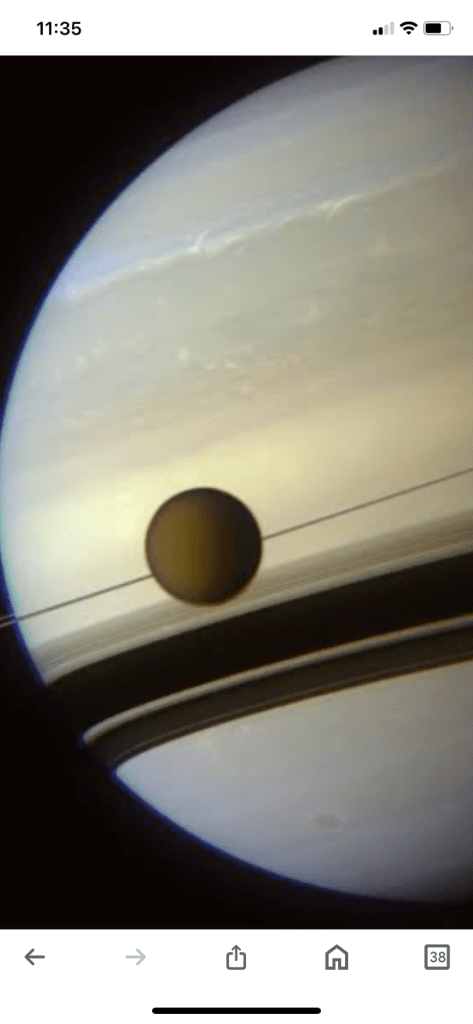
Saturn’s rings cast shadows on the planet. The shadows appear as two thick bands with thin, lighter stripes. The shadows seem to be inside out. The rings’ shadows can be seen in an amateur telescope
Saturn’s rings are tilted relative to its orbit around the sun. Every 15 years, the rings are perpendicular to the sun. During these times, some of Saturn’s moons can cast shadows across the rings.
Saturn’s rings are named A, B, C, D, E, F, and G. The rings are not in alphabetical order, but rather in the order they were discovered. B is the widest and thickest ring, and A and B are the brightest.
Saturn’s rings are made of about 98% pure water ice by volume, with only a small amount of rocky matter. Scientists have discovered that the rings might disappear completely in the next 300 million years.
Saturn’s rings appear to disappear when viewed edge-on because they are so thin. This is similar to trying to see a sheet of paper that is positioned edge-on at the far end of a soccer field.
This phenomenon is called the Saturnian equinox. It occurs every 15 years. The last time it occurred was in September 2009.
In 2025, Saturn will align edge-on with Earth, making its rings virtually invisible. This will be due to the planet’s tilt. The rings will return in 2032 when Saturn rotates and showcases the other side of its rings
Saturn’s rings are not visible to the naked eye from Earth. However, you can see where Saturn is in the night sky and some of the light you see will have been reflected by the rings
You can see Saturn’s rings with binoculars or a telescope. A telescope with at least 40 times magnification will clearly show the detail of the rings. The bigger the telescope, the better.
Saturn’s rings are easier to see than the rings of other gas giant planets because they are much bigger and wider. The rings are made up of a large number of particles.
Saturn will reach opposition on Sunday, August 27, 2023. This means the planet and its rings will appear brighter than usual, shining at magnitude 0.3
Saturn is not the only planet with rings. The other three gas giants in our solar system, Jupiter, Uranus, and Neptune, also have rings. However, Saturn’s rings are the largest and brightest, and the only ones visible to the naked eye. Saturn’s rings are so large and bright that they were discovered as soon as humans began using telescopes.
The other gas giants’ rings were discovered in the 1970s. Saturn’s rings are so prominent that it’s nicknamed the “Ringed Planet”.
Yes, there are planets with rings outside our solar system. In 2012, astronomers discovered the first set of rings outside our solar system. The planet is a giant planet orbiting the star J1407, which is about 434 light-years away from Earth. The planet has 30 rings, each with a diameter of tens of millions of kilometers.
Many exoplanets likely have rings. The planet could be a brown dwarf star.
Saturn’s rings appear to disappear from view every 13.5 to 15.7 years. This is because Earth sees Saturn on a horizontal plane, causing the rings to align with our line of sight. The rings are so thin that they reflect very little light and are difficult to see
Saturn’s rings are made of ice, dust, and rocky debris. They are relatively young and are slowly eroding due to repeated impacts from meteoroids. Some astronomers believe that planetary rings like Saturn’s are only temporary and last for only a few million years.
The gaps in Saturn’s rings are caused by the gravitational pull of Saturn’s moons on the ring’s particles. The moons’ gravity can pull particles out of the ring’s orbit.
Here are some examples of gaps in Saturn’s rings:
- A-B gap Caused by the moon Mimas. Mimas orbits Saturn once per day, while the ring material in the gap orbits twice as fast. This orbital resonance causes Mimas to tug on the gap’s material with each orbit.
- Encke gap Caused by the moon Pan. Pan orbits within the Encke gap. Its gravity pushes ring particles closer to Saturn into smaller orbits, and particles farther from Saturn into larger orbits.
- Propellers Caused by moonlets. Moonlets are smaller than known moons but larger than the particles in Saturn’s rings. There could be millions of moonlets.
Saturn also has shepherd moons, which are small moons that orbit near the rings’ outer edges or within gaps. The gravity of shepherd moons keeps the rings’ edges sharp
There are multiple theories about how Saturn’s rings formed:
- Collision of two moons In 2023, astronomers suggested that the rings may have formed from the collision of two moons a few hundred million years ago.
- Collision of a moon with a comet or meteor The leading hypothesis is that a comet or meteor collided with a moon, destroying both objects. Saturn’s gravity then flattened the debris into a disk.
- Debris from a former icy moon The rings could be debris from the tidal destruction of a former icy moon of Saturn.
- Comets and asteroids pulled into Saturn Saturn’s strong gravitational pull may have pulled comets and asteroids into the planet. The asteroids and comets were then smashed, and the pieces became the rings.
- Sun’s gravity The sun’s gravity may have jostled Saturn’s inner moons into colliding orbits, which created a ring of debris around the planet.
Saturn’s rings are the most extensive ring system of any planet in the Solar System. They are made up of countless small particles, ranging in size from micrometers to meters
Italian astronomer Galileo Galilei was the first to observe Saturn’s rings in 1610. He used a 20-power telescope to see the rings, but he couldn’t see them well enough to determine what they were. He thought they were large moons or “handles” on either side of the planet.
In 1655, Dutch astronomer Christiaan Huygens was the first to describe the rings as a disk surrounding Saturn. He used an improved telescope to study Saturn.
In 1675, Italian-born astronomer Jean-Dominique Cassini discovered a division between the A and B rings. This division is now known as the Cassini Division.
https://bfaddqjkd5ntjx8e4hea-9n804.hop.clickbank.net Universe discoveries