
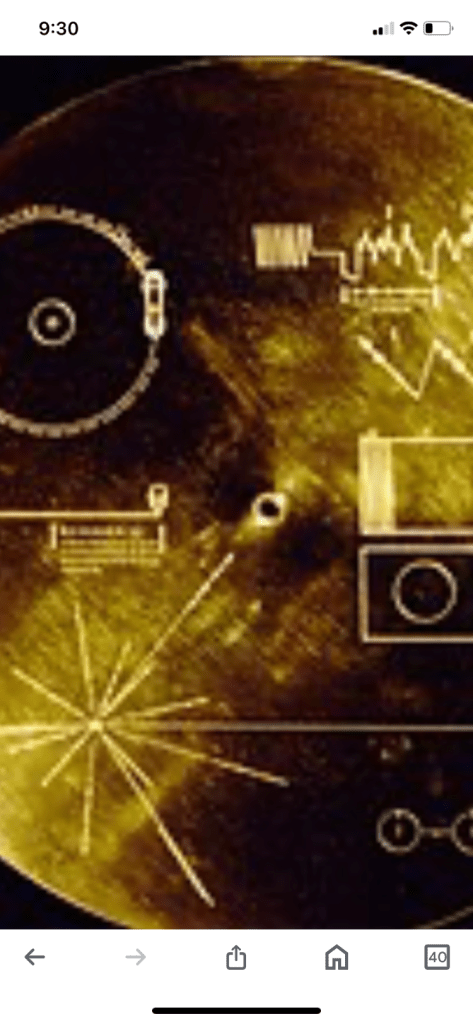
The Voyager Golden Record is a message from humanity to the cosmos. It contains:
- Greetings: 59 spoken greetings in different languages
- Sounds: A 12-minute compilation of sounds from Earth, including natural sounds, human sounds, and musical selections
- Images: 115 analog-encoded photographs of people and places on Earth
- Messages: Printed messages from President Jimmy Carter and U.N. Secretary-General Kurt Waldheim
The record also includes:
- Music from different cultures and eras, including Beethoven and Chuck Berry’s “Johnny B”
- Photos of the Great Barrier Reef, the Taj Mahal, and Ansel Adams landscapes
- Sounds like thunder, a humpback whale call, brainwaves, and a kiss
The record’s cover is electroplated with uranium-238, which acts as a radioactive clock. Half of the uranium-238 will decay in 4.51 billion years
The record also has a hand-carved inscription that reads, “To the makers of music — all worlds, all times“. This is the only example of human handwriting on each Voyager mission.
The record’s cover also has binary arithmetic that indicates the correct time for one rotation of the record. The time is 3.6 seconds, which is expressed in time units of 0.70 billionths of a second. This time period is associated with a fundamental transition of the hydrogen atom. The drawing on the cover also indicates that the record should be played from the outside in.
The two circles in the bottom right corner of the record represent the two spinning states of the hydrogen atom’s electron. The connecting line and the number 1 indicate that the time interval between the two states is the fundamental time scale
The record also contains navigational information, including distances and directions to local pulsars. The two glyphs above the starburst indicate the record’s play time and rotation time.
The record’s cover also includes a drawing of a phonograph record and a stylus. The stylus is positioned to play the record from the beginning.
The pulsar map on the Voyager Golden Record’s cover is a starburst-like diagram. It shows the location of the solar system in relation to 14 pulsars. Pulsars are the remnants of dying stars, and are only about 12 to 15 miles in diameter. However, most contain more than twice the mass of our sun.
The pulsar map was previously sent on the plaques of Pioneers 10 and 11.
The Voyager Golden Record is attached to the Voyager spacecraft. The Voyager spacecraft are currently in interstellar space.
Voyager 1
- Location: Kuiper belt
- Distance from Earth: 162 AU (24 billion km; 15 billion mi)
- Speed: 38,000 mph (17 kilometers per second)
- Status: The farthest human-made object from Earth
Voyager 2
- Location: Constellation of Pavo
- Distance from Earth: 12.4 billion miles
- Status: The second most distant human-made object from Earth
The Voyager spacecraft were launched in 1977 from Cape Canaveral, Florida. Their mission was to explore planets in the outer solar system, particularly Jupiter and Saturn
Yes, you can listen to the Voyager Golden Record on SoundCloud. NASA uploaded the contents of the record to SoundCloud. NASA also curated a playlist called Golden Record: Sounds of Earth.
The record is designed to be played at 16-2/3 revolutions per minute. It contains spoken greetings in 55 languages, including Akkadian, which was spoken in Sumer about six thousand years ago, and Wu, a modern Chinese dialect. The record also includes music by Bach and Chuck Berry, and songs by humpback whales.
The Voyager Golden Record includes 90 minutes of music from different cultures and eras. Some of the music includes:
- Beethoven: Excerpts from the first movement of Fifth Symphony and String Quartet No. 13 in B flat, Opus 130
- Stravinsky: The Rite of Spring
- Mozart: The Queen of the Night aria from The Magic Flute
The record also includes natural sounds, such as:
Volcanoes, Earthquakes, Thunder, Mud pots, Wind, Rain, Surf, Crickets, Frogs.
Other sounds include:
Morse code, Ships, Horse and cart, Train, Herding sheep, Blacksmith, Sawing, Tractor, Riveter, Automobile
The Voyager Golden Record is a message of goodwill from Earth to any extraterrestrials who might find the spacecraft. The record is intended to introduce Earthlings to other life forms. The sounds and images on the record are meant to portray the diversity of life and culture on Earth
The record was selected by a committee chaired by Carl Sagan. NASA invented a way to include images on the record by projecting them onto a screen, recording them with a television camera, and then turning the video signals into audio waveforms.
The record was mounted on Voyager 1 and Voyager 2, twin probes launched in 1977. The spacecraft spent 13 years exploring the outer planets of the sun.
The Voyager Golden Record was intended to be a time capsule of human culture and achievements. The record’s contents were selected to represent a range of human emotions and experiences. The record’s sounds and images were meant to show the diversity of life and culture on Earth.
The Voyager spacecraft were launched in 1977. The Voyager 1 spacecraft took a photograph of Earth called Pale Blue Dot on February 14, 1990. The image was taken from a distance of 3.7 billion miles from the sun. The image inspired the title of Carl Sagan’s book, Pale Blue Dot: A Vision of the Human Future in Space
The Voyager spacecraft also carried other recording devices, including:
- Television cameras
- Infrared and ultraviolet sensors
- Magnetometers
- Plasma detectors
- Cosmic-ray and charged-particle sensors
- High gain Cassegrain antenna
The Voyager 1 spacecraft’s radio communication system was designed to work beyond the limits of the solar system. The system includes a 12-foot antenna to send and receive radio waves.
https://bfaddqjkd5ntjx8e4hea-9n804.hop.clickbank.net Universe discoveries