
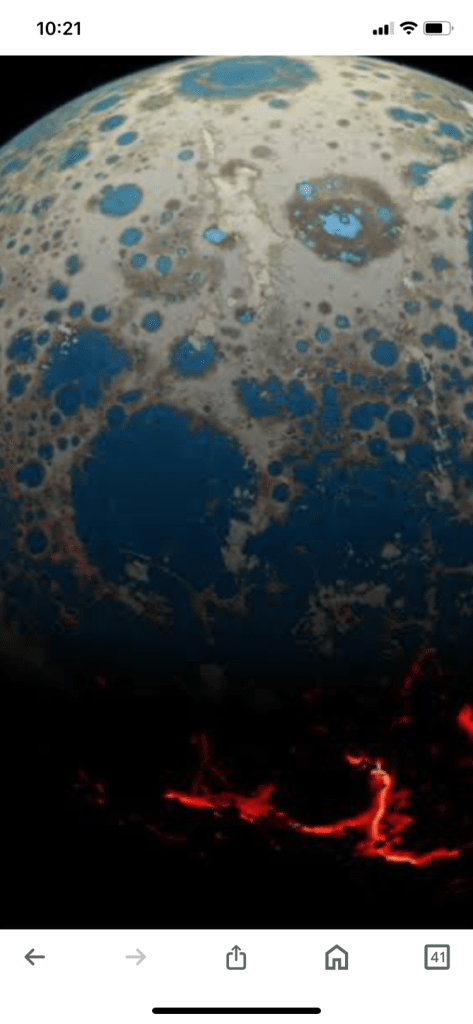
Recently, the James Webb Space Telescope detected methane in the atmosphere of WASP-80b, a gas giant about half as massive as Jupiter. WASP-80b orbits a K-type main sequence star about 1.5 billion years old. WASP 80 is about 162 light-years away, and WASP-80b is the only planet detected around the star so far.
NASA’s James Webb Space Telescope (JWST) has detected methane in the atmosphere of two exoplanets:
- WASP-80b A gas giant that’s about half as massive as Jupiter. WASP-80b orbits a K-type main sequence star that’s about 1.5 billion years old. The JWST observed the planet as it passed in front of and behind its host star. The spectra revealed an atmosphere containing methane gas and water vapor.
- K2-18 b An exoplanet that’s 8.6 times as massive as Earth. K2-18 b orbits the cool dwarf star K2-18 in the habitable zone and is 120 light-years from Earth. The JWST revealed the presence of carbon-bearing molecules including methane and carbon dioxide.
The JWST studies the atmospheres of exoplanets to search for the building blocks of life elsewhere in the universe.
The following planets have methane in their atmospheres:
- Jupiter The atmosphere is mostly hydrogen, but also contains methane, ammonia, sulfur, and water vapor.
- Saturn Methane is abundant in this giant planet.
- Uranus This gas planet has methane, hydrogen, and helium in its atmosphere. The methane gives Uranus a greenish blue color.
- Neptune This planet has methane, hydrogen, and helium in its atmosphere. The methane gives Neptune a bluish color.
Methane is also present in the atmosphere of Mars
Photochemistry is the study of how the Sun’s radiation interacts with the gases in a planet’s atmosphere. It’s a fundamental process that affects a planet’s habitability, atmospheric composition and stability, and aerosol formation.
The JWST has provided the first direct evidence of photochemistry in an exoplanet’s atmosphere:
- Sulfur dioxide: The JWST detected sulfur dioxide in the atmosphere of the hot, giant exoplanet WASP-39b. This molecule is produced by chemical reactions triggered by high-energy light from the planet’s parent star
Here are some highlights in the study of exoplanet atmospheres:
- Molecular spectral features
- Day-night temperature gradients
- Vertical atmospheric structure
- Chemical compositions
- Clouds and hazes
Exoplanet atmospheres can reveal properties such as mass, radius, and orbit. For example, exoplanets larger than 1.5 Earth radii must have atmospheres.
The study of exoplanet atmospheres can help understand the differences between their physical, chemical, and dynamical processes
Studying exoplanet atmospheres can help us understand:
- Formation markers
- The origin and evolution of planetary systems
- How our atmosphere might change in the future
- The history of an exoplanet
The chemical composition of exoplanet atmospheres can also tell us about the physical conditions on these worlds. For example, atmospheres can contain biosignature gases that may indicate the presence of life.
Astronomers use a technique called spectroscopy to study the atmospheres of other planets. Telescopes collect light and split it into its component wavelengths, creating a spectrum. Gases in the atmosphere block out certain slices of the spectrum. Scientists can read this like a bar code to understand the atmosphere
Astronomers can detect life on exoplanets by looking for biosignature gases in their atmospheres. These gases are produced by life as a byproduct of metabolism. If the planet is habitable, some of these gases will accumulate in the atmosphere.
To detect these gases, astronomers use a technique called transit spectroscopy. This method involves splitting the light from an exoplanet’s atmosphere into a rainbow spectrum. The spectrum can be read like a bar code to identify the gases and chemicals in the atmosphere.
To detect life on Earth-like planets, astronomers need large space telescopes that can block the light from the planet’s parent star
There’s no evidence of life on exoplanets. However, scientists have found potential signs of life on an exoplanet that’s covered in water and orbits a dim red star. The exoplanet K2-18b may also have some features that could support life, including carbon-bearing molecules and a hydrogen-rich atmosphere.
To support life, an exoplanet’s orbit must be in the “habitable zone” where the surface temperature is just right for liquid water to exist. Most known exoplanets are too far away from their host stars to support human life
WASP-80b is a gas giant exoplanet that orbits a K-type star. It was discovered in 2012.
Here are some characteristics of WASP-80b:
- Mass: 0.538 Jupiters
- Orbital period: 3.1 days
- Distance from its star: 0.0344 AU
- Equilibrium temperature: 800 K
- Color: May appear bluish due to the lack of high-altitude clouds and the presence of atmospheric methane
WASP-80b is a missing link in the study of exoatmospheres. It falls between the warm Neptunes and the hot Jupiters. The planet-to-star contrast is favorable for future observation of the emission spectrum of the planet.
WASP-80b was chosen as part of the MANATEE NIRCam + MIRI GTO program. The JWST era is enabling exoplanet atmosphere observations in new IR spectral ranges
 Universe discoveries