
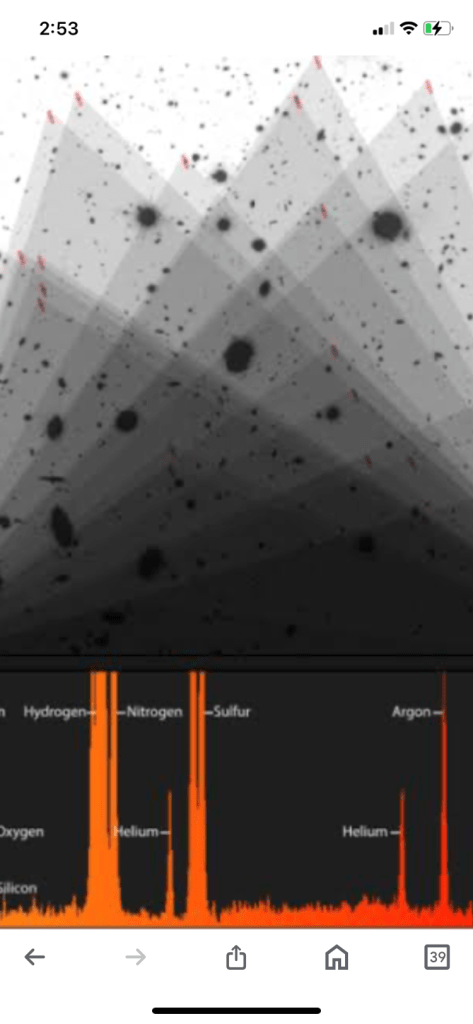
Adolescent galaxies, also known as “teenage galaxies”, are incandescent and contain unexpected elements. These galaxies formed two to three billion years after the Big Bang. They are unusually hot and contain elements like nickel, which are difficult to observe
The CECILIA team, which stands for Chemical Evolution Constrained Using Ionized Lines in Interstellar Aurorae, studied the spectra of 33 adolescent galaxies. The study used the JWST’s NIRSpec instrument to measure the light of the galaxies. This provided insights into the chemical composition and temperature of the galaxies.
The composite picture of the galaxies contained eight identifiable elements:
Hydrogen, Helium, Nitrogen, Oxygen, Silicon, Sulfur, Argon, Nickel.
While the lighter elements were expected, the presence of nickel came as a surprise. Nickel is heavier than iron in the periodic table
New research based on the James Webb Space Telescope shows that these teenage galaxies are unusually hot. Not only that, but they contain some unexpected chemical elements. The most surprising element found in these galaxies is nickel
Adolescent galaxies are galaxies that formed about 2–3 billion years after the Big Bang. They are also known as “teenage galaxies” because they have characteristics similar to human teenagers. These characteristics include:
- Growth spurts
- Immaturity
- Unexpected chemical elements
- Unusually high temperatures
The James Webb Space Telescope has captured images of adolescent galaxies. These images are helping scientists understand how galaxies evolve and form.
A galaxy is a collection of dust, gas, stars, and solar systems held together by gravity. There are an estimated 200 billion to 2 trillion galaxies in the observable universe
Galaxies that are further away appear younger because of the time it takes for light to travel. This is called lookback time. For example, if you see a galaxy that is 1 million light years away, you are seeing it as it was 1 million years ago.
Galaxies that are more than 11 billion light-years away are very blue. This indicates that they have many young stars and are forming stars at a faster rate than nearby galaxies
Here’s how young some of these galaxies look to us:
- GN-z11: This galaxy is the youngest and most distant galaxy observed by scientists. It looks as it did when the universe was 400 million years old.
- I Zwicky 18: This galaxy may be as young as 500 million years old. It looks as it did when complex life had already started to appear on Earth.
- Abell2744_Y1: This galaxy looks as it did 650 million years after the Big Bang.
- A1689-zD1: This galaxy looks as it did when the universe was 700 million years old.
The Chemical Evolution Constrained using Ionized Lines in Interstellar Aurorae (CECILIA) Survey is a study that uses the James Webb Space Telescope (JWST) to examine the chemistry of distant galaxies. The study’s name honors Cecilia Payne-Gaposchkin, a 20th century astronomer.
The CECILIA Survey uses the JWST’s NIRSpec instrument to study the spectra of 33 galaxies. The galaxies are at z ~ 1-3, which is roughly 2 to 3 billion years after the Big Bang. The study’s findings include:
- Chemically immature: The galaxies appear to be in a chemically immature phase, which suggests that they are still forming.
- Hotter than expected: The galaxies are hotter than expected.
- Heavy elements: The galaxies contain heavy elements, like nickel.
The CECILIA Survey also determines the amount of oxygen in the galaxies’ interstellar medium. The study helps scientists learn more about how these massive star systems grow and evolve.
The name CECILIA is short for Chemical Evolution Constrained using Ionized Lines in Interstellar Aurorae, while also honoring trail-blazing 20th century astronomer Cecilia Payne-Gaposchkin
https://5c68bmmh3yut8tdb0ci9ucnaao.hop.clickbank.net Universe discoveries