
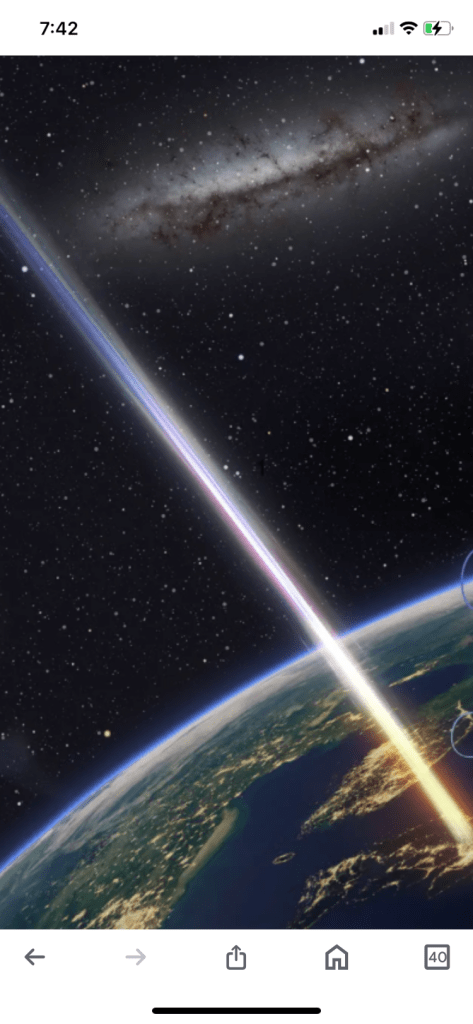
Scientists discovered the “Sun Goddess” particle, also known as the Amaterasu particle, in 2021. The particle was detected at the Telescope Array observatory in Utah’s West Desert. It has an energy level of 244 exa-electron volts
The particle is named after the Japanese sun goddess, Amaterasu Ōmikami, whose name translates to “shining in heaven”. In Shinto beliefs, Amaterasu helped create Japan.
The Amaterasu particle is the second-highest extreme-energy cosmic ray ever detected, after the “Oh-My-God” particle, which was detected in 1991. The “Oh-My-God” particle had an energy level of 320 exa-electron volts.
Cosmic rays are particles that come from faraway regions of space. The current particle appears to have originated from a dark region of our galaxy.
Scientists have detected an extremely powerful particle with ultra-high energy that they believe to have travelled to Earth from beyond the Milky Way galaxy. According to a report from space.com, it has been named the “sun goddess” (Amaterasu in Japanese) particle and is extraordinary.
The “Oh-My-God” particle was discovered by astronomers from the University of Utah in 1991. The particle was detected by the Fly’s Eye camera at Dugway Proving Ground in Utah. The discovery was initially called the “WTF particle”. Retired engineer John Walker later coined the new name.
Cosmic rays are particles that travel at nearly the speed of light. They are often protons, but can also be helium atoms or electrons. The “Oh-My-God” particle is the fastest cosmic ray ever found
The “Oh-My-God” particle hit the atmosphere at 99.9999999999999999999951 percent of the speed of light. This is equivalent to a proton traveling at 299,792,455 meters per second.
The “Oh-My-God” particle had 1020 times the photon energy of visible light. This is comparable to a 142-gram baseball traveling at 100 kilometers per hour. The “Oh-My-God” particle also had an energy level of 50 joules, which is similar to the kinetic energy of a 90-kilometer-per-hour baseball
The “Oh-My-God” particle is thought to have been a proton. Protons are stable subatomic particles with a positive electric charge. They are slightly less massive than neutrons and 1,836 times more massive than electrons.
Cosmic rays are often protons, but can also be helium atoms or electrons. They are thought to be produced in astrophysical events like gamma ray bursts or supermassive black holes
The fastest particle is the photon, or light particle, which travels at 299,792,458 meters per second in a vacuum.
According to Einstein’s theory of relativity, the speed of light is the ultimate speed limit. This is because photons are massless, and any particle with mass cannot travel faster than light.
However, there are hypothetical particles called tachyons that can travel faster than light. Tachyons are only mathematical speculation and have not been experimentally verified. Physicists believe that faster-than-light particles cannot exist because they are inconsistent with the known laws of physics.
Some other fast particles include:
- Neutrinos: Subatomic particles with almost no mass that can travel through planets. An Italian experiment has shown that neutrinos can travel faster than light.
- Fermilab proton: 980 GeV, 0.99999954c, 299,792,320 m/s
- LHC proton: 6.5 TeV, 0.9999999896c, 299,792,455 m/s
- LEP electron: 104.5 GeV, 0.999999999988c, 299,792,457.9964 m/s
According to Einstein’s theory of relativity, nothing can travel faster than the speed of light. This is because photons are massless, and any particle with mass cannot travel faster than light.
However, some experiments have detected particles traveling faster than light. These include:
- Neutrinos Subatomic particles with almost no mass that can travel through planets. One experiment found that neutrinos travel faster than light.
- Tachyons Hypothetical subatomic particles that always travel faster than light. The term “tachyon” comes from the Greek word tachys, which means “fast”
Some things that are faster than light include:
- Quantum entanglement
- The expansion of the universe
- The speed of galaxies inside the universe
- Cherenkov radiation
- Negative matter
Other things that are fast include:
- Gravitational waves
- Blazar jets
- The Big Bang
- The fastest possible cut through a piece of paper
Light is the fastest thing in the universe. It travels at 186,282 miles per second. However, light can travel faster than that when it’s not in a vacuum
https://5c68bmmh3yut8tdb0ci9ucnaao.hop.clickbank.net Universe discoveries