
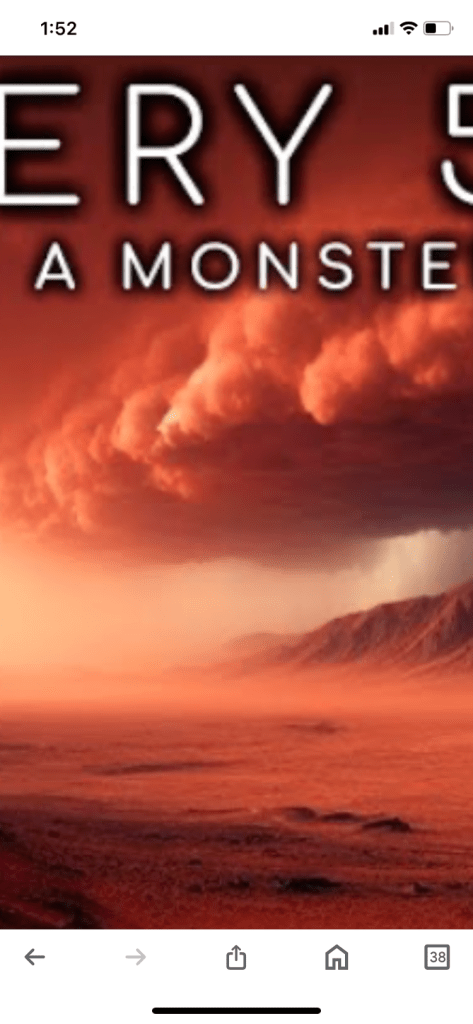
Mars experiences a 5-year storm cycle that disrupts NASA’s Mars rovers
NASA’s Curiosity Mars rover has also detected a monster dust storm.
Mars also experiences marsquakes. NASA’s InSight Mars lander recorded a magnitude 5 quake on May 4, 2022. This was the largest quake ever observed on another planet.
Mars experiences a 5.5 Earth year cycle of dust storms. These storms can grow from small to global, with speeds of up to 60 miles per hour. They usually occur during the warmer part of the Martian year, which is spring and summer in the southern hemisphere.
Dust storms can disrupt NASA’s Mars rovers:
- 2018 global dust storm: Ended NASA’s Opportunity rover
- 2022 dust storm: Reduced sunlight and forced NASA’s Insight lander to stop science work
NASA has sent six robotically operated rovers to Mars:
- Sojourner: Landed in 1997
- Spirit: Landed in 2004 and operated until 2010
- Opportunity: Landed in 2004 and operated until 2018
- Curiosity: Landed in 2012 and is still operating
- Perseverance: Landed in 2021 and is still operating
Mars has other storm systems, including:
- Clouds Mars has clouds made of water ice and CO2 ice particles. These clouds form near volcanoes when winds rise and ice particles condense.
- High- and low-pressure weather systems These systems are similar in size to Earth’s cyclones and anticyclones. They occur away from the equator, especially in the winter hemisphere.
Yes, Mars dust storms can produce lightning. The static electricity from dust storms can create lightning and release chlorine. However, the lightning on Mars is not as large as the lightning on Earth.
The low atmospheric pressure on Mars makes it unlikely that dust storms would produce lightning like thunderclouds or volcanoes on Earth. Instead, dust storms on Mars may produce tiny sparks that make the clouds glow purple.
Researchers at the University of Oregon have found that the friction of colliding dust particles on Mars is unlikely to produce large electrical storms
The sparks from dust storms on Mars can make clouds glow purple. This effect is called a “corona glow”. On Earth, a similar phenomenon is called “St. Elmo’s fire” and can occur on ships during thunderstorms
The 2018 global dust storm on Mars began shortly after the southern spring equinox. The first signature of the storm was detected by the Mars Climate Sounder on June 2, 2018.
Mars Global Dust Storms (GDS) are rare and unpredictable events. They are the largest dust storms on Mars and affect almost every aspect of the Martian atmosphere.
The 2018 dust storm had the following effects:
- UV radiation: The daily maximum of UV radiation decreased by 90% over 10 sols after the dust storm reached Gale.
- Hydrogen escape: The 2018 dust storm enhanced hydrogen escape.
Dust storms can:
- Reduce air quality and visibility
- Pose a respiratory risk to people
- Cause deadly pileups on interstates
- Make airports inoperable
In 2022, Mars experienced a continent-sized dust storm. The storm was first observed on September 21, 2022 by NASA’s Mars Reconnaissance Orbiter (MRO). The storm was about 2,175 miles (3,500 kilometers) from InSight.
The storm threatened a NASA lander. However, it eventually faded away.
Dust storms on Mars can have the following effects:
- Brighten the ground
- Reflect more sunlight
- Don’t become as hot
- Don’t generate as much wind
Mars and Earth both experience dust storms of various sizes.
https://5c68bmmh3yut8tdb0ci9ucnaao.hop.clickbank.net Universe discoveries
Very interesting! I didn’t know all this.
LikeLike