
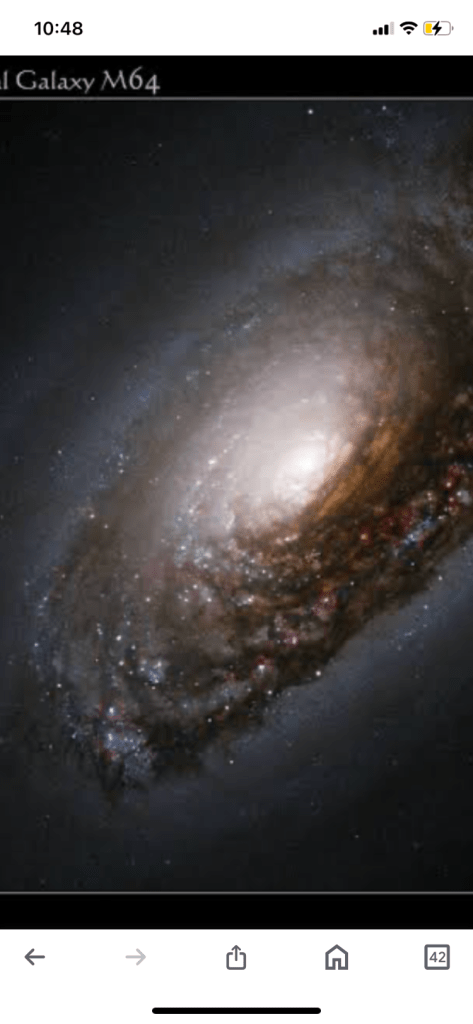
NASA shared an image of the “Evil Eye” galaxy on its Instagram page. The galaxy is located in the constellation Coma Berenices, which is 17 million light-years away from Earth. The galaxy is also known as the “Black Eye” galaxy.
The galaxy’s nicknames come from a dark band of dust that crosses one side of its bright nucleus. The galaxy’s unusual appearance and strange internal motions are likely the result of a merger between two galaxies that occurred a billion years ago.
The galaxy is best observed in May. It has an apparent magnitude of 9.8, so it can be seen with a moderately sized telescope. Astrophotographers can use Steallarium to track the galaxy in the night sky.
The space agency in a lengthy post shared that the “constellation Coma Berenices, known as the “Evil Eye, with sweeping bands of cosmic dust” is 17 million light-years away from Earth. The breathtaking image was captured by the NASA Hubble Space Telescope in 2008 and has left the internet awe-struck
The Black Eye Galaxy is dark because of a band of dust that blocks light from the stars behind it. The dust grains are rotating in the opposite direction from the stars and gas in the galaxy’s center
The galaxy’s spiral arms are so dark that they seem to cover the galaxy’s center. The dust in the spiral arms blocks light from the core.
The galaxy’s dark band of dust is believed to have been caused by a smaller galaxy colliding with the galaxy’s center. The collision would have caused the gas and dust in the two galaxies to collide and compress, leading to the formation of new stars
The Black Eye Galaxy was discovered by English astronomer Edward Pigott on March 23, 1779. German astronomer Johann Elert Bode independently discovered it 12 days later on April 4, 1779. French astronomer Charles Messier independently rediscovered it on March 1, 1780 and cataloged it as M64.
The Black Eye Galaxy has also been called the Evil Eye Galaxy, Sleeping Beauty Galaxy, and NGC 4826
Here are some more facts about the Black Eye Galaxy:
- Size: The Black Eye Galaxy is slightly smaller than the Milky Way, with a diameter of about 50,000 light-years.
- Rotation: The Black Eye Galaxy has two counter-rotating disks. The inner disk has a radius of 3,000 light-years and spins clockwise, while the outer disk has a radius of 40,000 light-years and spins in the opposite direction.
- Type: The Black Eye Galaxy is a type 2 Seyfert galaxy with an HII/LINER nucleus.
The Black Eye Galaxy has many types of planets, including:
- Class D: Planetoids or moons with little to no atmosphere
- Class H: Uninhabitable
- Class I: Ice planets
- Class K: Habitable, but only with pressure domes
- Class M: Earth-like, with oxygen and nucleogenic particles in the atmosphere
The most common types of planets in the Black Eye Galaxy are Class H and Class D. These planets are between 3.5 and 10 billion years old and can be found in many star systems.
The Black Eye Galaxy has 100 billion stars. It also has a mass of 0.4 billion solar masses.
The Black Eye Galaxy is about 17 million light-years away from Earth. However, some astronomers say it’s 12–44 million light-years away. One light-year is about 5.9 trillion miles.
The Black Eye Galaxy is too far away and too small to be seen with the naked eye. It has an apparent magnitude of +9.8, but most people can’t see objects with a magnitude greater than five.
The Black Eye Galaxy is a spiral galaxy that’s well known among amateur astronomers. It’s visible across inhabited latitudes and can be seen with small telescopes
The Black Eye Galaxy is a spiral galaxy. It’s also known as an S0a galaxy
The Black Eye Galaxy is classified as:
- SAab: Non-barred spiral with an outer ring-like structure, a transitional inner ring/spiral structure, and tightly wound spiral arms
- SABa: Weakly barred spiral with tightly wound arms
The Black Eye Galaxy’s morphological classification in the De Vaucouleurs system is SAab
The Black Eye Galaxy is cataloged as Messier 64 (M64). The Black Eye Galaxy is one of the most famous objects in the Messier Catalog. The Messier Catalog is one of the most influential catalogs of Deep Sky Objects
The Black Eye Galaxy is also cataloged as PKS 1254+21. It’s a known radio source
The Black Eye Galaxy contains:
- Two gas disks The galaxy has two counter-rotating gas disks that contain a few 108 solar masses each. The inner disk has a radius of 2,300 light-years and produces a high rate of star formation.
- Carbon particles The black band of dust is actually a complex cloud of carbon particles.
- Stellar nurseries The Hubble Space Telescope has photographed many stellar nurseries in the galaxy.
- Hot, blue stars The galaxy has many hot, young stars that shine bright blue. These stars live short lives, no more than a few tens of millions of years.
- Pink clouds The galaxy has pink clouds of glowing hydrogen gas that fluoresce when exposed to ultraviolet light from newly formed stars.
The Black Eye Galaxy also contains:
- About 100 billion stars
- No known Cepheid variables
- No evidence of supernovae
The Black Eye Galaxy has several other names, including:
- Evil Eye Galaxy
- Sleeping Beauty Galaxy
- NGC 4826
- PGC 44182
- UGC 8062
The Black Eye Galaxy is also known as:
- Messier 64
- M64
- (R)SA(rs)ab
The Black Eye Galaxy is located in the constellation Coma Berenices.(full article source google)
Best telescopes on discount on Amazon Universe discoveries