
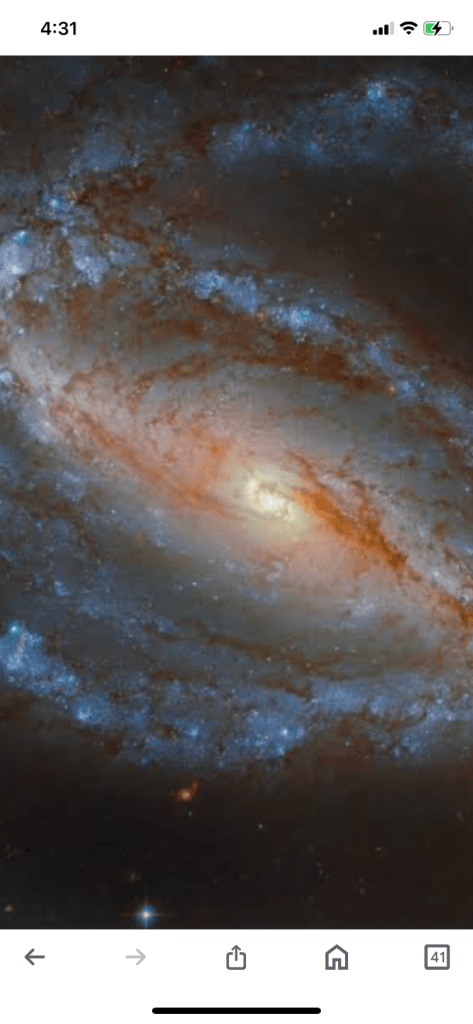
Astronomers previously believed that barred spiral galaxies could not exist until the universe was about half its current age. However, the discovery of a galaxy called CEERS-2112 challenges this idea. CEERS-2112 is a barred spiral galaxy that existed when the universe was only two billion years old. This is much earlier than previously thought possible.
CEERS-2112 is similar to the Milky Way, which also has a bar of stars and gas cutting across its center. The discovery of CEERS-2112 shows that bars can form in a fraction of the time previously thought. Bars can form in one billion years or less.
Barred spiral galaxies are different from normal spiral galaxies because the arms of the galaxy do not lead all the way into the center. Instead, the arms are connected to the two ends of a straight bar of stars. The bar contains the nucleus at its center.
About two-thirds of all spiral galaxies are thought to be barred spiral galaxies. Spiral galaxies are the most common type of galaxy in the universe, making up approximately 70% – 80% of all galaxies.
Spiral galaxies like the Milky Way are like cosmic snowflakes—no two are exactly alike. For many years, astronomers thought spirals couldn’t exist until the universe was about half its present age
Most spiral galaxies have a central bulge of older stars surrounded by a flat disk of younger stars, gas, and dust. The bulge is thought to contain a supermassive black hole
The bar in a barred spiral galaxy is thought to be the result of a density wave from the center of the galaxy. The bar can act like a funnel, pulling matter from the disk into the bulge.
Some examples of spiral galaxies with bars include: NGC 7496, NGC 1433, NGC 1073, NGC 1300.
M74 is an example of a spiral galaxy without a bar
The most widely accepted theory for the cause of spiral arms in galaxies is the spiral density wave model. This theory was first proposed by C.C. Lin and Frank Shu in 1964.
The spiral density wave model states that galaxies form with:
- Angular momentum: Galaxies form with significant angular momentum in a single direction.
- Mass: Galaxies start out with areas that have more mass than others.
- Compressional density waves: Spiral arms move through the gas and stars in the disk as compressional density waves.
- Star formation: Compressional density waves trigger star formation.
The spiral density wave model also states that the spiral structure is a wave pattern that remains quasi-stationary in the frame of reference rotating around the galaxy center.
Another leading hypothesis for the cause of spiral structure in galaxies is the stochastic self-propagating star formation model (SSPSF model). This model states that star formation is caused by shock waves in the interstellar medium.
Astronomers have observed more spiral galaxies than elliptical galaxies. This is because spiral galaxies are brighter and easier to spot. Elliptical galaxies are made up of older, dimmer stars.
Elliptical galaxies are thought to be more common because they are likely the result of many galactic collisions. When two spiral galaxies collide, gas and dust are flung off into space. Stars are knocked out of their orbits and randomly group together to create different orbits in the new galaxy.
Spiral galaxies are considered younger than elliptical galaxies because of their active star formation. Scientists believe that spiral galaxies make up nearly 60% of all galaxies in the universe.
Spiral galaxies are more likely to form stars because they contain more gas and dust. The gas and dust in spiral galaxies are pushed together by gravity, which causes them to collapse and form new stars. The spiral arms of spiral galaxies are especially dense, which means they have more mass and gravity. This makes the spiral arms the most likely place for star formation in a spiral galaxy.
Elliptical galaxies, on the other hand, have less gas and dust. This means they have less material for star formation. The stars that do exist in elliptical galaxies are usually older and give off more red light
CEERS-2112 is a barred spiral galaxy that was observed when the universe was 2.1 billion years old. It has a mass similar to the Milky Way.
CEERS-2112 was discovered by an international team using the James Webb Space Telescope. It formed soon after the Big Bang. The galaxy has a bar at its center, which is made of stars. Galactic bars are more common in spiral galaxies.
CEERS-2112 challenges previous conceptions about galaxy formation and structure in the early universe. It shows that galaxies in the early universe could be as ordered as the Milky Way.
https://8be65eis04u1g2gd9ji-nadbaa.hop.clickbank.net Universe discoveries
This is interesting. With just a telescope you can discover.
LikeLiked by 1 person
Yes
LikeLike