
The surface exploration of Saturn’s largest moon, Titan, just got one step closer to reality as NASA’s much-anticipated Dragonfly mission recently received approval from the powers that be to advance to Phase C, which is designated as Final Design and Fabrication, according to NASA’s Systems Engineering Handbook.
NASA’s Dragonfly mission to Saturn’s largest moon, Titan, has received approval to advance to Phase C. Phase C is the final design and fabrication phase
The Dragonfly mission involves:
- Building and realizing the spacecraft
- Studying prebiotic chemistry and extraterrestrial habitability
- Making the first powered and fully controlled atmospheric flight on any moon
The mission is expected to cover roughly 180 km over the course of the 2.7 Earth-year nominal mission. It will end up in 80 km diameter Selk Crater, north of the initial landing site.
The Dragonfly mission is projected to cost in the region of $1 billion in total. NASA is aiming to launch Dragonfly by 2028.
The Dragonfly mission is expected to last about three years. The spacecraft will spend about 3.3 years conducting science operations, and will explore 25–30 unique sites.
The Dragonfly spacecraft will be able to fly once per Titan day, which is about eight Earth days long. It will spend each Titan night charging its batteries.
The Dragonfly mission is scheduled to launch in 2027 and arrive at Titan in 2034.
The Dragonfly mission’s budget was cut in 2023. The mission’s projected cost is around $1 billion, which includes launch services. The budget excludes the cost of launch and operations.
The Dragonfly mission is part of NASA’s New Frontiers portfolio. The portfolio is a series of planetary science investigations led by principal investigators. The development cost cap for these investigations is around $850 million.
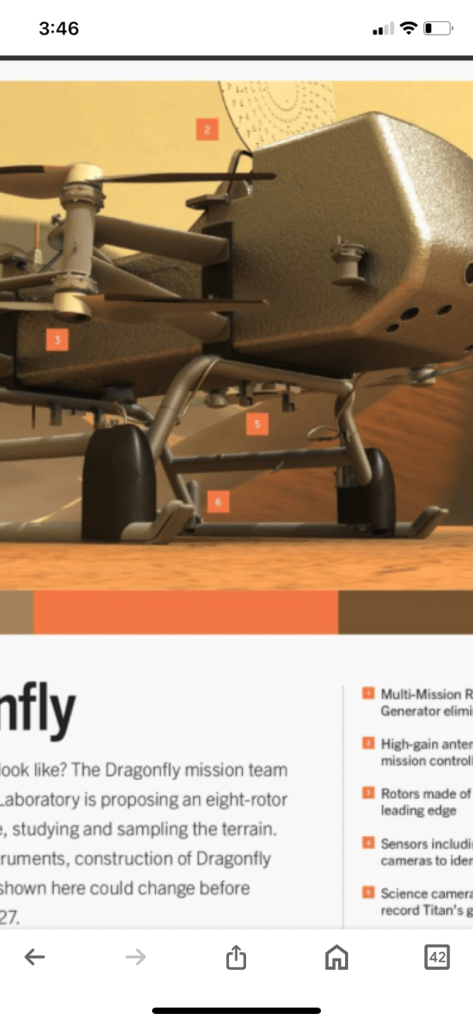
The Dragonfly spacecraft is a quadcopter drone with eight rotors. It weighs between 400 and 450 kg and is about the size of the largest Mars rovers. The craft can fly at speeds of up to 10 m/s and reach altitudes of 4,000 m.
Dragonfly will explore Titan’s environment to characterize its habitability. It will also investigate the progression of prebiotic chemistry and search for biosignatures of life. Dragonfly will sample and measure the composition of Titan’s organic surface materials. It will also analyze Titan’s atmosphere to see how it changes with the seasons.
Dragonfly will land in an equatorial, dry region of Titan. This region is more like a desert on Earth, with dunes, mountains, and an impact crater. It sometimes rains liquid methane.
Dragonfly will beam its data to Earth.
Dragonfly will land in the Shangri-La dune fields, which are located just south of Titan’s equator. The dunes are similar to those found in Namibia on Earth.
Dragonfly will also visit the Selk impact crater, which is 90 km in diameter. The impact may have created a temporary liquid-water lake
NASA is sending Dragonfly to Titan to study the moon’s habitability and search for signs of life. Titan’s environment is thought to be similar to Earth’s early stages, and may provide clues to how life formed on Earth.
Dragonfly will:
- Study prebiotic chemistry: The chemical processes that lead to the formation of life
- Analyze Titan’s atmosphere: To understand the possible starting ingredients for life on Earth
- Sample Titan’s surface: To study the chemical makeup of Titan’s liquid bodies
- Test Titan’s properties: Including its atmospheric composition
Dragonfly will also carry an instrument called the Dragonfly Mass Spectrometer
Yes, NASA’s Dragonfly mission will search for evidence of past or present life on Titan. The mission will also study prebiotic chemistry, which is the study of how organic compounds formed.
The Dragonfly mission will launch in June 2027 and arrive at Titan in the mid-2030s. The mission will last for nearly three years.
Yes, NASA’s Dragonfly mission could reveal the chemistry that led to life on Earth. The mission will study Titan’s prebiotic chemistry, which are the chemical processes that led to the formation of life.
Titan’s complex carbon-rich chemistry and past liquid water make it an ideal destination for studying prebiotic chemical processes. Titan’s subsurface water could harbor life as we know it, while its surface lakes and seas of liquid hydrocarbons could harbor life that uses different chemistry.
Dragonfly will carry the Dragonfly Mass Spectrometer (DraMS), which will help scientists determine the chemistry at work on Titan. The spacecraft will also test Titan’s properties, including its atmospheric composition and the chemical makeup of its differing liquid bodies.
Titan’s atmosphere is rich in organic compounds. These compounds include:
- Vinyl cyanide: A complex organic molecule that can form cell membrane-like spheres
- Hydrogen cyanide: A deadly organic compound formed by UV light
- Propene: The first chemical found on a moon or planet other than Earth
- Acrylonitrile: Also known as vinyl cyanide, this chemical is used to make plastics
Titan’s atmosphere is made up of: 94.2% nitrogen, 5.65% methane, 0.099% hydrogen.
Nitrogen and methane react in Titan’s atmosphere to produce organic molecules. Scientists believe that the heaviest of these molecules fall to the surface.
Titan’s atmosphere is a thousand times more poisonous than previously thought. However, Titan’s atmosphere lacks hydrogen, which is needed for life to form.
Dragonfly is a nuclear-powered drone that will use a Multi-Mission Radioisotope Thermoelectric Generator (MMRTG) to convert heat from the decay of a radioisotope into electricity. The generator uses plutonium-238 as a power source.
Dragonfly will operate on batteries during the day and recharge at night. It will have the ability to fly for approximately half an hour and cover distances up roughly 10 km on a single (8-day) battery charge
NASA’s Dragonfly is about the size of a small car or the largest Mars rovers. It has a mass of about 400–450 kg and weighs around 1,200 pounds.
Dragonfly is a quadcopter drone with eight rotors. It can fly at about 10 m/s and reach altitudes of 4,000 m. It will land on skids like a helicopter
NASA is planning to launch Dragonfly in June 2027. The spacecraft is scheduled to land on Titan in 2034.
NASA originally planned to launch Dragonfly in 2026, but postponed it due to budget uncertainty. The budget proposal for the mission reflects an 18.1% reduction from the $400.1 million Dragonfly received in fiscal year 2023.
Dragonfly will be the first aircraft on Titan. It will make the first powered and fully controlled atmospheric flight on any moon
Dragonfly’s science instruments include:
- Dragonfly Mass Spectrometer (DraMS): Analyzes the chemical composition of surface samples and noble gases in the atmosphere
- Dragonfly Gamma-Ray and Neutron Spectrometer (DraGNS): Identifies the surface composition under the lander
- DraGMet: A geophysical and meteorology package
- DragonCam: A suite of cameras
- DrACO: Drills into Titan’s surface and vacuums up samples of surface materials
- Seismometer: Measures Titan’s quake activity and subsurface structures
Dragonfly will also use LED arrays to provide nighttime imaging of Titan materials, and ultraviolet illumination to characterize Titan’s organic sediments.
(Full article source google)
Best science fiction books on discount on Amazon Universe discoveries