
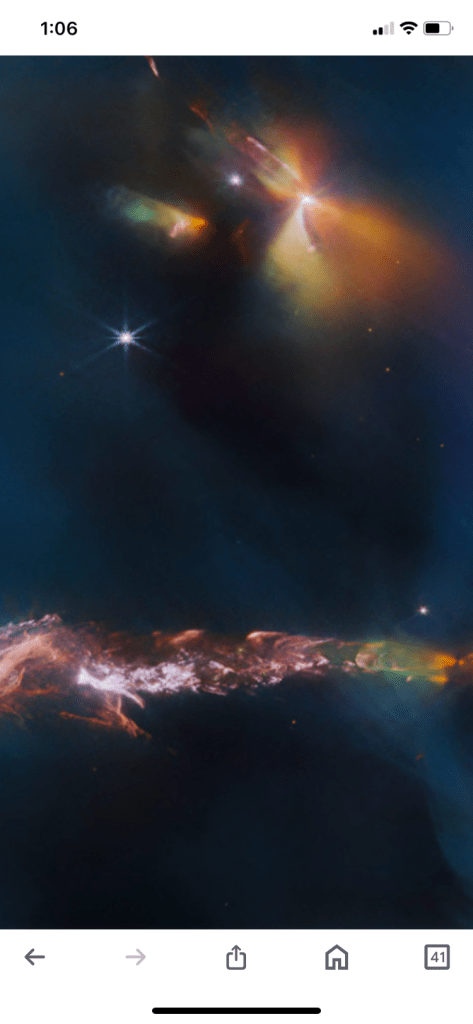
The James Webb Space Telescope (JWST) has revealed a double protostar. The JWST’s infrared imaging capabilities allow it to see through gas and dust that would otherwise block visible light. This allows the JWST to see objects in unprecedented detail.
The JWST has revealed:
- A double protostar The JWST’s infrared acuity revealed a second protostar hidden in gas and dust. What astronomers thought was a single outflow is actually two parallel outflows from two separate stars.
- A giant protostar The JWST revealed a protostar 30 times the mass of our sun. This protostar will eventually form into a massive star.
- A question mark-shaped structure Scientists say this structure is likely the merger of two or more galaxies.
The JWST’s science goals include expanding our understanding of how stars form.
The JWST has the power to see into the cocoons of gas and dust that hide young protostars. It peered inside one of these cocoons and showed us that what we thought was a single star is actually a binary star. The JWST’s image of the Herbig Haro object 797 (HH 797) is the telescope’s Picture of the Month
The JWST is able to see distant galaxies because of its infrared capabilities:
- Infrared light The JWST can see infrared light, which is stretched from the ultraviolet and visible light emitted by galaxies. This is because the expansion of the universe causes light to stretch to longer wavelengths.
- Larger mirror The JWST’s larger mirror allows it to collect more light and see fainter objects.
- Space location The JWST’s location in space, away from Earth’s atmosphere, provides clearer observations.
The JWST is the largest and most technically advanced telescope ever built. It can see galaxies that formed shortly after the Big Bang, 13.8 billion years ago.
A protostar becomes a star when its core temperature reaches 10 million K. This temperature is required for hydrogen fusion to occur efficiently.
A protostar’s life cycle begins when a portion of a molecular cloud collapses. The cloud’s gravitational forces pull it inward, and the material at the center heats up. The protostar continues to grow by absorbing gas and dust from the cloud.
The protostar’s stage ends when it stops gaining material and begins to push it away. The protostar develops a strong wind that blows away the gas and dust. The remaining star and its surrounding disk may clump together to form planets.
The protostar becomes a T-Tauri star for about 100 million years. These stars are hot, but they haven’t started nuclear fusion yet. Eventually, the protostar becomes a main sequence star when its core temperature exceeds 10 million K.
A protostar is a young star that is still gathering mass from its parent molecular cloud. It is the earliest phase in the process of stellar evolution. The stage of stellar evolution may last for between 100,000 and 10 million years depending on the size of the star being formed.
There are two types of protostars:
- T Tauri Star: A protostar with a mass of less than 2 solar masses
- Herbig Ae/Be Star: A protostar with a mass between 2 to 8 solar masses
Here are some examples of double protostars:
- Herbig-Haro 797: This object is powered by two protostars
- UYSO 1: This location has a double intermediate-mass protostar
- Perseus: This image has bright infrared objects that are thought to host two further protostars
A Herbig-Haro (HH) object is a small, bright nebula that forms in a star-forming region. HH objects are created when jets of material from a young star collide with the surrounding gas and dust. The jets travel at speeds of hundreds of kilometers per second.
The collision creates shock waves that heat and ionize the gas. The shock fronts form knotted clumps of nebulosity, which are known as HH objects.
HH objects are associated with newborn stars. They can provide the only visible clues to the physical processes occurring in a young star.
Some examples of HH objects include:
- HH 24: A prominent HH object
- HH-2: A cloud heated by shock waves from jets of high-speed gas
- HH 797: A prominent protostar in Perseus
Herbig-Haro object 797 (HH 797) is a luminous region that surrounds a newborn star in the constellation Perseus. Herbig-Haro objects are formed when stellar winds or gas jets from newborn stars collide with nearby gas and dust at high speeds
The James Webb Space Telescope (JWST) captured a detailed image of HH 797. The image shows a string of two baby stars spewing out almost parallel jets of gas. Astronomers previously thought there was only one star.
The bright infrared objects in the upper portion of the image are thought to host two further protostars. Infrared instruments like NIRCam are ideal for studying young stars and Herbig-Haro objects. (Full article source google)
Best science fiction books on discount on Amazon Universe discoveries
g;lorious
LikeLiked by 1 person
Thanks 🙏 freinds
LikeLike