
Jupiter’s magnetic field could be a reason for life on its moons. Jupiter’s magnetic field is the largest of any planet, and it extends out almost 5 million kilometers. Jupiter’s moons are enveloped by this magnetic field.
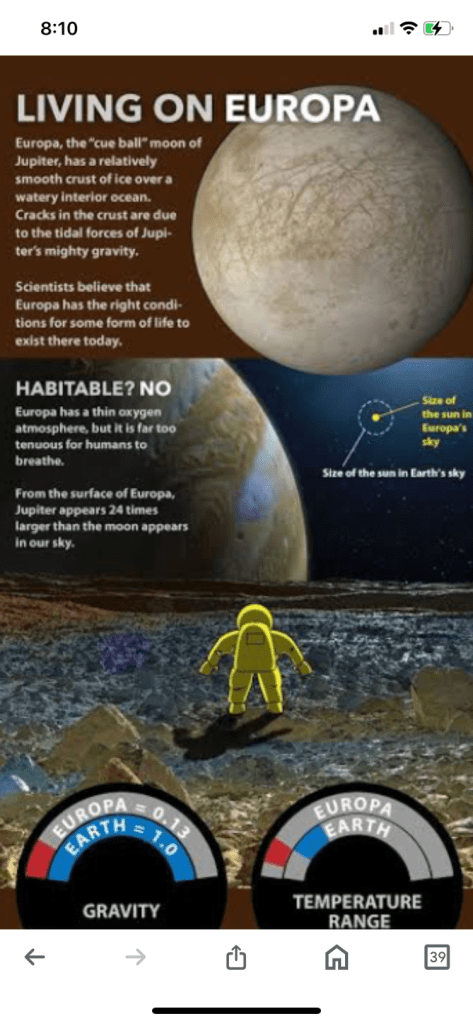
Jupiter’s moons are thought to have subsurface oceans of salty water. These oceans could potentially harbor life. For example, Europa’s subsurface ocean may contain hydrothermal vents, which are considered to be a fertile environment for life.
Jupiter’s magnetic field could also be moving Europa’s ocean. A jet stream around Europa’s equator could be stirring up compounds that are important for life.
One way to study life on Jupiter’s moons is to observe aurorae. Aurorae are produced when charged particles from Jupiter hit the moons’ magnetic fields. Europa has a constant aurora that can be seen in ultraviolet images from Hubble.
Jupiter’s moons have some of the highest potential to support life. Some of Jupiter’s moons have liquid oceans of water beneath their icy surface. These moons include:
- Europa This moon has temperatures that support liquid water and chemical compounds that could support extraterrestrial life. NASA’s James Webb Space Telescope has captured images of Europa’s frigid surface, which show an abundance of carbon dioxide.
- Ganymede This moon is the largest in the solar system, and it likely has a salty ocean underneath its icy surface.
The European Space Agency (ESA) has a $1.6 billion mission called the Jupiter Icy Moons Explorer (Juice). This mission will explore the habitability of three of Jupiter’s moons that may hold hidden oceans.
Jupiter’s magnetic field is caused by a number of factors:
- Rotation: Jupiter’s fast rotation
- Convection: Convection in the planet’s metallic core
- Metallic hydrogen: The planet’s metallic hydrogen core
- Electrically conductive liquid: Hydrogen molecules that are so tightly packed that they break up and become electrically conductive
- Swirling mass: A swirling mass of hydrogen deep within the planet
- Electrical currents: Electrical currents in the planet’s outer core
Jupiter’s magnetic field is 10 times stronger than Earth’s magnetic field.
To have a strong magnetic field, a planet needs to meet three requirements:
- Molten, electrically conducting interior
- Convection in the interior
- Moderately rapid rotation
The amount of electrically conducting fluid in a planet determines the strength of its magnetic field. More fluid means a stronger magnetic field.
The interaction between the planet’s rotation and the convection of its interior conducting material (molten rock and metal) creates planetary magnetic fields. For example, Earth’s rotation creates a dynamo effect, which generates electric currents and produces a magnetic field.
Not all planets have magnetic fields. The four gas giants have extremely strong magnetic fields. Earth has a moderately strong magnetic field. Mercury has an extremely weak field, and Venus and Mars have almost no measurable fields.
Ganymede is the only moon of Jupiter known to have its own magnetic field. This magnetic field shields some of Jupiter’s radiation.
Jupiter’s moons, Europa, Ganymede, and Callisto, all create dipole magnetic fields in response to Jupiter’s magnetic field. These magnetic fields compensate for changes in Jupiter’s magnetic field.
Jupiter’s magnetic field accelerates charged particles in space to high energies. These particles form Jupiter’s radiation belts. Jupiter’s magnetosphere blocks many of the galactic cosmic rays from Europa. However, Jupiter’s surface bombards Europa with lower-energy particles.
Europa, Ganymede, and Callisto are three of Jupiter’s moons that could support life.
Europa This icy moon is one of the most promising places in the solar system for extraterrestrial life. It has a subsurface ocean that may contain twice as much water as Earth’s oceans. Europa’s surface is bombarded by radiation from Jupiter, but this radiation may create fuel for life in the ocean.
- Ganymede This moon has a thin oxygen atmosphere, but researchers think it’s too thin to support life.
Callisto This moon has a very thin atmosphere and may contain an ocean. However, it’s not as geologically active as other moons because it’s not as close to Jupiter.
Europa is considered one of the best places to find life in our solar system. It’s the smallest of Jupiter’s four moons. Europa’s icy surface covers a vast ocean that may contain twice as much water as Earth’s oceans. The ocean’s liquid water is in direct contact with the silicate mantle, which makes Europa a good candidate for habitability.
Ganymede is another moon that might be good for life. It’s the largest moon in the solar system, and it’s likely to have a salty ocean under its icy surface. Ganymede also has a magnetosphere, which could be useful
Europa has some similarities to Earth: Iron core, Rocky mantle, Salty ocean.
Europa’s ocean is thought to be similar to Earth’s deep-ocean hydrothermal vents. Europa has an estimated depth of 40 to 100 miles (60 to 150 kilometers).
Europa is one of Jupiter’s four Galilean moons.
Callisto and Ganymede could support a human colony. Callisto orbits outside Jupiter’s radiation belt. Ganymede is the largest moon in the solar system. However, some scientists think that Ganymede’s ocean pressure is so high that any water would turn to ice.
NASA’s Europa Clipper spacecraft is scheduled to launch in October 2024 to explore the habitability of Jupiter’s ocean moons.
Humans could not live on Ganymede in the same way they do on Earth. However, Ganymede is one of only two Jovian moons where surface settlements could be feasible.
Here are some reasons why humans could live on Ganymede:
- Magnetic field Ganymede has a magnetosphere that shields it from some of Jupiter’s radiation.
- Temperature Ganymede’s surface temperature ranges from -300°F to -180°F, which is colder than the coldest places on Earth. However, humans would need heaters in their habitats.
- Radiation Ganymede receives about 0.08 Sv of radiation per day, which is much lower than Europa.
Here are some reasons why humans could not live on Ganymede:
- Atmosphere Ganymede has a thin atmosphere, so it has radiation from space, the sun, and Jupiter.
- Pressure Some scientists think that the pressure at the base of Ganymede’s ocean is so high that any water would turn to ice.
- Temperature Ganymede’s surface is very cold.
- Crust Ganymede’s silicate crust is fragile and mobile, and cannot support much weight.
Yes, some of Jupiter’s moons have oxygen:
- Europa: Has a thin atmosphere of molecular oxygen. The oxygen in Europa’s atmosphere is likely not produced biologically. Europa’s subsurface ocean may have enough oxygen to support millions of tons of fish.
- Callisto: Has a thick atmosphere with a surprising amount of oxygen.
- Ganymede: Has a thin oxygen atmosphere.
Other moons in our solar system with atmospheres include:
- Saturn’s moon Titan
- Neptune’s moon Triton
- Jupiter’s moon Io
- Saturn’s moon Rhea(full article source google)
Best desktops on heavy discount on Amazon
https://19b9dnhp62u-irkj5jcy-8dhft.hop.clickbank.net Universe discoveries